



 Chat with AI
Exam 12: Perfect Competition

Exam 1: What Is Economics483 Questions
Exam 2: The Economic Problem440 Questions
Exam 3: Demand and Supply515 Questions
Exam 4: Elasticity530 Questions
Exam 5: Efficiency and Equity450 Questions
Exam 6: Government Actions in Markets412 Questions
Exam 7: Global Markets in Action205 Questions
Exam 8: Utility and Demand366 Questions
Exam 10: Organizing Production385 Questions
Exam 11: Output and Costs493 Questions
Exam 12: Perfect Competition487 Questions
Exam 13: Monopoly599 Questions
Exam 14: Monopolistic Competition318 Questions
Exam 15: Oligopoly276 Questions
Exam 16: Public Choices, Public Goods, and Healthcare205 Questions
Exam 17: Externalities437 Questions
Exam 18: Markets for Factors of Production382 Questions
Exam 19: Economic Inequality351 Questions
Exam 20: Uncertainty and Information233 Questions
Select questions type


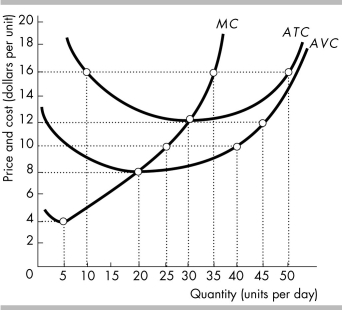 -In the above figure, if the price is $12, a profit-maximizing perfectly competitive firm will have an economic profit
 (Multiple Choice)
4.7/5  (89)
(89) 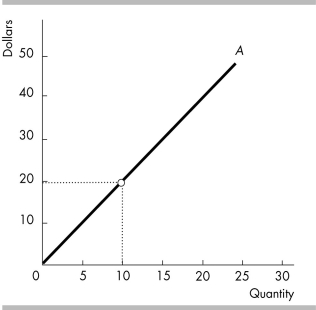 -The above figure shows a firm's total revenue line. The firm must be in a market with
 (Multiple Choice)
4.8/5 (85)
(85) A perfectly competitive firm will have an economic profit of zero if, at its profit-maximizing output, its marginal revenue equals its
(Multiple Choice)
4.8/5 (80)
(80) 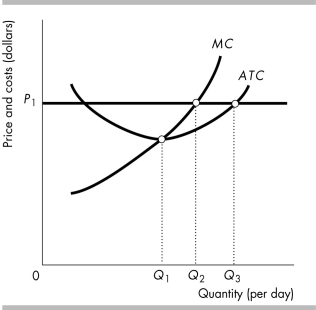 -In the above figure, if the firm increases its output from Q2 to Q3, it will
 (Multiple Choice)
4.9/5 (81)
(81) 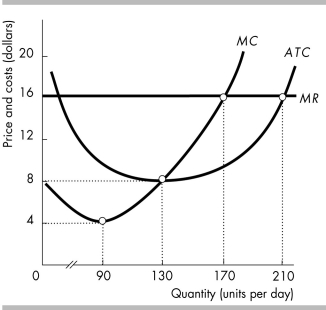 -The figure above shows depicts the marginal revenue and costs of a perfectly competitive firm. When 170 units are produced, the firm
 (Multiple Choice)
5.0/5 (81)
(81) If the donut industry is perfectly competitive and is in long-run equilibrium, then the price of a donut
(Multiple Choice)
4.7/5 (79)
(79) A perfectly competitive firm maximizes its profit by producing the output at which its marginal cost equals its
(Multiple Choice)
4.9/5 (80)
(80) In the short run, a perfectly competitive firm will make an economic profit as long as
(Multiple Choice)
4.9/5 (78)
(78) A perfectly competitive firm is making an economic profit when
(Multiple Choice)
4.9/5 (77)
(77) "Perfectly competitive firms have total control over the price they set for their product." Explain why the previous statement is correct or incorrect.
(Essay)
4.8/5 (80)
(80) All along the beach in San Diego, California are shops which rent boogie boards by the hour. Tourists perceive that all rental boogie boards are identical, all prices are clearly listed on signs in front of the shops, and there are no restrictions on entry and exit in the boogie board market. What type of market is the boogie board market?
(Multiple Choice)
4.8/5 (66)
(66) In a perfectly competitive market in the short run, as the market demand increases, the firms ________ their output and their economic profit ________.
(Multiple Choice)
4.8/5 (69)
(69) 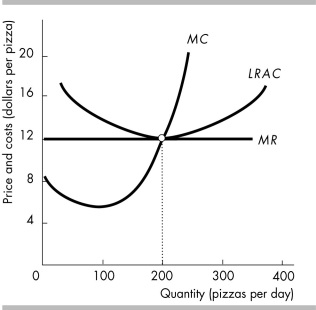 -The figure above shows the marginal revenue and long-run cost curves for a perfectly competitive firm. Which of the following statements is TRUE?
 (Multiple Choice)
5.0/5 (75)
(75) In perfect competition, each individual firm faces ________ demand curve.
(Multiple Choice)
4.9/5 (82)
(82) In the long run, if firms in a perfectly competitive market are incurring economic losses, then
(Multiple Choice)
4.9/5 (68)
(68) In the long-run equilibrium in a perfectly competitive market, the firms produce at the ________ possible average total cost and the price equals the ________ possible average total cost.
(Multiple Choice)
4.7/5 (86)
(86) A perfectly competitive firm's marginal revenue exceeds its marginal cost at its current output. To increase its profit, the firm will
(Multiple Choice)
4.8/5 (71)
(71) New reports indicate that eating turnips helps people remain healthy. The news shifts the demand curve for turnips rightward. In response, new farms enter the turnip industry. During the period in which the new farms are entering, the price of a turnip ________ and the economic profit of each existing firm ________.
(Multiple Choice)
4.9/5 (77)
(77) "A perfectly competitive firm will shut down if the price falls below its average total cost." Do you agree? Explain.
(Essay)
4.8/5 (78)
(78) 
Filters
- Essay(0)
- Multiple Choice(0)
- Short Answer(0)
- True False(0)
- Matching(0)