



 Chat with AI
Exam 14: Oligopoly

Exam 1: First Principles233 Questions
Exam 2: Economic Models: Trade-Offs and Trade 25382 Questions
Exam 3: Supply and Demand290 Questions
Exam 4: Consumer and Producer Surplus224 Questions
Exam 5: Price Controls and Quotas: Meddling With Markets227 Questions
Exam 6: Elasticity300 Questions
Exam 7: Taxes298 Questions
Exam 8: International Trade272 Questions
Exam 9: Decision Making by Individuals Firms201 Questions
Exam 10: The Rational Consumer372 Questions
Exam 11: Behind the Supply Curve: Inputs and Costs362 Questions
Exam 12: Perfect Competition and the Supply Curve355 Questions
Exam 13: Monopoly350 Questions
Exam 14: Oligopoly294 Questions
Exam 15: Monopolistic Competition and Product Differentiation262 Questions
Exam 16: Externalities199 Questions
Exam 17: Public Goods Common Resources224 Questions
Exam 18: The Economics of the Welfare140 Questions
Exam 19: Factor Markets and the Distribution of Income369 Questions
Exam 20: Uncertainty, Risk, and Private Information202 Questions
Select questions type


Use the following to answer questions:
Figure: Pricing Strategy in Cable TV Market II 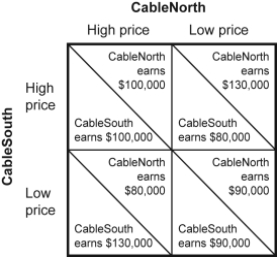 -(Figure: Pricing Strategy in Cable TV Market II) Look at the figure Pricing Strategy in Cable TV Market II. The Nash equilibrium in the cable TV market occurs when:
 (Multiple Choice)
4.9/5  (81)
(81) If Delta offers free drinks and snacks on its flights, and Southwest follows, they are engaging in nonprice competition.
(True/False)
4.7/5 (90)
(90) In the classic prisoners' dilemma with two accomplices in crime, the dominant strategy for each individual is to:
(Multiple Choice)
4.9/5 (84)
(84) _____ occurs when the only two firms in an industry agree to fix the price at a given level.
(Multiple Choice)
4.8/5 (89)
(89) A player's best action regardless of the action taken by the other player in a game is called a _____ strategy.
(Multiple Choice)
4.8/5 (72)
(72) Use the following to answer questions:
Figure: Monopoly Profits in Duopoly  -(Figure: Monopoly Profits in Duopoly) Look at the figure Monopoly Profits in Duopoly. Two firms could engage in _____ and reap monopoly profits.
 (Multiple Choice)
4.9/5 (84)
(84) The pattern of behavior in which one company tacitly sets prices for the industry as a whole is known as product differentiation.
(True/False)
4.9/5 (86)
(86) Use the following to answer questions: 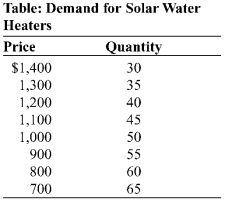 -(Table: Demand for Solar Water Heaters) Look at the table Demand for Solar Water Heaters. The marginal cost of producing solar water heaters is zero, and only two firms, Rheem and Calefi, produce them. Suppose they agree to produce only 25 water heaters each. If Rheem cheats on the agreement and produces 30 water heaters, what is the quantity effect for Rheem?
 (Multiple Choice)
4.7/5 (64)
(64) Use the following to answer questions:  -(Table: Demand for Crude Oil) Look at the table Demand for Crude Oil. Assume that the crude oil industry is a duopoly and the marginal cost of producing crude oil is zero. Suppose that the two firms are maximizing industry profit and splitting the profit evenly. If firm 1 decides to cheat and increase production by 10 more barrels, the price of crude oil will be:
 (Multiple Choice)
4.9/5 (82)
(82) The purpose of antitrust policy is to prevent the exercise of monopoly power.
(True/False)
4.9/5 (81)
(81) The purpose of the Sherman Antitrust Act was to encourage the establishment of monopolies to replace trusts.
(True/False)
4.7/5 (80)
(80) Use the following to answer questions:
-(Table: Demand for Crude Oil) Look at the table Demand for Crude Oil. Assume that the crude oil industry is a duopoly and the marginal cost and fixed cost of producing crude oil equal zero. Suppose that the two firms are maximizing industry profit and splitting the profit evenly. If both firms decide to cheat and produce 10 more barrels each, the price of crude oil will be:
-(Table: Demand for Crude Oil) Look at the table Demand for Crude Oil. Assume that the crude oil industry is a duopoly and the marginal cost and fixed cost of producing crude oil equal zero. Suppose that the two firms are maximizing industry profit and splitting the profit evenly. If both firms decide to cheat and produce 10 more barrels each, the price of crude oil will be: (Multiple Choice)
4.9/5 (75)
(75) Use the following to answer questions: 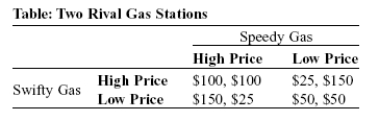 -(Table: Two Rival Gas Stations) Look at the table Two Rival Gas Stations, which shows a payoff matrix for two gas stations in a small town. Each firm can set either a high price or a low price, and customers view these two firms as nearly perfect substitutes. Profits in each cell of the payoff matrix are given as (Swifty, Speedy). Which of the following choices describes a dominant strategy?
 (Multiple Choice)
4.7/5 (68)
(68) In an oligopoly market, collusion between firms usually leads to higher profits than noncooperative behavior. However, formal, overt collusion doesn't usually occur in the United States because: I. it is illegal.
II) there is an incentive for each firm to cheat on a collusive agreement.
III) an oligopolistic firm will typically prefer lower profits if the only way to make higher profits is to improve the profit position of its rivals.
(Multiple Choice)
5.0/5 (83)
(83) Use the following to answer questions:
Figure: Monopoly Profits in Duopoly
-(Figure: Monopoly Profits in Oligopoly) Firms in the duopoly industry illustrated in the figure Monopoly Profits in Duopoly have zero fixed costs. The market demand curve is D2. If the two firms colluded to maximize their combined economic profits, they would set the market price at _____, and combined economic profits of the firms would be _____.
-(Figure: Monopoly Profits in Oligopoly) Firms in the duopoly industry illustrated in the figure Monopoly Profits in Duopoly have zero fixed costs. The market demand curve is D2. If the two firms colluded to maximize their combined economic profits, they would set the market price at _____, and combined economic profits of the firms would be _____. (Multiple Choice)
4.8/5 (84)
(84) The purpose of the nineteenth-century cartels was to increase production and encourage price competition.
(True/False)
4.8/5 (66)
(66) Use the following to answer questions:  -(Table: Demand Schedule for Gadgets) Look at the table Demand Schedule for Gadgets. The market for gadgets consists of two producers, Margaret and Ray. Each firm can produce gadgets with no marginal cost or fixed cost. If these two producers formed a cartel and acted to maximize total industry profits, total industry output would be _____ and the price would be _____.
 (Multiple Choice)
4.9/5 (76)
(76) 
Filters
- Essay(0)
- Multiple Choice(0)
- Short Answer(0)
- True False(0)
- Matching(0)