



 Chat with AI
Exam 14: Oligopoly

Exam 1: First Principles233 Questions
Exam 2: Economic Models: Trade-Offs and Trade 25382 Questions
Exam 3: Supply and Demand290 Questions
Exam 4: Consumer and Producer Surplus224 Questions
Exam 5: Price Controls and Quotas: Meddling With Markets227 Questions
Exam 6: Elasticity300 Questions
Exam 7: Taxes298 Questions
Exam 8: International Trade272 Questions
Exam 9: Decision Making by Individuals Firms201 Questions
Exam 10: The Rational Consumer372 Questions
Exam 11: Behind the Supply Curve: Inputs and Costs362 Questions
Exam 12: Perfect Competition and the Supply Curve355 Questions
Exam 13: Monopoly350 Questions
Exam 14: Oligopoly294 Questions
Exam 15: Monopolistic Competition and Product Differentiation262 Questions
Exam 16: Externalities199 Questions
Exam 17: Public Goods Common Resources224 Questions
Exam 18: The Economics of the Welfare140 Questions
Exam 19: Factor Markets and the Distribution of Income369 Questions
Exam 20: Uncertainty, Risk, and Private Information202 Questions
Select questions type


Why do the United States and many other countries have antitrust laws? What's so harmful about oligopoly that it warrants an entire body of law?
(Essay)
4.9/5  (86)
(86) The noncooperative equilibrium of a prisoners' dilemma game can be avoided if the game is played repeatedly and firms engage in strategic behavior.
(True/False)
4.9/5 (81)
(81) Use the following to answer questions:  -(Table: Demand Schedule for Gadgets) Look at the table Demand Schedule for Gadgets. The market for gadgets consists of two producers, Margaret and Ray. Each firm can produce gadgets with no marginal cost or fixed cost. If these two producers formed a cartel and acted to maximize total industry profits, total industry profit would be:
 (Multiple Choice)
4.8/5 (63)
(63) Use the following to answer question: 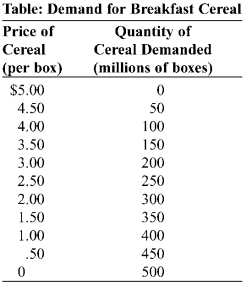 -(Table: Demand for Breakfast Cereal) Look at the table Demand for Breakfast Cereal. Suppose that the marginal cost of producing cereal is zero.
A) If General Mills is the sole producer of breakfast cereal, how many boxes will the firm produce, what price will be charged, and how much revenue will be earned?
B) Now assume that Kellogg enters the market, and the industry is now a duopoly with two equal-sized firms. If these firms agree to split the monopoly output equally, how much revenue will each firm earn under the agreement?
C) If General Mills can cheat on this agreement by producing 50 million more boxes of cereal without punishment, will it? Analyze the price effect and quantity effect for General Mills of producing 1 million more boxes.
-(Table: Demand for Breakfast Cereal) Look at the table Demand for Breakfast Cereal. Suppose that the marginal cost of producing cereal is zero.
A) If General Mills is the sole producer of breakfast cereal, how many boxes will the firm produce, what price will be charged, and how much revenue will be earned?
B) Now assume that Kellogg enters the market, and the industry is now a duopoly with two equal-sized firms. If these firms agree to split the monopoly output equally, how much revenue will each firm earn under the agreement?
C) If General Mills can cheat on this agreement by producing 50 million more boxes of cereal without punishment, will it? Analyze the price effect and quantity effect for General Mills of producing 1 million more boxes. (Essay)
4.9/5 (84)
(84) A Nash equilibrium results when each player chooses the action that maximizes his or her payoff given the actions of other players.
(True/False)
4.9/5 (81)
(81) Which of the following would make it difficult for oligopolists to collude?
(Multiple Choice)
4.9/5 (90)
(90) Attempts by the federal government to prevent the exercise of monopoly power in the United States are known as _____ policy.
(Multiple Choice)
5.0/5 (70)
(70) Use the following to answer questions:
Figure: Payoff Matrix for the United States and the European Union 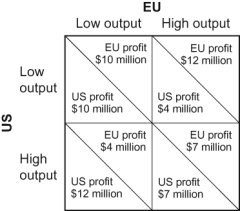 -(Figure: Payoff Matrix for the United States and the European Union) Look at the figure Payoff Matrix for the United States and the European Union. Suppose that the United States and the European Union both produce corn, and each region can make more profit if output is limited and the price of corn is high. The Nash equilibrium combination is for the United States to produce a _____ output and the European Union to produce a _____ output.
 (Multiple Choice)
4.9/5 (88)
(88) Use the following to answer questions:
Figure: Pricing Strategy in Cable TV Market I 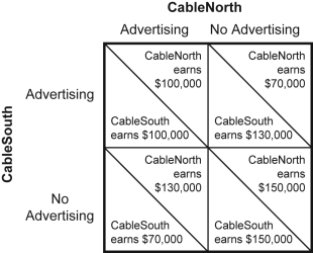 -(Figure: Pricing Strategy in Cable TV Market I) In the figure Pricing Strategy in Cable TV Market I, the dominant strategy for CableNorth:
 (Multiple Choice)
4.7/5 (80)
(80) The first trust in the United States was established in 1881 by lawyers at John D. Rockefeller's Standard Oil Company.
(True/False)
4.9/5 (79)
(79) The purpose of the trusts established in the United States in the late 1800s was to:
(Multiple Choice)
4.8/5 (90)
(90) Oligopoly is a market structure that is characterized by a _____ number of _____ firms that produce _____ products.
(Multiple Choice)
4.7/5 (69)
(69) Use the following to answer questions:
Figure: Monopoly Profits in Duopoly  -(Figure: Monopoly Profits in Duopoly) The figure Monopoly Profits in Duopoly shows how an industry consisting of two firms that face identical demand curves (D1) can collude to increase profits. If the firms collude to share the market demand equally, then each firm will act as if its marginal revenue curve is given by:
 (Multiple Choice)
4.7/5 (78)
(78) A situation in which one firm sets the price and other firms in the industry match it is known as:
(Multiple Choice)
4.8/5 (94)
(94) Use the following to answer questions:  -(Table: Demand for Crude Oil) Look at the table Demand for Crude Oil. The marginal cost of producing crude oil is zero. If the crude oil industry is a monopoly, the price of crude oil will be _____, the total quantity of crude oil produced by the monopoly will be _____ barrels, and the monopoly will earn revenue equal to _____.
 (Multiple Choice)
5.0/5 (89)
(89) Microsoft sets prices for its new line of computers, and Dell and HP follow. This practice is known as:
(Multiple Choice)
4.8/5 (78)
(78) Use the following to answer questions:
Figure: Pricing Strategy in Cable TV Market II 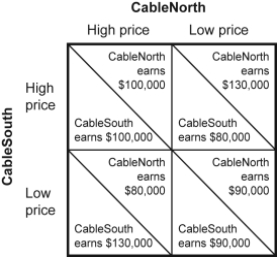 -(Figure: Pricing Strategy in Cable TV Market II) Look at the figure Pricing Strategy in Cable TV Market II. The dominant strategy for CableNorth:
 (Multiple Choice)
4.9/5 (79)
(79) If an industry initially has an HHI of 1,250, a merger between two of the largest (in terms of market share) firms in the industry:
(Multiple Choice)
4.9/5 (80)
(80) An unwritten, unspoken agreement through which firms limit competition among themselves is called:
(Multiple Choice)
4.9/5 (73)
(73) 
Filters
- Essay(0)
- Multiple Choice(0)
- Short Answer(0)
- True False(0)
- Matching(0)