



 Chat with AI
Exam 14: Oligopoly

Exam 1: First Principles233 Questions
Exam 2: Economic Models: Trade-Offs and Trade 25382 Questions
Exam 3: Supply and Demand290 Questions
Exam 4: Consumer and Producer Surplus224 Questions
Exam 5: Price Controls and Quotas: Meddling With Markets227 Questions
Exam 6: Elasticity300 Questions
Exam 7: Taxes298 Questions
Exam 8: International Trade272 Questions
Exam 9: Decision Making by Individuals Firms201 Questions
Exam 10: The Rational Consumer372 Questions
Exam 11: Behind the Supply Curve: Inputs and Costs362 Questions
Exam 12: Perfect Competition and the Supply Curve355 Questions
Exam 13: Monopoly350 Questions
Exam 14: Oligopoly294 Questions
Exam 15: Monopolistic Competition and Product Differentiation262 Questions
Exam 16: Externalities199 Questions
Exam 17: Public Goods Common Resources224 Questions
Exam 18: The Economics of the Welfare140 Questions
Exam 19: Factor Markets and the Distribution of Income369 Questions
Exam 20: Uncertainty, Risk, and Private Information202 Questions
Select questions type


Use the following to answer questions:  -(Table: Demand Schedule for Gadgets) Look at the table Demand Schedule for Gadgets. The market for gadgets consists of two producers, Margaret and Ray. Each firm can produce gadgets at a marginal cost of $2 and no fixed cost. Suppose that these two producers have formed a cartel, agreed to split production of output evenly, and are maximizing total industry profits. Each firm's output would be _____, and each firm's profit would be _____.
 (Multiple Choice)
4.8/5  (82)
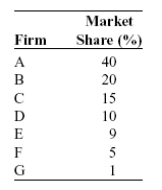
(82) Suppose an industry is composed of seven producers with market shares given in the table that follows. Compute the Herfindahl-Hirschman index (HHI) for this market.
A) If firms B and C merge, how will this affect the HHI, all else equal?
B) Instead, if firm A splits into two equal-sized competing firms, how would this affect the HHI, all else equal?
Support your answers with specific calculations. Do your results make sense?
(Essay)
4.8/5 (72)
(72) Use the following to answer questions:
Figure: Pricing Strategy in Cable TV Market II 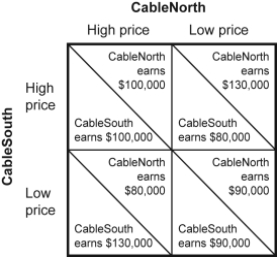 -(Figure: Pricing Strategy in Cable TV Market II) Look at the figure Pricing Strategy in Cable TV Market II. The dominant strategy for CableSouth:
 (Multiple Choice)
4.8/5 (90)
(90) Use the following to answer questions:
Figure: Monopoly Profits in Duopoly  -(Figure: Monopoly Profits in Duopoly) If the two firms in the figure Monopoly Profits in Duopoly colluded to split production evenly and to maximize their joint profits, the market price they set would be _____, and each firm's economic profit would be _____. (Assume that the market demand curve is D2.)
 (Multiple Choice)
5.0/5 (81)
(81) An action is a dominant strategy when it is a player's best action:
(Multiple Choice)
4.7/5 (75)
(75) Game theory is commonly used to explain behavior in oligopolies, because oligopolies are characterized by:
(Multiple Choice)
4.8/5 (84)
(84) An extreme case of oligopoly in which firms collude to raise joint profits is known as a:
(Multiple Choice)
4.8/5 (72)
(72) The Herfindahl-Hirschman index is a measure of concentration found by:
(Multiple Choice)
4.8/5 (92)
(92) Suppose two gas stations operate at the same busy intersection. You notice that the posted prices are almost always the same. Assuming that these firms are engaged in tacit price collusion, can we automatically conclude that there is no competition for customers between the two stations?
(Essay)
4.9/5 (89)
(89) Use the following to answer questions:
-(Table: Demand Schedule for Gadgets) Look at the table Demand Schedule for Gadgets. The market for gadgets consists of two producers, Margaret and Ray. Each firm can produce gadgets at a marginal cost of $2 and no fixed cost. If these two producers formed a cartel, agreed to split production of output evenly, and acted to maximize total industry profits, total industry profit would be:
-(Table: Demand Schedule for Gadgets) Look at the table Demand Schedule for Gadgets. The market for gadgets consists of two producers, Margaret and Ray. Each firm can produce gadgets at a marginal cost of $2 and no fixed cost. If these two producers formed a cartel, agreed to split production of output evenly, and acted to maximize total industry profits, total industry profit would be: (Multiple Choice)
4.9/5 (82)
(82) If the several companies in the tobacco industry produce similar products but have very different marginal costs:
(Multiple Choice)
4.8/5 (83)
(83) Use the following to answer questions:
Scenario: Payoff Matrix for Two Firms
The following table provides the payoff matrix for two firms, firm A and firm B. They are the only two firms in the industry and can either compete or cooperate with each other, with the following profit results reflecting their actions. 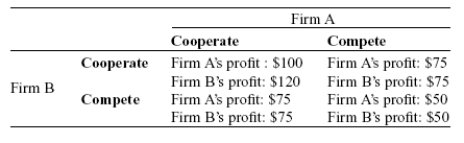 -(Scenario: Payoff Matrix for Two Firms) In the scenario Payoff Matrix for Two Firms, firm A:
 (Multiple Choice)
4.8/5 (78)
(78) Use the following to answer questions:
-(Table: Demand Schedule for Gadgets) Look at the table Demand Schedule for Gadgets. The market for gadgets consists of two producers, Margaret and Ray. Each firm can produce gadgets at a marginal cost of $2 and no fixed cost. Suppose that these two producers have formed a cartel, agreed to split production of output evenly, and are maximizing total industry profits. If Margaret decides to cheat on the agreement and sell 100 more gadgets, how many gadgets will Margaret sell?
-(Table: Demand Schedule for Gadgets) Look at the table Demand Schedule for Gadgets. The market for gadgets consists of two producers, Margaret and Ray. Each firm can produce gadgets at a marginal cost of $2 and no fixed cost. Suppose that these two producers have formed a cartel, agreed to split production of output evenly, and are maximizing total industry profits. If Margaret decides to cheat on the agreement and sell 100 more gadgets, how many gadgets will Margaret sell? (Multiple Choice)
4.9/5 (79)
(79) Oligopoly firms that produce only cement are less likely to collude than firms in a cell phone oligopoly.
(True/False)
4.9/5 (86)
(86) If there are many firms in an industry, there is little incentive for firms to engage in tacit collusion because a smaller proportion of the units of the product sold are affected by the price effect if a firm increases output.
(True/False)
4.9/5 (80)
(80) Use the following to answer questions:
-(Table: Demand Schedule for Gadgets) Look at the table Demand Schedule for Gadgets. The market for gadgets consists of two producers, Margaret and Ray. Each firm can produce gadgets at a marginal cost of $2 and no fixed cost. If industry output is 300 gadgets produced by Margaret and 200 gadgets produced by Ray and if Ray decides to increase output by 100, industry price will be:
-(Table: Demand Schedule for Gadgets) Look at the table Demand Schedule for Gadgets. The market for gadgets consists of two producers, Margaret and Ray. Each firm can produce gadgets at a marginal cost of $2 and no fixed cost. If industry output is 300 gadgets produced by Margaret and 200 gadgets produced by Ray and if Ray decides to increase output by 100, industry price will be: (Multiple Choice)
4.9/5 (75)
(75) Use the following to answer questions: 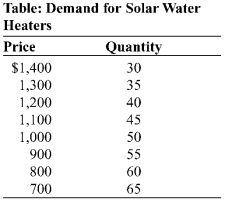 -(Table: Demand for Solar Water Heaters) Look at the table Demand for Solar Water Heaters. The marginal cost of producing solar water heaters is zero, and only two firms, Rheem and Calefi, produce them. Suppose they agree to produce only 25 water heaters each. By how much does Rheem's profit rise if it cheats on the agreement and produces 30 water heaters?
 (Multiple Choice)
4.8/5 (77)
(77) Oligopoly is a market structure that is characterized by a _____ number of _____ firms producing _____ products.
(Multiple Choice)
4.9/5 (89)
(89) 
Filters
- Essay(0)
- Multiple Choice(0)
- Short Answer(0)
- True False(0)
- Matching(0)