



 Chat with AI
Exam 14: Oligopoly

Exam 1: First Principles233 Questions
Exam 2: Economic Models: Trade-Offs and Trade 25382 Questions
Exam 3: Supply and Demand290 Questions
Exam 4: Consumer and Producer Surplus224 Questions
Exam 5: Price Controls and Quotas: Meddling With Markets227 Questions
Exam 6: Elasticity300 Questions
Exam 7: Taxes298 Questions
Exam 8: International Trade272 Questions
Exam 9: Decision Making by Individuals Firms201 Questions
Exam 10: The Rational Consumer372 Questions
Exam 11: Behind the Supply Curve: Inputs and Costs362 Questions
Exam 12: Perfect Competition and the Supply Curve355 Questions
Exam 13: Monopoly350 Questions
Exam 14: Oligopoly294 Questions
Exam 15: Monopolistic Competition and Product Differentiation262 Questions
Exam 16: Externalities199 Questions
Exam 17: Public Goods Common Resources224 Questions
Exam 18: The Economics of the Welfare140 Questions
Exam 19: Factor Markets and the Distribution of Income369 Questions
Exam 20: Uncertainty, Risk, and Private Information202 Questions
Select questions type


If a player has an incentive to cheat no matter what the other player does and if both players act in this manner, both players will be worse off. This is a:
(Multiple Choice)
4.7/5  (68)
(68) A customer with significant buying power in an industry would:
(Multiple Choice)
4.9/5 (84)
(84) The effect of product differentiation is to increase the firm's market power.
(True/False)
4.8/5 (86)
(86) Use the following to answer questions:  -(Table: Demand Schedule for Gadgets) Look at the table Demand Schedule for Gadgets. The market for gadgets consists of two producers, Margaret and Ray. Each firm can produce gadgets with no marginal cost or fixed cost. Suppose that these two producers have formed a cartel, agreed to split production of output evenly and are maximizing total industry profits. If Margaret decides to cheat on the agreement and sell 100 more gadgets but Ray continues to sell 250 gadgets, Ray's profits will be:
 (Multiple Choice)
4.7/5 (75)
(75) Use the following to answer questions:  -(Table: Demand for Crude Oil) Look at the table Demand for Crude Oil. Assume that the crude oil industry is a duopoly and the marginal cost and fixed cost of producing crude oil equals zero. Suppose that the two firms are maximizing industry profit and splitting the profit evenly. If firm 1 decides to cheat and increase production by 10 more barrels and firm 2 continues to produce 40 barrels, firm 2 will earn profits of:
 (Multiple Choice)
4.7/5 (83)
(83) The first law designed to curb monopoly power in the United States was the _____ Act.
(Multiple Choice)
4.8/5 (90)
(90) _____ is the unwritten or unspoken agreement through which firms limit _____.
(Multiple Choice)
4.9/5 (71)
(71) Use the following to answer questions:
Figure: Monopoly Profits in Duopoly  -(Figure: Monopoly Profits in Duopoly) Suppose the duopoly industry illustrated in the figure Monopoly Profits in Duopoly produces a perishable good. If the industry is perfectly competitive, the market price will likely end up being _____, and the combined economic profits of the firms will be _____.
 (Multiple Choice)
4.8/5 (73)
(73) Use the following to answer questions:
Figure: Prisoners' Dilemma for Thelma and Louise 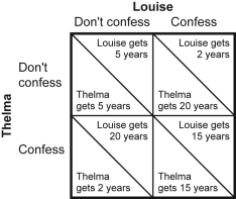 -(Figure: Prisoners' Dilemma for Thelma and Louise) Look at the Figure Prisoners' Dilemma for Thelma and Louise. Thelma and Louise are arrested and jailed for murder. Given the payoff matrix in the figure, the optimal behavior for Thelma and Louise to minimize their joint sentence is for Thelma _____ and for Louise ____.
 (Multiple Choice)
4.8/5 (77)
(77) In the past, most of the cars sold in the United States were produced by the Big Three auto companies. General Motors would announce its prices for the new model year first, and then the other companies would match it. This practice was an example of:
(Multiple Choice)
4.9/5 (89)
(89) When countries spend increasingly large amounts of funds on military production as a means of impressing an equally powerful antagonistic neighbor with possible military superiority, a prisoners' dilemma evolves, since both countries would be better off if they did not pursue such a strategy. This is an example of:
(Multiple Choice)
4.8/5 (75)
(75) Two large electronic retailers, Biggest Buy and Connection City, are considering entering a small town. Each firm can either enter the market or not. The table shows the payoff matrix. Profits in each cell of the payoff matrix are given as (Biggest Buy, Connection City). Are there any dominant strategies in the game? If this game is played only once and each firm makes the entry decision independently, what is the Nash equilibrium of this game? Explain your conclusions. 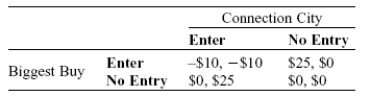
(Essay)
4.8/5 (68)
(68) Suppose there are 10 identical firms in an industry and each produces 10% of the total market sales. The HHI for this industry would indicate that the industry is:
(Multiple Choice)
4.9/5 (78)
(78) Use the following to answer questions:
-(Table: Demand Schedule for Gadgets) Look at the table Demand Schedule for Gadgets. The market for gadgets consists of two producers, Margaret and Ray. Each firm can produce gadgets with no marginal cost or fixed cost. If industry output is 350 gadgets produced by Margaret and 250 gadgets produced by Ray and if Ray decides to increase output by 100, industry price will be:
-(Table: Demand Schedule for Gadgets) Look at the table Demand Schedule for Gadgets. The market for gadgets consists of two producers, Margaret and Ray. Each firm can produce gadgets with no marginal cost or fixed cost. If industry output is 350 gadgets produced by Margaret and 250 gadgets produced by Ray and if Ray decides to increase output by 100, industry price will be: (Multiple Choice)
4.9/5 (63)
(63) In which of the following situations does overt collusion take place?
(Multiple Choice)
4.9/5 (68)
(68) Which of the following characteristics make an industry more conducive to collusive behavior?
(Multiple Choice)
4.8/5 (86)
(86) Use the following to answer questions:
Scenario: Payoff Matrix for Two Firms
The following table provides the payoff matrix for two firms, firm A and firm B. They are the only two firms in the industry and can either compete or cooperate with each other, with the following profit results reflecting their actions. 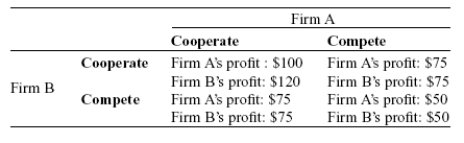 -(Scenario: Payoff Matrix for Two Firms) In the scenario Payoff Matrix for Two Firms, firm B:
 (Multiple Choice)
4.8/5 (84)
(84) A price war occurs when tacit collusion breaks down and aggressive price competition causes prices to collapse.
(True/False)
4.9/5 (91)
(91) 
Filters
- Essay(0)
- Multiple Choice(0)
- Short Answer(0)
- True False(0)
- Matching(0)