



 Chat with AI
Exam 14: Oligopoly

Exam 1: First Principles233 Questions
Exam 2: Economic Models: Trade-Offs and Trade 25382 Questions
Exam 3: Supply and Demand290 Questions
Exam 4: Consumer and Producer Surplus224 Questions
Exam 5: Price Controls and Quotas: Meddling With Markets227 Questions
Exam 6: Elasticity300 Questions
Exam 7: Taxes298 Questions
Exam 8: International Trade272 Questions
Exam 9: Decision Making by Individuals Firms201 Questions
Exam 10: The Rational Consumer372 Questions
Exam 11: Behind the Supply Curve: Inputs and Costs362 Questions
Exam 12: Perfect Competition and the Supply Curve355 Questions
Exam 13: Monopoly350 Questions
Exam 14: Oligopoly294 Questions
Exam 15: Monopolistic Competition and Product Differentiation262 Questions
Exam 16: Externalities199 Questions
Exam 17: Public Goods Common Resources224 Questions
Exam 18: The Economics of the Welfare140 Questions
Exam 19: Factor Markets and the Distribution of Income369 Questions
Exam 20: Uncertainty, Risk, and Private Information202 Questions
Select questions type


The market structure that is characterized by only a small number of producers is:
(Multiple Choice)
4.9/5  (80)
(80) Use the following to answer questions:  -(Table: Demand Schedule for Gadgets) Look at the table Demand Schedule for Gadgets. The market for gadgets consists of two producers, Margaret and Ray. Each firm can produce gadgets at a marginal cost of $2 and no fixed cost. Suppose that these two producers have formed a cartel, agreed to split production of output evenly, and are maximizing total industry profits. If Margaret decides to cheat on the agreement and sell 100 more gadgets, the market price of gadgets will be:
 (Multiple Choice)
4.9/5 (82)
(82) Use the following to answer questions:
Figure: Payoff Matrix for Gehrig and Gabriel 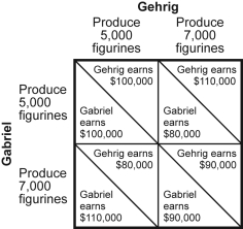 -(Figure: Payoff Matrix for Gehrig and Gabriel) The figure Payoff Matrix for Gehrig and Gabriel describes two people who sell handmade Davy Crockett figurines in San Antonio. Both Gehrig and Gabriel have two strategies available to them: to produce 5,000 figurines each month or to produce 7,000 figurines each month. For Gehrig and Gabriel, the dominant strategy is to:
 (Multiple Choice)
4.8/5 (77)
(77) When firms in a particular industry informally agree to charge the same price as the largest firm in that industry, it is called:
(Multiple Choice)
4.8/5 (77)
(77) When firms openly agree on price and output and they jointly make other decisions aimed at achieving monopoly profits, those firms are practicing:
(Multiple Choice)
4.9/5 (90)
(90) If the Herfindahl-Hirschman index (HHI) for an industry is 900, the market is considered:
(Multiple Choice)
4.8/5 (76)
(76) Use the following to answer questions:
-(Table: Demand Schedule for Gadgets) Look at the table Demand Schedule for Gadgets. The market for gadgets consists of two producers, Margaret and Ray. Each firm can produce gadgets with no marginal cost or fixed cost. Suppose that these two producers have formed a cartel, agreed to split production of output evenly and are maximizing total industry profits. If Margaret decides to cheat on the agreement and sell 100 more gadgets, Margaret's profit will be _____ and Ray's profit will be _____.
-(Table: Demand Schedule for Gadgets) Look at the table Demand Schedule for Gadgets. The market for gadgets consists of two producers, Margaret and Ray. Each firm can produce gadgets with no marginal cost or fixed cost. Suppose that these two producers have formed a cartel, agreed to split production of output evenly and are maximizing total industry profits. If Margaret decides to cheat on the agreement and sell 100 more gadgets, Margaret's profit will be _____ and Ray's profit will be _____. (Multiple Choice)
4.8/5 (72)
(72) Use the following to answer questions:
-(Table: Demand Schedule for Gadgets) Look at the table Demand Schedule for Gadgets. The market for gadgets consists of two producers, Margaret and Ray. Each firm can produce gadgets at a marginal cost of $2 and no fixed cost. Suppose that these two producers have formed a cartel, agreed to split production of output evenly, and are maximizing total industry profits. If Margaret decides to cheat on the agreement and sell 100 more gadgets but Ray continues to sell 200 gadgets, Ray's profits will be:
-(Table: Demand Schedule for Gadgets) Look at the table Demand Schedule for Gadgets. The market for gadgets consists of two producers, Margaret and Ray. Each firm can produce gadgets at a marginal cost of $2 and no fixed cost. Suppose that these two producers have formed a cartel, agreed to split production of output evenly, and are maximizing total industry profits. If Margaret decides to cheat on the agreement and sell 100 more gadgets but Ray continues to sell 200 gadgets, Ray's profits will be: (Multiple Choice)
4.7/5 (78)
(78) Use the following to answer questions:
Figure: Payoff Matrix for Jake and Zoe 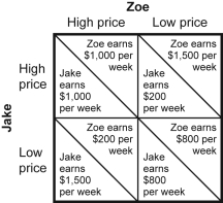 -(Figure: Payoff Matrix for Jake and Zoe) Look at the figure Payoff Matrix for Jake and Zoe, the only producers of slushies in their tourist town. Every week, each decides whether to price high or price low for the following week. The figure shows the profit per week earned by their two firms. Suppose the firms each decide to price high initially and adopt a tit-for-tat strategy for the following weeks. After a few weeks, Jakes profit would be _____ and Zoe's profit would be _____.
 (Multiple Choice)
4.8/5 (68)
(68) Two large universities, Humongous State (HSU) and Behemoth State (BSU), dominate college basketball. Each basketball program aggressively recruits the best athletes to attend the university, but the best athletes can skip college and jump immediately to professional basketball. Each school can illegally pay top players to enroll and thus increase the winning percentage of the team, or each program can follow the rules and lose the top players to the professional ranks. The table shows the payoff matrix of winning percentages that each school would receive from its recruiting decision, given the recruiting decision of its rival. Winning percentages in each cell of the payoff matrix are given as (HSU, BSU).
A) What is the noncooperative Nash equilibrium?
B) Suppose each school considers the future and devises a tit-for-tat strategy. Neither school will pay players to play basketball so long as the other does not. If one school breaks the agreement and pays players, the other school will do the same until the first school stops paying players. If both schools adopt the tit-for-tat strategy, what are the winning percentages every year? Will this be effective at eliminating the illegal practice of paying college athletes to play basketball?
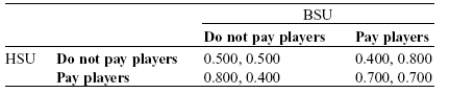
(Essay)
4.9/5 (78)
(78) Use the following to answer questions:
-(Table: Demand Schedule for Gadgets) Look at the table Demand Schedule for Gadgets. The market for gadgets consists of two producers, Margaret and Ray. Each firm can produce gadgets with no marginal cost or fixed cost. Suppose that these two producers have formed a cartel and are maximizing total industry profits and splitting the production of output evenly between themselves. If Margaret decides to cheat on the agreement and sell 100 more gadgets, how many gadgets will she sell?
-(Table: Demand Schedule for Gadgets) Look at the table Demand Schedule for Gadgets. The market for gadgets consists of two producers, Margaret and Ray. Each firm can produce gadgets with no marginal cost or fixed cost. Suppose that these two producers have formed a cartel and are maximizing total industry profits and splitting the production of output evenly between themselves. If Margaret decides to cheat on the agreement and sell 100 more gadgets, how many gadgets will she sell? (Multiple Choice)
4.7/5 (79)
(79) One of the most inefficient ways for duopolists to earn a profit is to engage in collusion or form a cartel.
(True/False)
4.9/5 (84)
(84) Across most industries, oligopoly is far more common than either perfect competition or monopoly.
(True/False)
4.7/5 (79)
(79) Use the following to answer questions:
-(Table: Demand Schedule for Gadgets) Look at the table Demand Schedule for Gadgets. The market for gadgets consists of two producers, Margaret and Ray. Each firm can produce gadgets at a marginal cost of $2 and no fixed cost. Suppose that these two producers have formed a cartel, agreed to split production of output evenly, and are maximizing total industry profits. If Margaret decides to cheat on the agreement and sell 100 more gadgets, Margaret's quantity effect will be a(n) _____ in profit of _____.
-(Table: Demand Schedule for Gadgets) Look at the table Demand Schedule for Gadgets. The market for gadgets consists of two producers, Margaret and Ray. Each firm can produce gadgets at a marginal cost of $2 and no fixed cost. Suppose that these two producers have formed a cartel, agreed to split production of output evenly, and are maximizing total industry profits. If Margaret decides to cheat on the agreement and sell 100 more gadgets, Margaret's quantity effect will be a(n) _____ in profit of _____. (Multiple Choice)
4.8/5 (67)
(67) To limit competition, oligopolists often practice product differentiation.
(True/False)
4.8/5 (89)
(89) 
Filters
- Essay(0)
- Multiple Choice(0)
- Short Answer(0)
- True False(0)
- Matching(0)