



 Chat with AI
Exam 15: Monopoly

Exam 1: Ten Principles of Economics220 Questions
Exam 2: Thinking Like an Economist284 Questions
Exam 3: Interdependence and the Gains From Trade192 Questions
Exam 4: The Market Forces of Supply and Demand277 Questions
Exam 5: Elasticity and Its Application222 Questions
Exam 6: Supply, Demand, and Government Policies321 Questions
Exam 7: Consumers, Producers, and the Efficiency of Markets218 Questions
Exam 8: Applications: The Costs of Taxation203 Questions
Exam 9: Application: International Trade214 Questions
Exam 10: Externalities204 Questions
Exam 11: Public Goods and Common Resources182 Questions
Exam 12: The Design of the Tax System225 Questions
Exam 13: The Costs of Production261 Questions
Exam 14: Firms in Competitive Markets243 Questions
Exam 15: Monopoly231 Questions
Exam 16: Monopolistic Competition246 Questions
Exam 17: Oligopoly204 Questions
Exam 18: The Markets for the Factors of Production232 Questions
Exam 19: Earnings and Discrimination230 Questions
Exam 20: Income Inequality and Poverty194 Questions
Exam 21: The Theory of Consumer Choice209 Questions
Exam 22: Frontiers in Microeconomics185 Questions
Exam 23: Measuring a Nations Income231 Questions
Exam 24: Measuring the Cost of Living214 Questions
Exam 25: Production and Growth187 Questions
Exam 26: Saving, Investment, and the Financial System225 Questions
Exam 27: Tools of Finance198 Questions
Exam 28: Unemployment and Its Natural Rate361 Questions
Exam 29: The Monetary System210 Questions
Exam 30: Money Growth and Inflation201 Questions
Exam 31: Open-Economy Macroeconomics: Basic Concepts194 Questions
Exam 32: A Macroeconomic Theory of the Open Economy188 Questions
Exam 33: Aggregate Demand and Aggregate Supply189 Questions
Exam 34: The Influence of Monetary and Fiscal Policy on Aggregate Demand207 Questions
Exam 35: The Short-Run Tradeoff Between Inflation and Unemployment223 Questions
Exam 36: Six Debates Over Macroeconomic Policy154 Questions
Select questions type


At the profit-maximizing quantity of output for a monopolist, average revenue, marginal revenue, and price are all equal.
(True/False)
4.8/5  (83)
(83) The amount of power that a monopoly has depends on whether there are close substitutes for its product.
(True/False)
4.9/5 (75)
(75) Scenario 15-1
A monopoly firm maximizes its profit by producing Q = 500 units of output. At that level of output, its marginal revenue is $40, its average revenue is $80, and its average total cost is $44.
-Refer to Scenario 15-1. At Q = 500, the firm's profit is
(Multiple Choice)
4.8/5 (65)
(65) If the government regulates the price a natural monopolist can charge to be equal to the firm's marginal cost, the government will likely need to subsidize the firm.
(True/False)
4.8/5 (75)
(75) Table 15-4
Quantity Price 10 \ 46 20 \ 42 30 \ 38 40 \ 34 50 \ 30 60 \ 26 70 \ 22 80 \ 18 90 \ 14 100 \ 10
-Refer to Table 15-4. The marginal revenue becomes negative with the production of which unit of output?
(Short Answer)
4.9/5 (82)
(82) A patent gives a single person or firm the exclusive right to sell some good or service forever.
(True/False)
4.7/5 (79)
(79) Which of the following is an example of public ownership of a monopoly?
(Multiple Choice)
4.8/5 (104)
(104) The De Beers Diamond company advertises heavily to promote the sale of all diamonds, not just its own. This is evidence that it has a monopoly position to some degree.
(True/False)
4.9/5 (93)
(93) Figure 15-12
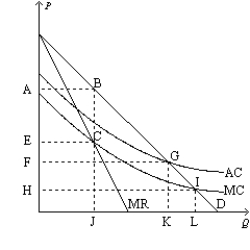
-Refer to Figure 15-12. If a regulator requires this firm to charge a socially optimal price, how much deadweight loss results?
-Refer to Figure 15-12. If a regulator requires this firm to charge a socially optimal price, how much deadweight loss results? (Short Answer)
4.8/5 (81)
(81) A monopoly creates a deadweight loss to society because it earns both short-run and long-run positive economic profits.
(True/False)
4.9/5 (68)
(68) University financial aid can be viewed as a type of price discrimination.
(True/False)
4.9/5 (83)
(83) Scenario 15-3
Vincent operates a scenic tour business in Boston. He has one bus which can fit 50 people per tour and each tour lasts 2 hours. His total cost of operating one tour is fixed at $450. Vincent's cost is not reduced if he runs a tour with a partially full bus. While his cost is the same for all tours, Vincent charges each passenger his/her willingness to pay: adults $18 per trip, children $10 per trip, and senior citizens $12 per trip. At those rates, on a typical day Vincent's demand is:
Passen ger Type Willingness to Pay Demand per day Adults \ 18 70 Children \ 10 25 Senior Citizens \ 12 55 Assume that Vincent's customers are always available for the tour; therefore, he can fill his bus for each tour as long as there is sufficient total demand for the day.
-Refer to Scenario 15-3. What is Vincent's cost of serving all passengers demanding a tour on a typical day?
(Short Answer)
4.8/5 (75)
(75) When a monopolist increases the quantity that it sells, price decreases, which, all else equal, decreases total revenue; this is called the price effect.
(True/False)
4.9/5 (74)
(74) Suppose most people regard emeralds, rubies, and sapphires as close substitutes for diamonds. Then DeBeers, a large diamond company, has
(Multiple Choice)
4.7/5 (70)
(70) For a long while, electricity producers were thought to be a classic example of a natural monopoly. People held this view because
(Multiple Choice)
4.7/5 (88)
(88) Movie theatres charge different prices to different groups of people based on the differing marginal costs that exist from group to group.
(True/False)
4.8/5 (85)
(85) Figure 15-10

-Refer to Figure 15-10. If the firm profit-maximizes, how much profit will it earn?
-Refer to Figure 15-10. If the firm profit-maximizes, how much profit will it earn? (Short Answer)
4.8/5 (74)
(74) It is difficult in a natural monopoly market for the firm to achieve both efficiency and zero economic profit simultaneously, even with regulation.
(True/False)
4.9/5 (83)
(83) 
Filters
- Essay(0)
- Multiple Choice(0)
- Short Answer(0)
- True False(0)
- Matching(0)