



 Chat with AI
Exam 15: Monopoly

Exam 1: Ten Principles of Economics220 Questions
Exam 2: Thinking Like an Economist284 Questions
Exam 3: Interdependence and the Gains From Trade192 Questions
Exam 4: The Market Forces of Supply and Demand277 Questions
Exam 5: Elasticity and Its Application222 Questions
Exam 6: Supply, Demand, and Government Policies321 Questions
Exam 7: Consumers, Producers, and the Efficiency of Markets218 Questions
Exam 8: Applications: The Costs of Taxation203 Questions
Exam 9: Application: International Trade214 Questions
Exam 10: Externalities204 Questions
Exam 11: Public Goods and Common Resources182 Questions
Exam 12: The Design of the Tax System225 Questions
Exam 13: The Costs of Production261 Questions
Exam 14: Firms in Competitive Markets243 Questions
Exam 15: Monopoly231 Questions
Exam 16: Monopolistic Competition246 Questions
Exam 17: Oligopoly204 Questions
Exam 18: The Markets for the Factors of Production232 Questions
Exam 19: Earnings and Discrimination230 Questions
Exam 20: Income Inequality and Poverty194 Questions
Exam 21: The Theory of Consumer Choice209 Questions
Exam 22: Frontiers in Microeconomics185 Questions
Exam 23: Measuring a Nations Income231 Questions
Exam 24: Measuring the Cost of Living214 Questions
Exam 25: Production and Growth187 Questions
Exam 26: Saving, Investment, and the Financial System225 Questions
Exam 27: Tools of Finance198 Questions
Exam 28: Unemployment and Its Natural Rate361 Questions
Exam 29: The Monetary System210 Questions
Exam 30: Money Growth and Inflation201 Questions
Exam 31: Open-Economy Macroeconomics: Basic Concepts194 Questions
Exam 32: A Macroeconomic Theory of the Open Economy188 Questions
Exam 33: Aggregate Demand and Aggregate Supply189 Questions
Exam 34: The Influence of Monetary and Fiscal Policy on Aggregate Demand207 Questions
Exam 35: The Short-Run Tradeoff Between Inflation and Unemployment223 Questions
Exam 36: Six Debates Over Macroeconomic Policy154 Questions
Select questions type


Like competitive firms, monopolies choose to produce a quantity in which marginal revenue equals marginal cost.
(True/False)
4.8/5  (77)
(77) In both perfectly competitive and monopoly markets, the price per unit of a good is equal to the
(Short Answer)
4.8/5 (74)
(74) Monopolies are socially inefficient because the price they charge is
(Multiple Choice)
5.0/5 (63)
(63) Figure 15-7 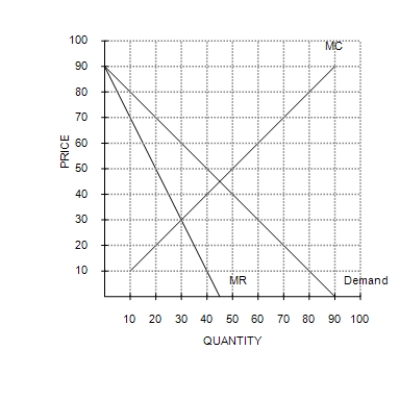 -Refer to Figure 15-7. To maximize total surplus, a benevolent social planner would choose which of the following outcomes?
 (Multiple Choice)
4.8/5 (81)
(81) Price discrimination adds to social welfare in the form of
(Multiple Choice)
4.9/5 (90)
(90) Figure 15-4 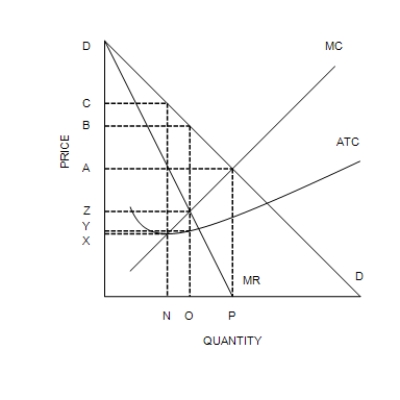
-Refer to Figure 15-4. What price will the monopolist charge in order to maximize profit?
-Refer to Figure 15-4. What price will the monopolist charge in order to maximize profit? (Multiple Choice)
4.9/5 (83)
(83) Comparing firms in perfectly competitive markets to monopoly firms, which results in a deadweight loss?
(Short Answer)
4.8/5 (88)
(88) Government intervention is always preferable to doing nothing when reducing the social inefficiencies of monopoly.
(True/False)
4.8/5 (84)
(84) In order for a firm to maximize profits through price discrimination, the firm must have some market power and be able to prevent arbitrage.
(True/False)
4.7/5 (74)
(74) There has been much discussion of deregulating electricity and natural gas delivery companies in the United States. Discuss the likely effect of deregulation on prices in these two industries.
(Essay)
4.9/5 (84)
(84) Table 15-2
Suppose a monopolist faces the following demand curve:
Price (Dollars per unit) Quantity (Units) 8 300 7 400 6 500 5 600 4 700 3 800 2 900 1 1,000
-Refer to Table 15-2. The monopolist has fixed costs of $1,000 and has a constant marginal cost of $2 per unit. If the monopolist were able to perfectly price discriminate, how many units would it sell?
(Multiple Choice)
4.9/5 (76)
(76) Which of the following is not an example of a barrier to entry?
(Multiple Choice)
4.9/5 (77)
(77) The law passed by Congress in 1890 to reduce the market power of the dominating trusts at that time was
(Multiple Choice)
4.7/5 (77)
(77) For a monopoly, the socially efficient level of output occurs where
(Multiple Choice)
4.9/5 (70)
(70) Scenario 15-1
A monopoly firm maximizes its profit by producing Q = 500 units of output. At that level of output, its marginal revenue is $40, its average revenue is $80, and its average total cost is $44.
-Refer to Scenario 15-1. At Q = 500, the firm's total revenue is
(Multiple Choice)
4.8/5 (67)
(67) Figure 15-12
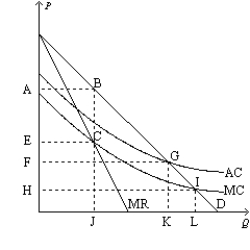
-Refer to Figure 15-12. If a regulator requires this firm to charge a socially optimal price, which letter represents the amount of output it will produce?
-Refer to Figure 15-12. If a regulator requires this firm to charge a socially optimal price, which letter represents the amount of output it will produce? (Short Answer)
4.8/5 (89)
(89) As long as as a monopolist is able to control the resale of its product, then it can successfully practice price discrimination.
(True/False)
4.8/5 (85)
(85) 
Filters
- Essay(0)
- Multiple Choice(0)
- Short Answer(0)
- True False(0)
- Matching(0)