



 Chat with AI
Exam 15: Monopoly

Exam 1: Ten Principles of Economics220 Questions
Exam 2: Thinking Like an Economist284 Questions
Exam 3: Interdependence and the Gains From Trade192 Questions
Exam 4: The Market Forces of Supply and Demand277 Questions
Exam 5: Elasticity and Its Application222 Questions
Exam 6: Supply, Demand, and Government Policies321 Questions
Exam 7: Consumers, Producers, and the Efficiency of Markets218 Questions
Exam 8: Applications: The Costs of Taxation203 Questions
Exam 9: Application: International Trade214 Questions
Exam 10: Externalities204 Questions
Exam 11: Public Goods and Common Resources182 Questions
Exam 12: The Design of the Tax System225 Questions
Exam 13: The Costs of Production261 Questions
Exam 14: Firms in Competitive Markets243 Questions
Exam 15: Monopoly231 Questions
Exam 16: Monopolistic Competition246 Questions
Exam 17: Oligopoly204 Questions
Exam 18: The Markets for the Factors of Production232 Questions
Exam 19: Earnings and Discrimination230 Questions
Exam 20: Income Inequality and Poverty194 Questions
Exam 21: The Theory of Consumer Choice209 Questions
Exam 22: Frontiers in Microeconomics185 Questions
Exam 23: Measuring a Nations Income231 Questions
Exam 24: Measuring the Cost of Living214 Questions
Exam 25: Production and Growth187 Questions
Exam 26: Saving, Investment, and the Financial System225 Questions
Exam 27: Tools of Finance198 Questions
Exam 28: Unemployment and Its Natural Rate361 Questions
Exam 29: The Monetary System210 Questions
Exam 30: Money Growth and Inflation201 Questions
Exam 31: Open-Economy Macroeconomics: Basic Concepts194 Questions
Exam 32: A Macroeconomic Theory of the Open Economy188 Questions
Exam 33: Aggregate Demand and Aggregate Supply189 Questions
Exam 34: The Influence of Monetary and Fiscal Policy on Aggregate Demand207 Questions
Exam 35: The Short-Run Tradeoff Between Inflation and Unemployment223 Questions
Exam 36: Six Debates Over Macroeconomic Policy154 Questions
Select questions type


Microsoft's government-granted exclusive right to make and sell the Windows operating system is called a
(Short Answer)
4.9/5  (80)
(80) In order for antitrust laws to raise social welfare, the government must
(Multiple Choice)
4.7/5 (78)
(78) When a monopolist increases the quantity that it sells, all else equal, total revenue increases, which is called the output effect.
(True/False)
4.9/5 (82)
(82) Which of the following is a necessary characteristic of a monopoly?
(Multiple Choice)
4.8/5 (79)
(79) Antitrust laws give the Justice Department the authority to challenge potential mergers between companies in an effort to safeguard society from monopoly power.
(True/False)
4.8/5 (69)
(69) Which of the following is not an example of price discrimination?
(Multiple Choice)
5.0/5 (84)
(84) Figure 15-2 
-Refer to Figure 15-2. The demand curve for a monopoly firm is depicted by curve
-Refer to Figure 15-2. The demand curve for a monopoly firm is depicted by curve (Multiple Choice)
4.8/5 (79)
(79) Reduced competition through merging of companies will raise social welfare
(Multiple Choice)
4.9/5 (71)
(71) Figure 15-2
-Refer to Figure 15-2. If the monopoly firm is currently producing Q4 units of output, then a decrease in output will necessarily cause profit to
-Refer to Figure 15-2. If the monopoly firm is currently producing Q4 units of output, then a decrease in output will necessarily cause profit to (Multiple Choice)
4.9/5 (77)
(77) The supply curve for a monopolist, in the short run, is defined in the same way as that for a competitive firm: it is the portion of the marginal cost curve above average variable cost.
(True/False)
4.9/5 (72)
(72) When a monopolist increases the amount of output that it produces and sells, average revenue
(Multiple Choice)
4.9/5 (70)
(70) Scenario 15-1
A monopoly firm maximizes its profit by producing Q = 500 units of output. At that level of output, its marginal revenue is $40, its average revenue is $80, and its average total cost is $44.
-Refer to Scenario 15-1. At Q = 500, the firm's marginal cost is
(Multiple Choice)
4.8/5 (82)
(82) To maximize total surplus with a monopoly firm, a benevolent social planner would choose the level of output where
(Multiple Choice)
4.9/5 (81)
(81) Comparing firms in perfectly competitive markets to monopoly firms, which charges higher prices?
(Short Answer)
4.9/5 (88)
(88) A natural monopoly has economies of scale for most if not all of its range of output.
(True/False)
4.8/5 (88)
(88) Figure 15-1 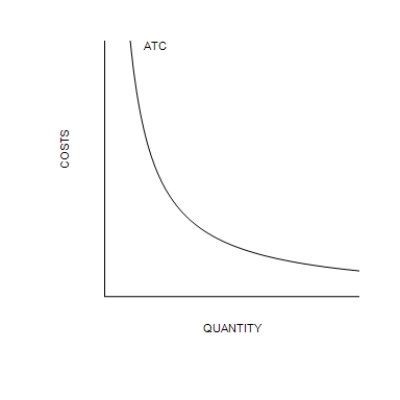 -Refer to Figure 15-1. The shape of the average total cost curve reveals information about the nature of the barrier to entry that might exist in a monopoly market. Which of the following monopoly types best coincides with the figure?
 (Multiple Choice)
5.0/5 (75)
(75) 
Filters
- Essay(0)
- Multiple Choice(0)
- Short Answer(0)
- True False(0)
- Matching(0)