



 Chat with AI
Exam 15: Monopoly

Exam 1: Ten Principles of Economics220 Questions
Exam 2: Thinking Like an Economist284 Questions
Exam 3: Interdependence and the Gains From Trade192 Questions
Exam 4: The Market Forces of Supply and Demand277 Questions
Exam 5: Elasticity and Its Application222 Questions
Exam 6: Supply, Demand, and Government Policies321 Questions
Exam 7: Consumers, Producers, and the Efficiency of Markets218 Questions
Exam 8: Applications: The Costs of Taxation203 Questions
Exam 9: Application: International Trade214 Questions
Exam 10: Externalities204 Questions
Exam 11: Public Goods and Common Resources182 Questions
Exam 12: The Design of the Tax System225 Questions
Exam 13: The Costs of Production261 Questions
Exam 14: Firms in Competitive Markets243 Questions
Exam 15: Monopoly231 Questions
Exam 16: Monopolistic Competition246 Questions
Exam 17: Oligopoly204 Questions
Exam 18: The Markets for the Factors of Production232 Questions
Exam 19: Earnings and Discrimination230 Questions
Exam 20: Income Inequality and Poverty194 Questions
Exam 21: The Theory of Consumer Choice209 Questions
Exam 22: Frontiers in Microeconomics185 Questions
Exam 23: Measuring a Nations Income231 Questions
Exam 24: Measuring the Cost of Living214 Questions
Exam 25: Production and Growth187 Questions
Exam 26: Saving, Investment, and the Financial System225 Questions
Exam 27: Tools of Finance198 Questions
Exam 28: Unemployment and Its Natural Rate361 Questions
Exam 29: The Monetary System210 Questions
Exam 30: Money Growth and Inflation201 Questions
Exam 31: Open-Economy Macroeconomics: Basic Concepts194 Questions
Exam 32: A Macroeconomic Theory of the Open Economy188 Questions
Exam 33: Aggregate Demand and Aggregate Supply189 Questions
Exam 34: The Influence of Monetary and Fiscal Policy on Aggregate Demand207 Questions
Exam 35: The Short-Run Tradeoff Between Inflation and Unemployment223 Questions
Exam 36: Six Debates Over Macroeconomic Policy154 Questions
Select questions type


Explain how a profit-maximizing monopolist chooses its level of output and the price of its goods.
(Essay)
4.7/5  (92)
(92) A monopolist is able to choose whatever price that it wishes and is only constrained by its greed.
(True/False)
4.9/5 (91)
(91) Like competitive firms, monopolies charge a price equal to marginal cost.
(True/False)
4.8/5 (80)
(80) In the market for "home heating" consumers typically have several options (e.g., electricity, heating fuel, natural gas, propane, etc.), yet we often think of firms in this industry as behaving like monopolists. Discuss the context in which your electricity provider is a monopolist. Is this characterization universally applicable? Explain your answer.
(Essay)
4.7/5 (84)
(84) For a monopolist, an increase in output sold causes marginal revenue to be negative when
(Multiple Choice)
4.9/5 (90)
(90) Scenario 15-3
Vincent operates a scenic tour business in Boston. He has one bus which can fit 50 people per tour and each tour lasts 2 hours. His total cost of operating one tour is fixed at $450. Vincent's cost is not reduced if he runs a tour with a partially full bus. While his cost is the same for all tours, Vincent charges each passenger his/her willingness to pay: adults $18 per trip, children $10 per trip, and senior citizens $12 per trip. At those rates, on a typical day Vincent's demand is:
Passen ger Type Willingness to Pay Demand per day Adults \ 18 70 Children \ 10 25 Senior Citizens \ 12 55 Assume that Vincent's customers are always available for the tour; therefore, he can fill his bus for each tour as long as there is sufficient total demand for the day.
-Refer to Scenario 15-3. One of Vincent's friends tells him he would be more profitable if he charged a single price of $18. Assuming no changes in consumer demand, what would Vincent's profit be if he charged every customer $18?
(Short Answer)
4.8/5 (81)
(81) Deadweight loss measures the loss in society's welfare that occurs because a monopolist does not produce the socially efficient level of output.
(True/False)
4.8/5 (64)
(64) Table 15-3
Tommy's Tie Company, a monopolist, has the following cost and revenue information. Assume that Tommy's is able to engage in perfect price discrimination.
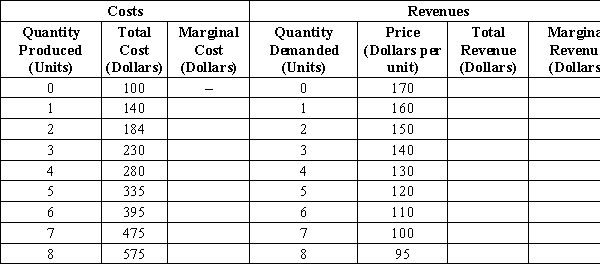
-Refer to Table 15-3. If the monopolist can engage in perfect price discrimination, what is the total revenue when 3 ties are sold?
-Refer to Table 15-3. If the monopolist can engage in perfect price discrimination, what is the total revenue when 3 ties are sold? (Multiple Choice)
4.9/5 (74)
(74) One problem with government operation of monopolies is that
(Multiple Choice)
4.9/5 (63)
(63) Which of the following is not an example of price discrimination by a firm?
(Multiple Choice)
4.8/5 (80)
(80) Figure 15-9
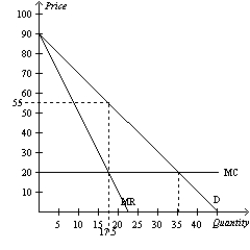
-Refer to Figure 15-9. How much profit will this monopolist earn if it charges each consumer the same price?
-Refer to Figure 15-9. How much profit will this monopolist earn if it charges each consumer the same price? (Short Answer)
4.8/5 (96)
(96) Copyrights and patents are examples of barriers to entry that give firms monopoly pricing powers.
(True/False)
4.8/5 (75)
(75) State one benefit of government-granted monopolies like patents and copyrights.
(Short Answer)
4.9/5 (93)
(93) Figure 15-5
The following graph depicts the market situation for a monopoly pastry shop called Bearclaws. 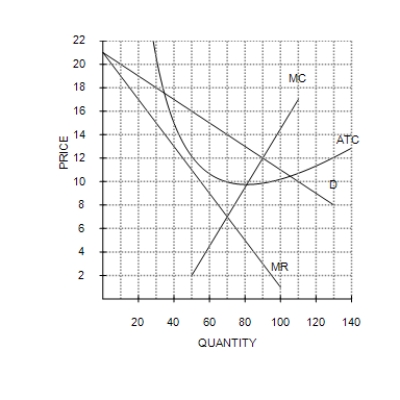 -Refer to Figure 15-5. Based upon the information shown, how many units will Bearclaws produce to maximize profits?
 (Multiple Choice)
4.9/5 (73)
(73) Figure 15-4 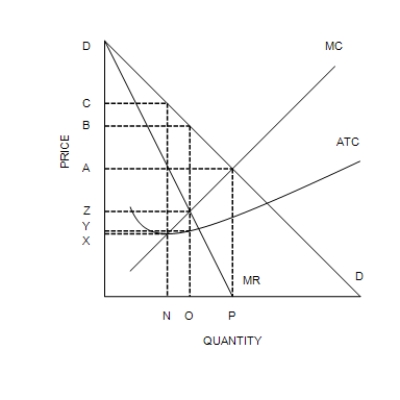
-Refer to Figure 15-4. What area measures the monopolist's profit?
-Refer to Figure 15-4. What area measures the monopolist's profit? (Multiple Choice)
4.9/5 (74)
(74) Suppose a profit-maximizing monopolist faces a constant marginal cost of $10, produces an output level of 100 units, and charges a price of $50. The socially efficient level of output is 200 units. Assume that the demand curve and marginal revenue curve are the typical downward-sloping straight lines. The monopoly deadweight loss equals $2,000.
(True/False)
4.9/5 (89)
(89) A patent gives a single person or firm the exclusive right to sell some good or service for a specific period of time.
(True/False)
4.9/5 (73)
(73) Since monopolists that practice price discrimination generally increase market output, compared to a monopoly that charges a single price, practicing price discrimination generally leads to a smaller deadweight loss.
(True/False)
4.9/5 (80)
(80) Table 15-4
Quantity Price 10 \ 46 20 \ 42 30 \ 38 40 \ 34 50 \ 30 60 \ 26 70 \ 22 80 \ 18 90 \ 14 100 \ 10
-Refer to Table 15-4. The average revenue of the 50th unit of output is
(Short Answer)
4.9/5 (83)
(83) 
Filters
- Essay(0)
- Multiple Choice(0)
- Short Answer(0)
- True False(0)
- Matching(0)