



 Chat with AI
Exam 15: Monopoly

Exam 1: Ten Principles of Economics220 Questions
Exam 2: Thinking Like an Economist284 Questions
Exam 3: Interdependence and the Gains From Trade192 Questions
Exam 4: The Market Forces of Supply and Demand277 Questions
Exam 5: Elasticity and Its Application222 Questions
Exam 6: Supply, Demand, and Government Policies321 Questions
Exam 7: Consumers, Producers, and the Efficiency of Markets218 Questions
Exam 8: Applications: The Costs of Taxation203 Questions
Exam 9: Application: International Trade214 Questions
Exam 10: Externalities204 Questions
Exam 11: Public Goods and Common Resources182 Questions
Exam 12: The Design of the Tax System225 Questions
Exam 13: The Costs of Production261 Questions
Exam 14: Firms in Competitive Markets243 Questions
Exam 15: Monopoly231 Questions
Exam 16: Monopolistic Competition246 Questions
Exam 17: Oligopoly204 Questions
Exam 18: The Markets for the Factors of Production232 Questions
Exam 19: Earnings and Discrimination230 Questions
Exam 20: Income Inequality and Poverty194 Questions
Exam 21: The Theory of Consumer Choice209 Questions
Exam 22: Frontiers in Microeconomics185 Questions
Exam 23: Measuring a Nations Income231 Questions
Exam 24: Measuring the Cost of Living214 Questions
Exam 25: Production and Growth187 Questions
Exam 26: Saving, Investment, and the Financial System225 Questions
Exam 27: Tools of Finance198 Questions
Exam 28: Unemployment and Its Natural Rate361 Questions
Exam 29: The Monetary System210 Questions
Exam 30: Money Growth and Inflation201 Questions
Exam 31: Open-Economy Macroeconomics: Basic Concepts194 Questions
Exam 32: A Macroeconomic Theory of the Open Economy188 Questions
Exam 33: Aggregate Demand and Aggregate Supply189 Questions
Exam 34: The Influence of Monetary and Fiscal Policy on Aggregate Demand207 Questions
Exam 35: The Short-Run Tradeoff Between Inflation and Unemployment223 Questions
Exam 36: Six Debates Over Macroeconomic Policy154 Questions
Select questions type


Figure 15-8 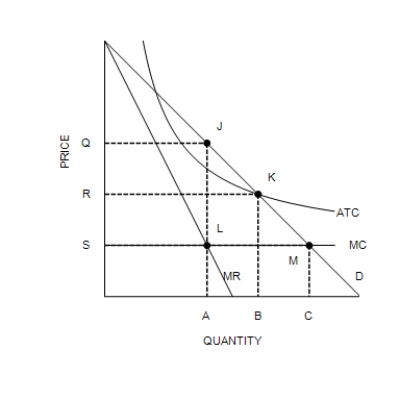
-Refer to Figure 15-8. What is the socially efficient price and quantity for this natural monopolist?
-Refer to Figure 15-8. What is the socially efficient price and quantity for this natural monopolist? (Multiple Choice)
4.9/5  (86)
(86) In a monopoly market, the socially efficient quantity of output is typically higher than the profit-maximizing quantity of output for the monopolist.
(True/False)
4.9/5 (81)
(81) Government intervention always reduces monopoly deadweight loss.
(True/False)
4.8/5 (77)
(77) Comparing firms in perfectly competitive markets to monopoly firms, which can earn economic profits in the long run?
(Short Answer)
4.9/5 (92)
(92) Price discrimination is a rational strategy for a profit-maximizing monopolist when
(Multiple Choice)
4.7/5 (90)
(90) The profit that a monopolist earns represents a loss to society that is measured through deadweight loss.
(True/False)
4.8/5 (65)
(65) By selling hardcover books to die-hard fans and paperback books to less enthusiastic readers, the publisher is able to price discriminate and raise its profits.
(True/False)
4.8/5 (80)
(80) Goods that do not have close substitutes have downward-sloping demand curves.
(True/False)
4.8/5 (84)
(84) Suppose a monopolist is able to charge each customer a price equal to that customer's willingness-to-pay for the product. Then the monopolist is engaging in
(Multiple Choice)
4.7/5 (70)
(70) Scenario 15-2
Vincent operates a scenic tour business in Boston. He has one bus that can fit 50 people per tour and each tour lasts 2 hours. His total cost of operating one tour is fixed at $450. Vincent's cost is not reduced if he runs a tour with a partially full bus. While his cost is the same for all tours, Vincent charges each passenger his/her willingness to pay: adults $18 per trip, children $10 per trip, and senior citizens $12 per trip. At those rates, on a typical day Vincent's demand is:
Passenger Type Willingness to Pay (Dollars per unit) Quantity Demanded (Units) Adult 18 70 Children 10 25 Senior Citizens 12 55 Assume that Vincent's customers are always available for the tour; therefore, he can fill his bus for each tour as long as there is sufficient total demand for the day.
-Refer to Scenario 15-2. What is Vincent's profit on a typical day?
(Multiple Choice)
4.9/5 (82)
(82) 
Filters
- Essay(0)
- Multiple Choice(0)
- Short Answer(0)
- True False(0)
- Matching(0)