



 Chat with AI
Exam 15: Monopoly

Exam 1: Ten Principles of Economics220 Questions
Exam 2: Thinking Like an Economist284 Questions
Exam 3: Interdependence and the Gains From Trade192 Questions
Exam 4: The Market Forces of Supply and Demand277 Questions
Exam 5: Elasticity and Its Application222 Questions
Exam 6: Supply, Demand, and Government Policies321 Questions
Exam 7: Consumers, Producers, and the Efficiency of Markets218 Questions
Exam 8: Applications: The Costs of Taxation203 Questions
Exam 9: Application: International Trade214 Questions
Exam 10: Externalities204 Questions
Exam 11: Public Goods and Common Resources182 Questions
Exam 12: The Design of the Tax System225 Questions
Exam 13: The Costs of Production261 Questions
Exam 14: Firms in Competitive Markets243 Questions
Exam 15: Monopoly231 Questions
Exam 16: Monopolistic Competition246 Questions
Exam 17: Oligopoly204 Questions
Exam 18: The Markets for the Factors of Production232 Questions
Exam 19: Earnings and Discrimination230 Questions
Exam 20: Income Inequality and Poverty194 Questions
Exam 21: The Theory of Consumer Choice209 Questions
Exam 22: Frontiers in Microeconomics185 Questions
Exam 23: Measuring a Nations Income231 Questions
Exam 24: Measuring the Cost of Living214 Questions
Exam 25: Production and Growth187 Questions
Exam 26: Saving, Investment, and the Financial System225 Questions
Exam 27: Tools of Finance198 Questions
Exam 28: Unemployment and Its Natural Rate361 Questions
Exam 29: The Monetary System210 Questions
Exam 30: Money Growth and Inflation201 Questions
Exam 31: Open-Economy Macroeconomics: Basic Concepts194 Questions
Exam 32: A Macroeconomic Theory of the Open Economy188 Questions
Exam 33: Aggregate Demand and Aggregate Supply189 Questions
Exam 34: The Influence of Monetary and Fiscal Policy on Aggregate Demand207 Questions
Exam 35: The Short-Run Tradeoff Between Inflation and Unemployment223 Questions
Exam 36: Six Debates Over Macroeconomic Policy154 Questions
Select questions type


Figure 15-9
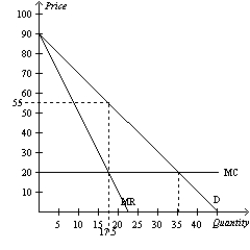
-Refer to Figure 15-9. If the monopolist uses perfect price discrimination, how much deadweight loss results?
-Refer to Figure 15-9. If the monopolist uses perfect price discrimination, how much deadweight loss results? (Short Answer)
4.8/5  (76)
(76) The socially efficient quantity is found where the demand curve intersects the marginal cost curve.
(True/False)
4.9/5 (75)
(75) If the government regulates the price a natural monopolist can charge to be equal to the firm's average total cost, the firm has no incentive to reduce costs.
(True/False)
4.8/5 (74)
(74) Table 15-3
Tommy's Tie Company, a monopolist, has the following cost and revenue information. Assume that Tommy's is able to engage in perfect price discrimination.
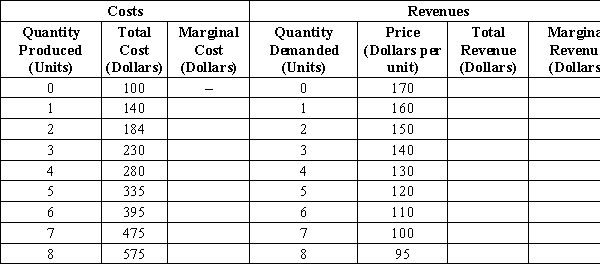
-Refer to Table 15-3. If the monopolist can engage in perfect price discrimination, what is the marginal revenue from selling the 5th tie?
-Refer to Table 15-3. If the monopolist can engage in perfect price discrimination, what is the marginal revenue from selling the 5th tie? (Multiple Choice)
4.8/5 (77)
(77) Granting a pharmaceutical company a patent for a new medicine will lead to
(Multiple Choice)
4.8/5 (73)
(73) Why might economists prefer private ownership of monopolies over public ownership of monopolies?
(Essay)
4.7/5 (79)
(79) A monopolist produces an output level where marginal revenue equals marginal cost and charges a price where marginal cost equals average total cost.
(True/False)
4.9/5 (71)
(71) Figure 15-9
-Refer to Figure 15-9. If the monopolist uses perfect price discrimination, what price will it charge?
-Refer to Figure 15-9. If the monopolist uses perfect price discrimination, what price will it charge? (Essay)
4.9/5 (90)
(90) Which of the following can defeat the profit-maximizing strategy of price discrimination?
(Multiple Choice)
4.8/5 (81)
(81) The best solution to the problem of welfare loss from monopoly is public ownership.
(True/False)
4.8/5 (80)
(80) Figure 15-9
-Refer to Figure 15-9. How much deadweight loss results if this single-price monopolist profit-maximizes?
-Refer to Figure 15-9. How much deadweight loss results if this single-price monopolist profit-maximizes? (Short Answer)
5.0/5 (77)
(77) In many countries, the government chooses to "internalize" the monopoly by owning monopoly providers of goods and services. (In some cases these firms are "nationalized," and the government actually buys or confiscates firms that operate in monopoly markets). What would be the advantages and disadvantages of such an approach to ensure that the "best interest of society" is promoted in these markets? Explain your answer.
(Essay)
4.9/5 (82)
(82) When deciding what price to charge consumers, the monopolist may choose to charge them different prices based on the customers'
(Multiple Choice)
4.9/5 (80)
(80) Airlines often separate their customers into business travelers and personal travelers by giving a discount to those travelers who stay over a Saturday night.
(True/False)
4.8/5 (92)
(92) A natural monopoly will always operate in the region of the long run average total cost curve where the cost per unit is constant.
(True/False)
4.9/5 (74)
(74) Figure 15-10

-Refer to Figure 15-10. If the firm profit-maximizes, what price will it charge?
-Refer to Figure 15-10. If the firm profit-maximizes, what price will it charge? (Short Answer)
4.9/5 (86)
(86) 
Filters
- Essay(0)
- Multiple Choice(0)
- Short Answer(0)
- True False(0)
- Matching(0)