



 Chat with AI
Exam 15: Monopoly

Exam 1: Ten Principles of Economics220 Questions
Exam 2: Thinking Like an Economist284 Questions
Exam 3: Interdependence and the Gains From Trade192 Questions
Exam 4: The Market Forces of Supply and Demand277 Questions
Exam 5: Elasticity and Its Application222 Questions
Exam 6: Supply, Demand, and Government Policies321 Questions
Exam 7: Consumers, Producers, and the Efficiency of Markets218 Questions
Exam 8: Applications: The Costs of Taxation203 Questions
Exam 9: Application: International Trade214 Questions
Exam 10: Externalities204 Questions
Exam 11: Public Goods and Common Resources182 Questions
Exam 12: The Design of the Tax System225 Questions
Exam 13: The Costs of Production261 Questions
Exam 14: Firms in Competitive Markets243 Questions
Exam 15: Monopoly231 Questions
Exam 16: Monopolistic Competition246 Questions
Exam 17: Oligopoly204 Questions
Exam 18: The Markets for the Factors of Production232 Questions
Exam 19: Earnings and Discrimination230 Questions
Exam 20: Income Inequality and Poverty194 Questions
Exam 21: The Theory of Consumer Choice209 Questions
Exam 22: Frontiers in Microeconomics185 Questions
Exam 23: Measuring a Nations Income231 Questions
Exam 24: Measuring the Cost of Living214 Questions
Exam 25: Production and Growth187 Questions
Exam 26: Saving, Investment, and the Financial System225 Questions
Exam 27: Tools of Finance198 Questions
Exam 28: Unemployment and Its Natural Rate361 Questions
Exam 29: The Monetary System210 Questions
Exam 30: Money Growth and Inflation201 Questions
Exam 31: Open-Economy Macroeconomics: Basic Concepts194 Questions
Exam 32: A Macroeconomic Theory of the Open Economy188 Questions
Exam 33: Aggregate Demand and Aggregate Supply189 Questions
Exam 34: The Influence of Monetary and Fiscal Policy on Aggregate Demand207 Questions
Exam 35: The Short-Run Tradeoff Between Inflation and Unemployment223 Questions
Exam 36: Six Debates Over Macroeconomic Policy154 Questions
Select questions type


If a profit-maximizing monopolist faces a downward-sloping market demand curve, its
(Multiple Choice)
4.9/5  (67)
(67) Suppose a profit-maximizing monopolist faces a constant marginal cost of $20, produces an output level of 100 units, and charges a price of $50. The socially efficient level of output is 200 units. Assume that the demand curve and marginal revenue curve are the typical downward-sloping straight lines. The monopoly deadweight loss equals $1,500.
(True/False)
4.8/5 (66)
(66) A monopolist that can practice perfect price discrimination will not impose a deadweight loss on society.
(True/False)
4.9/5 (80)
(80) Figure 15-10

-Refer to Figure 15-10. If a regulator requires the firm to charge a marginal cost price, what is the amount of profit or loss earned by the firm?
-Refer to Figure 15-10. If a regulator requires the firm to charge a marginal cost price, what is the amount of profit or loss earned by the firm? (Short Answer)
4.8/5 (93)
(93) Figure 15-10
-Refer to Figure 15-10. If a regulator requires the firm to charge an average cost price, what quantity will the firm produce?
-Refer to Figure 15-10. If a regulator requires the firm to charge an average cost price, what quantity will the firm produce? (Short Answer)
4.8/5 (73)
(73) Describe how government is involved in creating a monopoly. Why might the government create one? Give an example.
(Essay)
4.9/5 (84)
(84) A benefit to society of the patent and copyright laws is that those laws
(Multiple Choice)
4.8/5 (83)
(83) Figure 15-5
The following graph depicts the market situation for a monopoly pastry shop called Bearclaws. 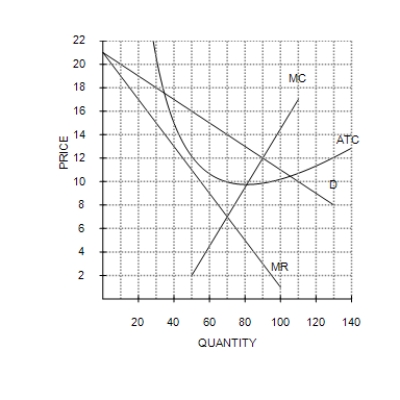 -Refer to Figure 15-5. Given that Bearclaws chooses the profit-maximizing price and quantity, what profit level will it obtain?
 (Multiple Choice)
4.8/5 (82)
(82) One example of price discrimination occurs in the publishing industry when a publisher initially releases an expensive hardcover edition of a popular novel and later releases a cheaper paperback edition. Use this example to demonstrate the benefits and potential pitfalls of a price discrimination pricing strategy.
(Essay)
4.8/5 (83)
(83) A monopolist does not have a supply curve because the firm's decision about how much to supply is impossible to separate from the demand curve it faces.
(True/False)
4.7/5 (86)
(86) Table 15-4
Quantity Price 10 \ 46 20 \ 42 30 \ 38 40 \ 34 50 \ 30 60 \ 26 70 \ 22 80 \ 18 90 \ 14 100 \ 10
-Refer to Table 15-4. The marginal revenue, when the quantity changes from 30 to 40 units, is
(Short Answer)
4.8/5 (81)
(81) Table 15-1
The following table provides information on the price, quantity, and average total cost for a monopoly.
Price (Dollars per unit) Quantity (Units) Average Total Cost (Dollars per unit) 24 0 - 18 5 14.00 12 10 11.00 6 15 10.67 0 20 11.00
-Refer to Table 15-1. At what price will the monopolist maximize his profit?
(Multiple Choice)
4.9/5 (86)
(86) Deadweight loss measures the loss in society's welfare that occurs because a monopolist can earn profits without the concern of new firms entering its industry.
(True/False)
4.8/5 (78)
(78) When a single firm can supply a good or service to an entire market at a lower cost than could two or more firms, the industry is known as a
(Short Answer)
4.8/5 (75)
(75) If a product can be produced by a natural monopoly, society will benefit in the form of lower prices if the monopolist is broken up into several smaller firms.
(True/False)
4.8/5 (81)
(81) Figure 15-10
-Refer to Figure 15-10. If a regulator requires the firm to charge a marginal cost price, what price will the firm charge?
-Refer to Figure 15-10. If a regulator requires the firm to charge a marginal cost price, what price will the firm charge? (Short Answer)
4.8/5 (60)
(60) The government may choose to do nothing to reduce monopoly inefficiency because the "fix" may be worse than the problem.
(True/False)
4.8/5 (83)
(83) Comparing firms in perfectly competitive markets to monopoly firms, which produces more output?
(Short Answer)
4.8/5 (82)
(82) 
Filters
- Essay(0)
- Multiple Choice(0)
- Short Answer(0)
- True False(0)
- Matching(0)