



 Chat with AI
Exam 16: Monopolistic Competition

Exam 1: Ten Principles of Economics220 Questions
Exam 2: Thinking Like an Economist284 Questions
Exam 3: Interdependence and the Gains From Trade192 Questions
Exam 4: The Market Forces of Supply and Demand277 Questions
Exam 5: Elasticity and Its Application222 Questions
Exam 6: Supply, Demand, and Government Policies321 Questions
Exam 7: Consumers, Producers, and the Efficiency of Markets218 Questions
Exam 8: Applications: The Costs of Taxation203 Questions
Exam 9: Application: International Trade214 Questions
Exam 10: Externalities204 Questions
Exam 11: Public Goods and Common Resources182 Questions
Exam 12: The Design of the Tax System225 Questions
Exam 13: The Costs of Production261 Questions
Exam 14: Firms in Competitive Markets243 Questions
Exam 15: Monopoly231 Questions
Exam 16: Monopolistic Competition246 Questions
Exam 17: Oligopoly204 Questions
Exam 18: The Markets for the Factors of Production232 Questions
Exam 19: Earnings and Discrimination230 Questions
Exam 20: Income Inequality and Poverty194 Questions
Exam 21: The Theory of Consumer Choice209 Questions
Exam 22: Frontiers in Microeconomics185 Questions
Exam 23: Measuring a Nations Income231 Questions
Exam 24: Measuring the Cost of Living214 Questions
Exam 25: Production and Growth187 Questions
Exam 26: Saving, Investment, and the Financial System225 Questions
Exam 27: Tools of Finance198 Questions
Exam 28: Unemployment and Its Natural Rate361 Questions
Exam 29: The Monetary System210 Questions
Exam 30: Money Growth and Inflation201 Questions
Exam 31: Open-Economy Macroeconomics: Basic Concepts194 Questions
Exam 32: A Macroeconomic Theory of the Open Economy188 Questions
Exam 33: Aggregate Demand and Aggregate Supply189 Questions
Exam 34: The Influence of Monetary and Fiscal Policy on Aggregate Demand207 Questions
Exam 35: The Short-Run Tradeoff Between Inflation and Unemployment223 Questions
Exam 36: Six Debates Over Macroeconomic Policy154 Questions
Select questions type


When a firm operates at efficient scale, it is producing at the minimum point on its average total cost curve.
(True/False)
4.8/5  (77)
(77) If we observe a great deal more advertising for Mucinex, an over-the-counter drug, than for a Grainger drill press, we can infer that
(Multiple Choice)
4.9/5 (80)
(80) The product-variety externality and the business-stealing externality are both spillover benefits of new firms entering a monopolistically competitive market.
(True/False)
4.9/5 (76)
(76) A new Mexican restaurant opens in the city of Manchester. The residents are happy about this new restaurant because they are experiencing what externality?
(Short Answer)
4.8/5 (78)
(78) Table 16-4
Beatrice's Birthday Cakes operates in a monopolistically competitive market, so it is one bakery among many in the market for birthday cakes. The following table presents cost and revenue data for birthday cakes at Beatrice's.

-Refer to Table 16-4. At the profit-maximizing quantity, what is Beatrice's total profit?
-Refer to Table 16-4. At the profit-maximizing quantity, what is Beatrice's total profit? (Multiple Choice)
4.9/5 (104)
(104) Scenario 16-1
Venya operates an ice cream shop in the center of Fairfield. He sells several unusual flavors of organic, homemade ice cream so he has a monopoly over his own ice cream, though he competes with many other firms selling ice cream in Fairfield for the same customers. Venya's demand and cost values for sales per day are given in the following table. (Everyone who purchases Venya's ice cream buys a double scoop cone because it's so delicious.)
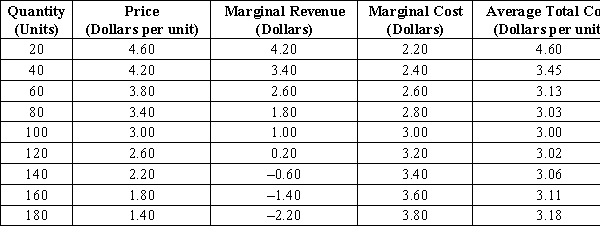
-Refer to Scenario 16-1. How many double scoop ice cream cones should Venya sell per day to maximize his profit?
-Refer to Scenario 16-1. How many double scoop ice cream cones should Venya sell per day to maximize his profit? (Multiple Choice)
4.8/5 (73)
(73) Economists are unanimous in their belief that advertising is socially inefficient.
(True/False)
4.8/5 (97)
(97) Figure 16-3  -Refer to Figure 16-3. What price will the monopolistically competitive firm charge in this market?
 (Multiple Choice)
4.9/5 (96)
(96) To be considered an oligopoly, the market must have a concentration ratio below 50%.
(True/False)
4.9/5 (68)
(68) Figure 16-6
The figure is drawn for a monopolistically competitive firm. 
-Refer to Figure 16-6. In order to maximize its profit, the firm will choose to produce
-Refer to Figure 16-6. In order to maximize its profit, the firm will choose to produce (Multiple Choice)
4.9/5 (76)
(76) Oligopoly and monopolistic competition are examples of a market structure called imperfect competition.
(True/False)
4.9/5 (77)
(77) Which market structure(s) include(s) many firms with differentiated products who can enter and exit the market freely?
(Short Answer)
4.7/5 (88)
(88) Monopolistic competition and monopoly are examples of a market structure called imperfect competition.
(True/False)
4.9/5 (91)
(91) Scenario 16-2
Delish, a moderately priced restaurant, has recently announced intentions to open a restaurant in Boston, MA. Assume that the restaurant market in Boston is characterized by monopolistic competition.
-Refer to Scenario 16-2. As a result of the new restaurant, consumers in Boston are likely to experience a
(Multiple Choice)
4.8/5 (85)
(85) A monopolistically competitive firm is currently producing 25 units of output. At this level of output the firm is charging the highest price it can at $30, has marginal revenue equal to $21, has marginal cost equal to $21, and has average total cost equal to $22. From this information we can infer that
(Multiple Choice)
4.8/5 (83)
(83) The term excess capacity refers to the fact that a firm produces a lower quantity than it would if it operated at the efficient scale.
(True/False)
4.9/5 (82)
(82) Figure 16-9
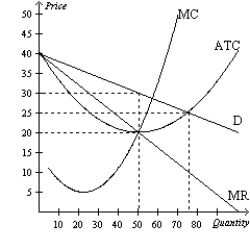
-Refer to Figure 16-9. If this firm profit-maximizes, how much revenue will it earn?
-Refer to Figure 16-9. If this firm profit-maximizes, how much revenue will it earn? (Short Answer)
4.8/5 (71)
(71) Table 16-3
A monopolistically competitive firm has the following cost structure:
Output (Units) Total Cost (Dollars) 1 30 2 32 3 36 4 42 5 50 6 63 7 77
-Refer to Table 16-3. The monopolistically competitive firm faces the following demand curve: ?
Quantity (Units) Price (Dollars per unit) 1 20 2 18 3 15 4 12 5 9 6 7 7 4 If the government forces this firm to produce at its efficient scale, it will
(Multiple Choice)
4.7/5 (60)
(60) 
Filters
- Essay(0)
- Multiple Choice(0)
- Short Answer(0)
- True False(0)
- Matching(0)