



 Chat with AI
Exam 16: Monopolistic Competition

Exam 1: Ten Principles of Economics220 Questions
Exam 2: Thinking Like an Economist284 Questions
Exam 3: Interdependence and the Gains From Trade192 Questions
Exam 4: The Market Forces of Supply and Demand277 Questions
Exam 5: Elasticity and Its Application222 Questions
Exam 6: Supply, Demand, and Government Policies321 Questions
Exam 7: Consumers, Producers, and the Efficiency of Markets218 Questions
Exam 8: Applications: The Costs of Taxation203 Questions
Exam 9: Application: International Trade214 Questions
Exam 10: Externalities204 Questions
Exam 11: Public Goods and Common Resources182 Questions
Exam 12: The Design of the Tax System225 Questions
Exam 13: The Costs of Production261 Questions
Exam 14: Firms in Competitive Markets243 Questions
Exam 15: Monopoly231 Questions
Exam 16: Monopolistic Competition246 Questions
Exam 17: Oligopoly204 Questions
Exam 18: The Markets for the Factors of Production232 Questions
Exam 19: Earnings and Discrimination230 Questions
Exam 20: Income Inequality and Poverty194 Questions
Exam 21: The Theory of Consumer Choice209 Questions
Exam 22: Frontiers in Microeconomics185 Questions
Exam 23: Measuring a Nations Income231 Questions
Exam 24: Measuring the Cost of Living214 Questions
Exam 25: Production and Growth187 Questions
Exam 26: Saving, Investment, and the Financial System225 Questions
Exam 27: Tools of Finance198 Questions
Exam 28: Unemployment and Its Natural Rate361 Questions
Exam 29: The Monetary System210 Questions
Exam 30: Money Growth and Inflation201 Questions
Exam 31: Open-Economy Macroeconomics: Basic Concepts194 Questions
Exam 32: A Macroeconomic Theory of the Open Economy188 Questions
Exam 33: Aggregate Demand and Aggregate Supply189 Questions
Exam 34: The Influence of Monetary and Fiscal Policy on Aggregate Demand207 Questions
Exam 35: The Short-Run Tradeoff Between Inflation and Unemployment223 Questions
Exam 36: Six Debates Over Macroeconomic Policy154 Questions
Select questions type


A monopolistically competitive firm cannot earn an economic profit in the long run.
(True/False)
5.0/5  (85)
(85) Table 16-1
The following table shows the output produced by each of the top eight firms in four industries as well as the total industry output for those industries.
Firm Industry A Industry B Industry C Industry D 1 50,000 18,000 37,000 40,000 2 47,000 17,750 36,500 39,000 3 43,000 17,250 35,500 37,000 4 38,000 16,500 34,000 34,000 5 32,000 15,500 32,000 30,000 6 25,000 14,250 29,500 25,000 7 17,000 12,750 26,500 19,000 8 8,000 11,000 23,000 12,000 Total
-Refer to Table 16-1. What is the concentration ratio for Industry C?
(Multiple Choice)
4.8/5 (79)
(79) If a monopolistically competitive firms incurs an increase in fixed costs, its price will rise and its output will fall.
(True/False)
4.8/5 (91)
(91) Economists who argue that advertising enhances market efficiency suggest that celebrity advertising signals inferior product quality.
(True/False)
4.9/5 (83)
(83) Figure 16-11
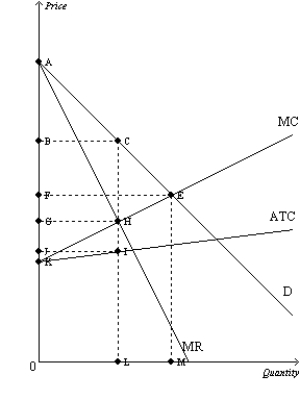
-Refer to Figure 16-11. Which letter represents the profit-maximizing price?
-Refer to Figure 16-11. Which letter represents the profit-maximizing price? (Short Answer)
4.9/5 (78)
(78) The government may not be able to improve the inefficiencies of a monopolistically competitive market.
(True/False)
4.9/5 (81)
(81) Why does a typical monopolistically competitive firm face a downward-sloping demand curve?
(Essay)
4.9/5 (77)
(77) In the long run, a monopolistically competitive firm produces at efficient scale.
(True/False)
4.8/5 (85)
(85) Figure 16-4
Graph (a)
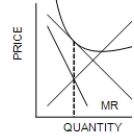 Graph (b)
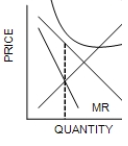 Graph (c)
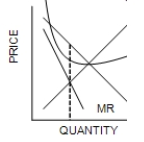 Graph (d)
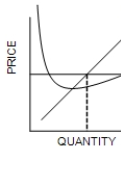
-Refer to Figure 16-4. Which of the graphs depicts a short-run equilibrium that will encourage the entry of other firms into this monopolistically competitive industry?
Graph (b)
Graph (c)
Graph (d)
-Refer to Figure 16-4. Which of the graphs depicts a short-run equilibrium that will encourage the entry of other firms into this monopolistically competitive industry? (Multiple Choice)
4.8/5 (78)
(78) A firm in a monopolistically competitive market can earn both short-run and long-run profits.
(True/False)
4.9/5 (87)
(87) A firm in a monopolistically competitive market can earn short-run profits but not long-run profits.
(True/False)
4.8/5 (80)
(80) Consider two industries in which firms hold the following market shares:
Industry A: 25%, 20%, 18%, 15%, 8%, 7%, 4%, 2%, 1%
Industry B: 30%, 10%, 9%, 8%, 8%, 8%, 8%, 6%, 6%, 5%, 2%
What are the concentration ratios for each industry? Which is more competitive?
(Short Answer)
4.8/5 (76)
(76) Figure 16-3  -Refer to Figure 16-3. Which of the following will occur in the long run in this industry?
 (Multiple Choice)
4.8/5 (80)
(80) Which market structure(s) is(are) considered highly concentrated?
(Short Answer)
4.8/5 (92)
(92) The business-stealing externality states that entry of a new firms imposes a cost on existing firms because they lose customers.
(True/False)
4.9/5 (82)
(82) Figure 16-8 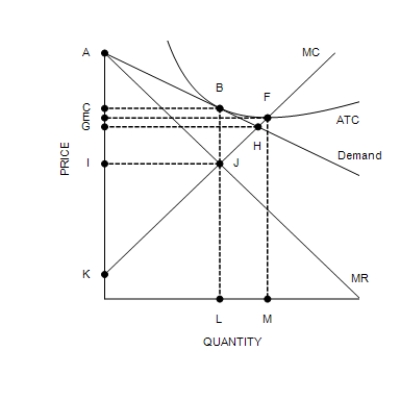
-Refer to Figure 16-8. If this firm were operating in a perfectly competitive market in the long run, it would charge a price equal to point
-Refer to Figure 16-8. If this firm were operating in a perfectly competitive market in the long run, it would charge a price equal to point (Multiple Choice)
5.0/5 (80)
(80) Evaluate the following statement: "Advertisements that use celebrity endorsements are devoid of any value and do not enhance the efficient functioning of markets."
(Essay)
4.9/5 (68)
(68) A law that restricts the ability of hotels/motels to advertise on billboards outside of a resort community would likely lead to
(Multiple Choice)
4.9/5 (90)
(90) Assume the role of a defender of advertising. Describe the characteristics of advertising that enhance the effectiveness of markets and increase the social welfare of society.
(Essay)
4.7/5 (72)
(72) Figure 16-10

-Refer to Figure 16-10. Compare the price and marginal cost in this market with price and marginal cost if this were a perfectly competitive market.
-Refer to Figure 16-10. Compare the price and marginal cost in this market with price and marginal cost if this were a perfectly competitive market. (Essay)
4.8/5 (67)
(67) 
Filters
- Essay(0)
- Multiple Choice(0)
- Short Answer(0)
- True False(0)
- Matching(0)