



 Chat with AI
Exam 16: Monopolistic Competition

Exam 1: Ten Principles of Economics220 Questions
Exam 2: Thinking Like an Economist284 Questions
Exam 3: Interdependence and the Gains From Trade192 Questions
Exam 4: The Market Forces of Supply and Demand277 Questions
Exam 5: Elasticity and Its Application222 Questions
Exam 6: Supply, Demand, and Government Policies321 Questions
Exam 7: Consumers, Producers, and the Efficiency of Markets218 Questions
Exam 8: Applications: The Costs of Taxation203 Questions
Exam 9: Application: International Trade214 Questions
Exam 10: Externalities204 Questions
Exam 11: Public Goods and Common Resources182 Questions
Exam 12: The Design of the Tax System225 Questions
Exam 13: The Costs of Production261 Questions
Exam 14: Firms in Competitive Markets243 Questions
Exam 15: Monopoly231 Questions
Exam 16: Monopolistic Competition246 Questions
Exam 17: Oligopoly204 Questions
Exam 18: The Markets for the Factors of Production232 Questions
Exam 19: Earnings and Discrimination230 Questions
Exam 20: Income Inequality and Poverty194 Questions
Exam 21: The Theory of Consumer Choice209 Questions
Exam 22: Frontiers in Microeconomics185 Questions
Exam 23: Measuring a Nations Income231 Questions
Exam 24: Measuring the Cost of Living214 Questions
Exam 25: Production and Growth187 Questions
Exam 26: Saving, Investment, and the Financial System225 Questions
Exam 27: Tools of Finance198 Questions
Exam 28: Unemployment and Its Natural Rate361 Questions
Exam 29: The Monetary System210 Questions
Exam 30: Money Growth and Inflation201 Questions
Exam 31: Open-Economy Macroeconomics: Basic Concepts194 Questions
Exam 32: A Macroeconomic Theory of the Open Economy188 Questions
Exam 33: Aggregate Demand and Aggregate Supply189 Questions
Exam 34: The Influence of Monetary and Fiscal Policy on Aggregate Demand207 Questions
Exam 35: The Short-Run Tradeoff Between Inflation and Unemployment223 Questions
Exam 36: Six Debates Over Macroeconomic Policy154 Questions
Select questions type


Figure 16-5
The figure is drawn for a monopolistically competitive firm.  -Refer to Figure 16-5. The firm's maximum profit is
 (Multiple Choice)
4.9/5  (92)
(92) Scenario 16-5
Burger Bonanza, a major national burger chain, recently decided to spend $4 million on an advertising campaign featuring a world famous actor to promote its new Bomber Burger.
-Refer to Scenario 16-5. What can consumers conclude from Burger Bonanza's willingness to spend $4 million on an advertising campaign?
(Short Answer)
4.9/5 (90)
(90) The market for wheat is most likely considered a monopolistically competitive market.
(True/False)
4.9/5 (77)
(77) Figure 16-10

-Refer to Figure 16-10. If this firm profit-maximizes, what price will it charge?
-Refer to Figure 16-10. If this firm profit-maximizes, what price will it charge? (Short Answer)
4.7/5 (65)
(65) Firms that sell highly differentiated consumer goods, such as over-the-counter drugs, soft drinks, breakfast cereals, and dog food, typically spend between 10 and 20 percent of revenue for
(Short Answer)
4.9/5 (74)
(74) Monopolistically competitive firms could reduce the average total cost of producing by increasing output; therefore, these firms have
(Short Answer)
4.9/5 (76)
(76) Scenario 16-5
Burger Bonanza, a major national burger chain, recently decided to spend $4 million on an advertising campaign featuring a world famous actor to promote its new Bomber Burger.
-Refer to Scenario 16-5. What two benefits are conveyed by the brand name Burger Bonanza?
(Essay)
4.8/5 (90)
(90) When advertising is used to relay information about price, each firm is able to enhance market power.
(True/False)
4.8/5 (72)
(72) A monopolistically competitive industry is characterized by
(Multiple Choice)
4.7/5 (75)
(75) For a profit-maximizing firm in a monopolistically competitive market, when price is equal to average total cost, price must lie above marginal cost.
(True/False)
4.8/5 (74)
(74) Scenario 16-4
Peter operates an ice cream shop in the center of Fairfield. He sells several unusual flavors of organic, homemade ice cream so he has a monopoly over his own ice cream, though he competes with many other firms selling ice cream in Fairfield for the same customers. Peter's demand and cost values for sales per day are given in the table below. (Everyone who purchases Peter's ice cream buys a double scoop cone because it's so delicious.)
Quantity Price MR MC ATC 20 \ 5.60 \ 5.20 \ 2.20 \ 2.05 40 \ 5.20 \ 4.40 \ 2.40 \ 2.10 60 \ 4.80 \ 3.60 \ 2.60 \ 2.15 80 \ 4.40 \ 2.80 \ 2.80 \ 2.20 100 \ 4.00 \ 2.00 \ 3.00 \ 2.25 120 \ 3.60 \ 1.20 \ 3.20 \ 2.30 140 \ 3.20 \ 0.40 \ 3.40 \ 2.35 160 \ 2.80 -\ 0.40 \ 3.60 \ 2.40 180 \ 2.40 -\ 1.20 \ 3.80 \ 2.45
-Refer to Scenario 16-4. What price should Peter charge to maximize his profits?
(Short Answer)
4.8/5 (82)
(82) Scenario 16-2
Delish, a moderately priced restaurant, has recently announced intentions to open a restaurant in Boston, MA. Assume that the restaurant market in Boston is characterized by monopolistic competition.
-Refer to Scenario 16-2. As a result of the new restaurant, existing restaurant owners in Boston are likely to experience a
(Multiple Choice)
4.8/5 (85)
(85) Excess capacity characterizes firms in monopolistically competitive markets, even in situations of long-run equilibrium.
(True/False)
4.9/5 (78)
(78) Scenario 16-3
Consider the problem facing two firms, YumYum and Bertollini, in the frozen food market. Each firm has just come up with an idea for a new "frozen meal for two" which it would sell for $9. Assume that the marginal cost for each new product is a constant $2, and the only fixed cost is for advertising. Each company knows that if it spends $12 million on advertising it will get 1.5 million consumers to try its new product. YumYum has done market research which suggests that its product does not have any "staying" power in the market. Even though it could get 1.5 million consumers to buy the product once, it is unlikely that they will continue to buy the product in the future. Bertollini's market research suggests that its product is very good, and consumers who try the product will continue to be consumers over the ensuing year. On the basis of its market research, Bertollini estimates that its initial 1.5 million customers will buy one unit of the product each month in the coming year, for a total of 18 million units.
-Refer to Scenario 16-3. On the basis of a theory that people buy a product because it is advertised, the content of advertisements for Bertollini's product
(Multiple Choice)
4.9/5 (96)
(96) Figure 16-11
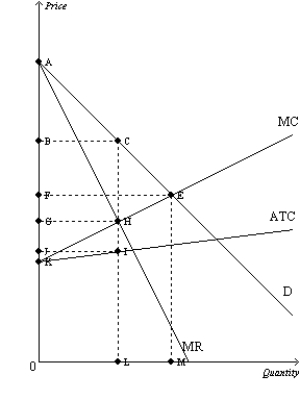
-Refer to Figure 16-11. Use the letters to identify the area of profit for this firm.
-Refer to Figure 16-11. Use the letters to identify the area of profit for this firm. (Short Answer)
4.9/5 (82)
(82) Suppose there is a market in which the firms hold the following market shares: 25%, 20%, 18%, 15%, 8%, 7%, 4%, 2%, 1%. What is the concentration ratio for this market?
(Short Answer)
4.8/5 (79)
(79) A similarity between monopoly and monopolistic competition is that in both market structures
(Multiple Choice)
4.9/5 (80)
(80) Figure 16-2
This figure depicts a situation in a monopolistically competitive market. 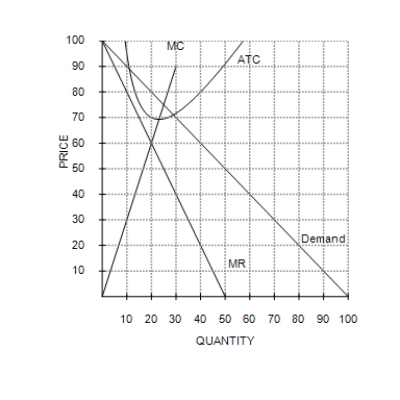 -Refer to Figure 16-2. How much profit will the monopolistically competitive firm earn in this situation?
 (Multiple Choice)
4.7/5 (89)
(89) Defenders of advertising argue that in some markets advertising may
(Multiple Choice)
4.8/5 (83)
(83) Scenario 16-6
Dean goes to the grocery store to buy chips and soda for a party. He purchases brand name products even though generic versions are available at lower prices. His friend John says he was irrational to spend more for a nearly identical product. His friend Martina agreed with Dean's decision to spend more for the brand name products.
-Refer to Scenario 16-6. Martina offers two reasons for agreeing with Dean's decision. What are they?
(Essay)
4.8/5 (87)
(87) 
Filters
- Essay(0)
- Multiple Choice(0)
- Short Answer(0)
- True False(0)
- Matching(0)