



 Chat with AI
Exam 16: Monopolistic Competition

Exam 1: Ten Principles of Economics220 Questions
Exam 2: Thinking Like an Economist284 Questions
Exam 3: Interdependence and the Gains From Trade192 Questions
Exam 4: The Market Forces of Supply and Demand277 Questions
Exam 5: Elasticity and Its Application222 Questions
Exam 6: Supply, Demand, and Government Policies321 Questions
Exam 7: Consumers, Producers, and the Efficiency of Markets218 Questions
Exam 8: Applications: The Costs of Taxation203 Questions
Exam 9: Application: International Trade214 Questions
Exam 10: Externalities204 Questions
Exam 11: Public Goods and Common Resources182 Questions
Exam 12: The Design of the Tax System225 Questions
Exam 13: The Costs of Production261 Questions
Exam 14: Firms in Competitive Markets243 Questions
Exam 15: Monopoly231 Questions
Exam 16: Monopolistic Competition246 Questions
Exam 17: Oligopoly204 Questions
Exam 18: The Markets for the Factors of Production232 Questions
Exam 19: Earnings and Discrimination230 Questions
Exam 20: Income Inequality and Poverty194 Questions
Exam 21: The Theory of Consumer Choice209 Questions
Exam 22: Frontiers in Microeconomics185 Questions
Exam 23: Measuring a Nations Income231 Questions
Exam 24: Measuring the Cost of Living214 Questions
Exam 25: Production and Growth187 Questions
Exam 26: Saving, Investment, and the Financial System225 Questions
Exam 27: Tools of Finance198 Questions
Exam 28: Unemployment and Its Natural Rate361 Questions
Exam 29: The Monetary System210 Questions
Exam 30: Money Growth and Inflation201 Questions
Exam 31: Open-Economy Macroeconomics: Basic Concepts194 Questions
Exam 32: A Macroeconomic Theory of the Open Economy188 Questions
Exam 33: Aggregate Demand and Aggregate Supply189 Questions
Exam 34: The Influence of Monetary and Fiscal Policy on Aggregate Demand207 Questions
Exam 35: The Short-Run Tradeoff Between Inflation and Unemployment223 Questions
Exam 36: Six Debates Over Macroeconomic Policy154 Questions
Select questions type


The Mikati Philippines Hard Rock Cafe has the exact same menu as the Hard Rock Cafe in New York. This is an example of a brand name enhancing market efficiency for U.S. tourists visiting the Philippines.
(True/False)
4.7/5  (93)
(93) A profit-maximizing firm in a monopolistically competitive market can earn positive, negative, or zero profits in the short run.
(True/False)
4.7/5 (84)
(84) Scenario 16-6
Dean goes to the grocery store to buy chips and soda for a party. He purchases brand name products even though generic versions are available at lower prices. His friend John says he was irrational to spend more for a nearly identical product. His friend Martina agreed with Dean's decision to spend more for the brand name products.
-Refer to Scenario 16-6. If Dean bought the brand name because of advertising he saw for the product, a defender of advertising would say
(Essay)
4.9/5 (91)
(91) The market structure in which each firm has a monopoly over the product it makes, but many other firms make similar products that compete for the same customers is called
(Short Answer)
4.8/5 (76)
(76) In a long-run equilibrium, firms in both perfectly competitive markets and monopolistically competitive markets produce a quantity below the efficient scale of production.
(True/False)
4.7/5 (67)
(67) Considering perfect competition, monopolistic competition, and monopoly, which of the market structures results in production of the welfare-maximizing level of output?
(Short Answer)
4.7/5 (82)
(82) Professional organizations (for example, the American Medical Association and the American Bar Association) have been active advocates for regulation to restrict the right of professionals to advertise. Describe what economic incentives might exist for existing professionals to restrict advertising.
(Essay)
4.8/5 (72)
(72) Figure 16-2
This figure depicts a situation in a monopolistically competitive market. 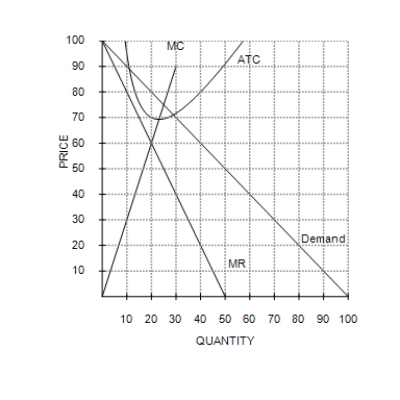 -Refer to Figure 16-2. How much consumer surplus will be derived from the purchase of this product at the monopolistically competitive price?
 (Multiple Choice)
4.9/5 (88)
(88) In the long run, a monopolistically competitive firm's demand curve becomes more elastic and shifts to the left
(True/False)
5.0/5 (76)
(76) Figure 16-11
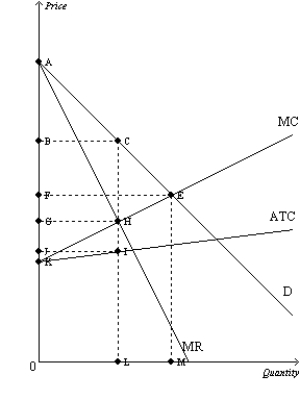
-Refer to Figure 16-11. Use the letters to identify the area of total cost for this firm.
-Refer to Figure 16-11. Use the letters to identify the area of total cost for this firm. (Short Answer)
4.8/5 (86)
(86) The "monopoly" in monopolistically competitive markets is most likely a result of firms having some pricing power due to product differentiation.
(True/False)
4.8/5 (95)
(95) When a new firm considers entering a market, it takes into account only the profit it would make. What are the two external effects that occur in the market that the firm does not consider?
(Essay)
4.8/5 (99)
(99) Scenario 16-3
Consider the problem facing two firms, YumYum and Bertollini, in the frozen food market. Each firm has just come up with an idea for a new "frozen meal for two" which it would sell for $9. Assume that the marginal cost for each new product is a constant $2, and the only fixed cost is for advertising. Each company knows that if it spends $12 million on advertising it will get 1.5 million consumers to try its new product. YumYum has done market research which suggests that its product does not have any "staying" power in the market. Even though it could get 1.5 million consumers to buy the product once, it is unlikely that they will continue to buy the product in the future. Bertollini's market research suggests that its product is very good, and consumers who try the product will continue to be consumers over the ensuing year. On the basis of its market research, Bertollini estimates that its initial 1.5 million customers will buy one unit of the product each month in the coming year, for a total of 18 million units.
-Refer to Scenario 16-3. If YumYum decides to advertise its product it can expect to
(Multiple Choice)
5.0/5 (89)
(89) Empirical evidence suggests that advertising usually leads to an increase in the price for advertised products.
(True/False)
4.9/5 (84)
(84) Due to free entry and exit in monopolistic competition, in the long run price must be equal to
(Short Answer)
5.0/5 (75)
(75) Figure 16-6
The figure is drawn for a monopolistically competitive firm. 
-Refer to Figure 16-6. In response to the situation represented by the figure, we would expect
-Refer to Figure 16-6. In response to the situation represented by the figure, we would expect (Multiple Choice)
4.8/5 (76)
(76) Figure 16-6
The figure is drawn for a monopolistically competitive firm.
-Refer to Figure 16-6. If the firm is maximizing profit, the firm is in
-Refer to Figure 16-6. If the firm is maximizing profit, the firm is in (Multiple Choice)
4.9/5 (86)
(86) Table 16-5
A monopolistically competitive firm faces the following demand schedule for its product. In addition, the firm has total fixed costs equal to 20.
Price Quantity \ 30 1 \ 26 2 \ 22 3 \ 18 4 \ 14 5 \ 10 6 \ 6 7
-Refer to Table 16-5. If this firm has a constant marginal cost of $7, what is the profit-maximizing level of output?
(Short Answer)
4.9/5 (64)
(64) Figure 16-9
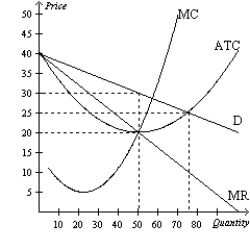
-Refer to Figure 16-9. If this firm profit-maximizes, how much profit or loss will it earn?
-Refer to Figure 16-9. If this firm profit-maximizes, how much profit or loss will it earn? (Short Answer)
4.7/5 (80)
(80) 
Filters
- Essay(0)
- Multiple Choice(0)
- Short Answer(0)
- True False(0)
- Matching(0)