



 Chat with AI
Exam 16: Monopolistic Competition

Exam 1: Ten Principles of Economics220 Questions
Exam 2: Thinking Like an Economist284 Questions
Exam 3: Interdependence and the Gains From Trade192 Questions
Exam 4: The Market Forces of Supply and Demand277 Questions
Exam 5: Elasticity and Its Application222 Questions
Exam 6: Supply, Demand, and Government Policies321 Questions
Exam 7: Consumers, Producers, and the Efficiency of Markets218 Questions
Exam 8: Applications: The Costs of Taxation203 Questions
Exam 9: Application: International Trade214 Questions
Exam 10: Externalities204 Questions
Exam 11: Public Goods and Common Resources182 Questions
Exam 12: The Design of the Tax System225 Questions
Exam 13: The Costs of Production261 Questions
Exam 14: Firms in Competitive Markets243 Questions
Exam 15: Monopoly231 Questions
Exam 16: Monopolistic Competition246 Questions
Exam 17: Oligopoly204 Questions
Exam 18: The Markets for the Factors of Production232 Questions
Exam 19: Earnings and Discrimination230 Questions
Exam 20: Income Inequality and Poverty194 Questions
Exam 21: The Theory of Consumer Choice209 Questions
Exam 22: Frontiers in Microeconomics185 Questions
Exam 23: Measuring a Nations Income231 Questions
Exam 24: Measuring the Cost of Living214 Questions
Exam 25: Production and Growth187 Questions
Exam 26: Saving, Investment, and the Financial System225 Questions
Exam 27: Tools of Finance198 Questions
Exam 28: Unemployment and Its Natural Rate361 Questions
Exam 29: The Monetary System210 Questions
Exam 30: Money Growth and Inflation201 Questions
Exam 31: Open-Economy Macroeconomics: Basic Concepts194 Questions
Exam 32: A Macroeconomic Theory of the Open Economy188 Questions
Exam 33: Aggregate Demand and Aggregate Supply189 Questions
Exam 34: The Influence of Monetary and Fiscal Policy on Aggregate Demand207 Questions
Exam 35: The Short-Run Tradeoff Between Inflation and Unemployment223 Questions
Exam 36: Six Debates Over Macroeconomic Policy154 Questions
Select questions type


The government of Italy will not allow any Hard Rock Cafe restaurants to open in Italy. Defenders of the efficiency of brand-name markets would argue that this has hindered restaurant market efficiency in Italy.
(True/False)
4.7/5  (80)
(80) Which of the following is not a key feature of monopolistic competition?
(Multiple Choice)
4.8/5 (74)
(74) A market structure with only a few sellers, each offering similar or identical products, is known as
(Multiple Choice)
5.0/5 (76)
(76) Table 16-4
Beatrice's Birthday Cakes operates in a monopolistically competitive market, so it is one bakery among many in the market for birthday cakes. The following table presents cost and revenue data for birthday cakes at Beatrice's.

-Refer to Table 16-4. If the government required Beatrice's to produce at the efficient scale of output, how many cakes would Beatrice's sell?
-Refer to Table 16-4. If the government required Beatrice's to produce at the efficient scale of output, how many cakes would Beatrice's sell? (Multiple Choice)
4.8/5 (75)
(75) The debate over whether advertising serves a valuable purpose in society is definitively answered by economists who study the tastes and preferences of individuals.
(True/False)
4.9/5 (70)
(70) A firm in a monopolistically competitive market is usually indifferent to an additional customer walking through the door, since a sale to that customer will not increase the firm's profit.
(True/False)
4.8/5 (82)
(82) Figure 16-11
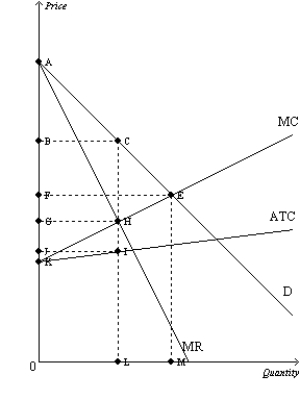
-Refer to Figure 16-11. Which letter represents the profit-maximizing quantity?
-Refer to Figure 16-11. Which letter represents the profit-maximizing quantity? (Short Answer)
4.8/5 (76)
(76) The term excess capacity refers to the fact that a firm operates on the upward-sloping portion of its average-total-cost curve.
(True/False)
4.9/5 (88)
(88) Considering perfect competition, monopolistic competition, and monopoly, which of the market structures can have positive profits in the short run?
(Essay)
4.9/5 (67)
(67) The "competition" in monopolistically competitive markets is most likely a result of having many sellers in the market.
(True/False)
4.9/5 (86)
(86) Scenario 16-6
Dean goes to the grocery store to buy chips and soda for a party. He purchases brand name products even though generic versions are available at lower prices. His friend John says he was irrational to spend more for a nearly identical product. His friend Martina agreed with Dean's decision to spend more for the brand name products.
-Refer to Scenario 16-6. If advertising were banned in these markets, what would likely happen to the prices of chips and soda?
(Short Answer)
4.9/5 (77)
(77) A monopolistically competitive market is characterized by barriers to entry.
(True/False)
4.8/5 (75)
(75) Which of the following is true about a monopolistically competitive firm?
(Multiple Choice)
4.8/5 (76)
(76) Product differentiation in monopolistically competitive markets ensures that, for profit-maximizing firms,
(Multiple Choice)
4.7/5 (67)
(67) In the long run, monopolistically competitive firms produce where demand equals marginal cost.
(True/False)
4.9/5 (76)
(76) Scenario 16-3
Consider the problem facing two firms, YumYum and Bertollini, in the frozen food market. Each firm has just come up with an idea for a new "frozen meal for two" which it would sell for $9. Assume that the marginal cost for each new product is a constant $2, and the only fixed cost is for advertising. Each company knows that if it spends $12 million on advertising it will get 1.5 million consumers to try its new product. YumYum has done market research which suggests that its product does not have any "staying" power in the market. Even though it could get 1.5 million consumers to buy the product once, it is unlikely that they will continue to buy the product in the future. Bertollini's market research suggests that its product is very good, and consumers who try the product will continue to be consumers over the ensuing year. On the basis of its market research, Bertollini estimates that its initial 1.5 million customers will buy one unit of the product each month in the coming year, for a total of 18 million units.
-Refer to Scenario 16-3. By its willingness to spend money on advertising, Bertollini
(Multiple Choice)
4.8/5 (95)
(95) Scenario 16-1
Venya operates an ice cream shop in the center of Fairfield. He sells several unusual flavors of organic, homemade ice cream so he has a monopoly over his own ice cream, though he competes with many other firms selling ice cream in Fairfield for the same customers. Venya's demand and cost values for sales per day are given in the following table. (Everyone who purchases Venya's ice cream buys a double scoop cone because it's so delicious.)
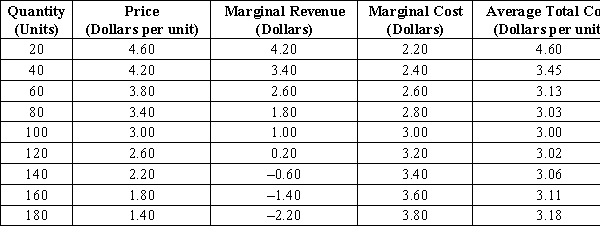
-Refer to Scenario 16-1. What price should Venya charge per double scoop ice cream cone to maximize his profit?
-Refer to Scenario 16-1. What price should Venya charge per double scoop ice cream cone to maximize his profit? (Multiple Choice)
4.9/5 (70)
(70) List five goods that are likely sold in a monopolistically competitive market.
(Essay)
4.9/5 (74)
(74) 
Filters
- Essay(0)
- Multiple Choice(0)
- Short Answer(0)
- True False(0)
- Matching(0)