



 Chat with AI
Exam 16: Monopolistic Competition

Exam 1: Ten Principles of Economics220 Questions
Exam 2: Thinking Like an Economist284 Questions
Exam 3: Interdependence and the Gains From Trade192 Questions
Exam 4: The Market Forces of Supply and Demand277 Questions
Exam 5: Elasticity and Its Application222 Questions
Exam 6: Supply, Demand, and Government Policies321 Questions
Exam 7: Consumers, Producers, and the Efficiency of Markets218 Questions
Exam 8: Applications: The Costs of Taxation203 Questions
Exam 9: Application: International Trade214 Questions
Exam 10: Externalities204 Questions
Exam 11: Public Goods and Common Resources182 Questions
Exam 12: The Design of the Tax System225 Questions
Exam 13: The Costs of Production261 Questions
Exam 14: Firms in Competitive Markets243 Questions
Exam 15: Monopoly231 Questions
Exam 16: Monopolistic Competition246 Questions
Exam 17: Oligopoly204 Questions
Exam 18: The Markets for the Factors of Production232 Questions
Exam 19: Earnings and Discrimination230 Questions
Exam 20: Income Inequality and Poverty194 Questions
Exam 21: The Theory of Consumer Choice209 Questions
Exam 22: Frontiers in Microeconomics185 Questions
Exam 23: Measuring a Nations Income231 Questions
Exam 24: Measuring the Cost of Living214 Questions
Exam 25: Production and Growth187 Questions
Exam 26: Saving, Investment, and the Financial System225 Questions
Exam 27: Tools of Finance198 Questions
Exam 28: Unemployment and Its Natural Rate361 Questions
Exam 29: The Monetary System210 Questions
Exam 30: Money Growth and Inflation201 Questions
Exam 31: Open-Economy Macroeconomics: Basic Concepts194 Questions
Exam 32: A Macroeconomic Theory of the Open Economy188 Questions
Exam 33: Aggregate Demand and Aggregate Supply189 Questions
Exam 34: The Influence of Monetary and Fiscal Policy on Aggregate Demand207 Questions
Exam 35: The Short-Run Tradeoff Between Inflation and Unemployment223 Questions
Exam 36: Six Debates Over Macroeconomic Policy154 Questions
Select questions type


Professional organizations and producer groups have an incentive to
(Multiple Choice)
4.9/5  (78)
(78) There is general disagreement among economists about the role of advertising, but there is widespread agreement about the role of brand names on market efficiency.
(True/False)
4.8/5 (63)
(63) Figure 16-5
The figure is drawn for a monopolistically competitive firm.  -Refer to Figure 16-5. As the figure is drawn, the firm is in
 (Multiple Choice)
4.8/5 (70)
(70) When a firm operates with excess capacity, it must be in a monopolistically competitive market.
(True/False)
4.8/5 (64)
(64) If advertising decreases the elasticity of demand for specific brand names of hard liquor, we would expect firms to be able to charge a larger markup over marginal cost.
(True/False)
5.0/5 (81)
(81) A profit-maximizing firm in a monopolistically competitive market charges a price equal to marginal cost.
(True/False)
4.8/5 (73)
(73) Figure 16-2
This figure depicts a situation in a monopolistically competitive market. 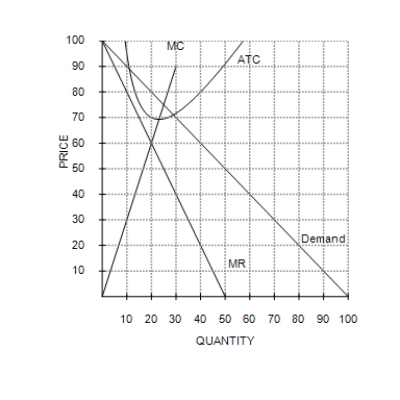 -Refer to Figure 16-2. What price will the monopolistically competitive firm charge in this market?
 (Multiple Choice)
4.8/5 (77)
(77) Economists measure a market's domination by a small number of firms with a statistic called the
(Short Answer)
4.8/5 (92)
(92) In the short run, a firm in a monopolistically competitive market operates much like a
(Multiple Choice)
4.7/5 (74)
(74) Table 16-1
The following table shows the output produced by each of the top eight firms in four industries as well as the total industry output for those industries.
Firm Industry A Industry B Industry C Industry D 1 50,000 18,000 37,000 40,000 2 47,000 17,750 36,500 39,000 3 43,000 17,250 35,500 37,000 4 38,000 16,500 34,000 34,000 5 32,000 15,500 32,000 30,000 6 25,000 14,250 29,500 25,000 7 17,000 12,750 26,500 19,000 8 8,000 11,000 23,000 12,000 Total
-Refer to Table 16-1. Based on the concentration ratio, which industry is the most competitive?
(Multiple Choice)
4.7/5 (75)
(75) Figure 16-11
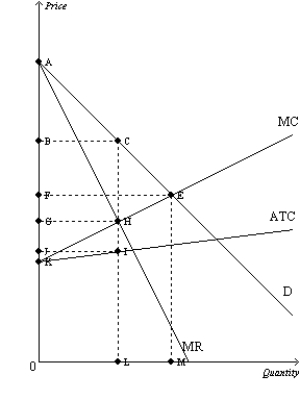
-Refer to Figure 16-11. Use the letters to identify the deadweight loss associated with this firm's profit-maximizing production.
-Refer to Figure 16-11. Use the letters to identify the deadweight loss associated with this firm's profit-maximizing production. (Short Answer)
4.9/5 (77)
(77) Figure 16-5
The figure is drawn for a monopolistically competitive firm.
-Refer to Figure 16-5. Efficient scale is reached
-Refer to Figure 16-5. Efficient scale is reached (Multiple Choice)
4.8/5 (82)
(82) Figure 16-1
Graph (a)
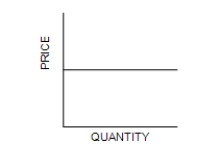 Graph (b)
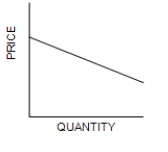 Graph (c)
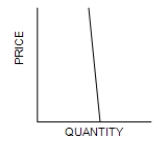
-Refer to Figure 16-1. Which of the graphs illustrates the demand curve most likely faced by a firm in a monopolistically competitive market?
Graph (b)
Graph (c)
-Refer to Figure 16-1. Which of the graphs illustrates the demand curve most likely faced by a firm in a monopolistically competitive market? (Multiple Choice)
4.7/5 (71)
(71) The product-variety externality and the business-stealing externality are both spillover costs of new firms entering a monopolistically competitive market.
(True/False)
4.8/5 (82)
(82) Figure 16-12
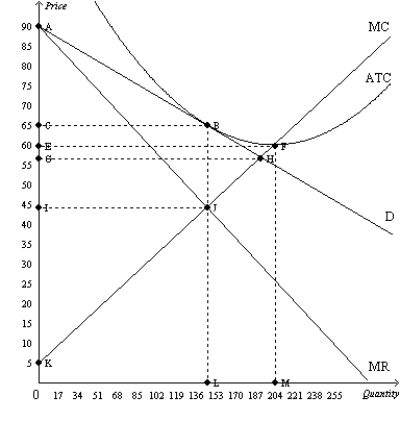
-Refer to Figure 16-12. Which letter identifies the profit-maximizing level of output for this firm?
-Refer to Figure 16-12. Which letter identifies the profit-maximizing level of output for this firm? (Short Answer)
4.8/5 (79)
(79) Use a graph to demonstrate why a profit-maximizing monopolistically competitive firm must operate at excess capacity. Explain why a perfectly competitive firm is not subject to the same constraint.
(Short Answer)
4.9/5 (76)
(76) In monopolistically competitive markets, positive economic profits
(Multiple Choice)
4.9/5 (75)
(75) According to one theory, advertising sends a signal to consumers about the quality of the product being offered. An implication of this theory is that
(Multiple Choice)
4.9/5 (75)
(75) Figure 16-10

-Refer to Figure 16-10. If this firm profit-maximizes, how much output will it produce?
-Refer to Figure 16-10. If this firm profit-maximizes, how much output will it produce? (Short Answer)
4.8/5 (72)
(72) 
Filters
- Essay(0)
- Multiple Choice(0)
- Short Answer(0)
- True False(0)
- Matching(0)