



 Chat with AI
Exam 15: Monetary Policy

Exam 1: What Economics Is About174 Questions
Exam 2: Production Possibilities Frontier Framework156 Questions
Exam 3: Supply and Demand Theory224 Questions
Exam 4: Prices Free Controlled and Relative122 Questions
Exam 5: Supply Demand and Price Applications76 Questions
Exam 6: Macroeconomic Measurements Part I Prices and Unemployment151 Questions
Exam 7: Macroeconomic Measurements Part II Gdp and Real Gdp150 Questions
Exam 8: Aggregate Demand and Aggregate Supply204 Questions
Exam 9: Classical Macroeconomics and the Self Regulating Economy172 Questions
Exam 10: Keynesian Macroeconomics and Economic Instability a Critique of the Self Regulating Economy200 Questions
Exam 11: Fiscal Policy and the Federal Budget167 Questions
Exam 12: Money Banking and the Financial System150 Questions
Exam 13: The Federal Reserve System180 Questions
Exam 14: Money and the Economy150 Questions
Exam 15: Monetary Policy185 Questions
Exam 16: Expectations Theory and the Economy150 Questions
Exam 17: Economic Growth Resources Technology Ideas and Institutions103 Questions
Exam 18: Debates in Macroeconomics Over the Role and Effects of Government100 Questions
Exam 19: Elasticity204 Questions
Exam 20: Consumer Choice and Behavioral Economics179 Questions
Exam 21: Production and Costs245 Questions
Exam 22: Perfect Competition187 Questions
Exam 23: Monopoly195 Questions
Exam 24: Monopolistic Competition Oligopoly and Game Theory172 Questions
Exam 25: Government and Product Markets Antitrust and Regulation158 Questions
Exam 26: Factor Markets With Emphasis on the Labor Market184 Questions
Exam 27: Wages Unions and Labor138 Questions
Exam 28: The Distribution of Income and Poverty99 Questions
Exam 29: Interest Rent and Profit198 Questions
Exam 30: Market Failure Externalities Public Goods and Asymmetric Information187 Questions
Exam 31: Public Choice and Special Interest Group Politics135 Questions
Exam 32: Building Theories to Explain Everyday Life From Observations to Questions to Theories to Predictions62 Questions
Exam 33: International Trade152 Questions
Exam 34: International Finance122 Questions
Exam 35: The Economic Case for and Against Government Five Topics Considered87 Questions
Exam 36: Stocks Bonds Futures and Options110 Questions
Select questions type


Exhibit 15-1
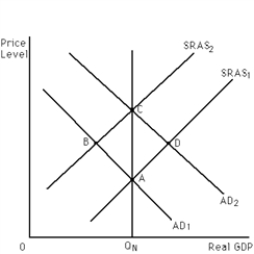 -Refer to Exhibit 15-l. A monetarist would claim that in a recessionary gap, the economy would move on its own from point
 (Multiple Choice)
4.8/5  (73)
(73) According to the Taylor Rule: if the inflation rate is 2% and the GDP gap is 3%, what does the federal funds rate target equal?
(Multiple Choice)
4.9/5 (79)
(79) Assume the Keynesian transmission mechanism is operational and the economy is currently operating in the horizontal portion of the AS curve. If the money supply increases and the demand for money curve is downward sloping and investment is interest ____________, then Real GDP will ___________________.
(Multiple Choice)
4.8/5 (86)
(86) According to the Keynesian transmission mechanism, an increase in the money supply will __________ the interest rate, causing a __________ in investment, which then __________ Real GDP.
(Multiple Choice)
5.0/5 (83)
(83) Suppose that the bond market and the money market both start out in equilibrium, then the Federal Reserve increases the money supply. The result will be a ______________ in the money market and a _________________ in the bond market, which will push bond prices _________________ and interest rates will ___________________ until a new equilibrium is reached.
(Multiple Choice)
4.9/5 (74)
(74) Exhibit 15-1
-Refer to Exhibit 15-1. Keynesians are often accused of having an "inflationary bias." This is due at least in part to their advocacy of expansionary monetary policy when they believe it is needed to take the economy from point
-Refer to Exhibit 15-1. Keynesians are often accused of having an "inflationary bias." This is due at least in part to their advocacy of expansionary monetary policy when they believe it is needed to take the economy from point (Multiple Choice)
4.8/5 (74)
(74) Which of the following might break the link in the Keynesian transmission mechanism between the expansionary monetary policy and the goods-and-services market?
(Multiple Choice)
4.9/5 (70)
(70) To eliminate a recessionary gap the Fed typically uses __________ monetary policy, and to eliminate an inflationary gap the Fed typically uses __________ monetary policy.
(Multiple Choice)
4.7/5 (79)
(79) Suppose a constant-money-growth-rate rule of 3 percent is being considered. If it is estimated that average annual Real GDP growth is 3.5 percent and it turns out that velocity is rising by 2 percent a year on average, the rule would produce an average annual rate of inflation of __________ percent.
(Multiple Choice)
4.9/5 (80)
(80) If a liquidity trap exists, people are likely to be thinking that
(Multiple Choice)
4.7/5 (77)
(77) A decrease in the money supply will shift the aggregate __________ curve to the __________.
(Multiple Choice)
4.8/5 (90)
(90) As the interest rate __________, the opportunity cost of holding money __________ and individuals choose to hold __________ money.
(Multiple Choice)
4.9/5 (86)
(86) The Keynesian link between the money market and the goods and services market is __________. Changes in the money market must affect the __________ market before the goods and services market is affected.
(Multiple Choice)
4.8/5 (76)
(76) Compared to the Keynesian transmission mechanism, the monetarist transmission mechanism is
(Multiple Choice)
4.7/5 (82)
(82) In the Keynesian transmission mechanism, if the money market is in the liquidity trap, an increase in the money supply will
(Multiple Choice)
4.8/5 (88)
(88) Investment spending is insensitive to changes in the interest rate and the SRAS curve is upward sloping. According to a monetarist, an increase in the money supply will __________ Real GDP. According to a Keynesian, an increase in the money supply will __________ Real GDP.
(Multiple Choice)
4.9/5 (67)
(67) If market interest rates increase, the prices of existing bonds will
(Multiple Choice)
4.8/5 (84)
(84) If Real GDP increases at an annual rate of 4 percent and velocity increases at a rate of 1 percent per year, then rules-based monetary policy advocates who wish to maintain a stable price level would set the annual money supply growth rate at
(Multiple Choice)
4.9/5 (79)
(79) 
Filters
- Essay(0)
- Multiple Choice(0)
- Short Answer(0)
- True False(0)
- Matching(0)