



 Chat with AI
Exam 15: Monetary Policy

Exam 1: What Economics Is About174 Questions
Exam 2: Production Possibilities Frontier Framework156 Questions
Exam 3: Supply and Demand Theory224 Questions
Exam 4: Prices Free Controlled and Relative122 Questions
Exam 5: Supply Demand and Price Applications76 Questions
Exam 6: Macroeconomic Measurements Part I Prices and Unemployment151 Questions
Exam 7: Macroeconomic Measurements Part II Gdp and Real Gdp150 Questions
Exam 8: Aggregate Demand and Aggregate Supply204 Questions
Exam 9: Classical Macroeconomics and the Self Regulating Economy172 Questions
Exam 10: Keynesian Macroeconomics and Economic Instability a Critique of the Self Regulating Economy200 Questions
Exam 11: Fiscal Policy and the Federal Budget167 Questions
Exam 12: Money Banking and the Financial System150 Questions
Exam 13: The Federal Reserve System180 Questions
Exam 14: Money and the Economy150 Questions
Exam 15: Monetary Policy185 Questions
Exam 16: Expectations Theory and the Economy150 Questions
Exam 17: Economic Growth Resources Technology Ideas and Institutions103 Questions
Exam 18: Debates in Macroeconomics Over the Role and Effects of Government100 Questions
Exam 19: Elasticity204 Questions
Exam 20: Consumer Choice and Behavioral Economics179 Questions
Exam 21: Production and Costs245 Questions
Exam 22: Perfect Competition187 Questions
Exam 23: Monopoly195 Questions
Exam 24: Monopolistic Competition Oligopoly and Game Theory172 Questions
Exam 25: Government and Product Markets Antitrust and Regulation158 Questions
Exam 26: Factor Markets With Emphasis on the Labor Market184 Questions
Exam 27: Wages Unions and Labor138 Questions
Exam 28: The Distribution of Income and Poverty99 Questions
Exam 29: Interest Rent and Profit198 Questions
Exam 30: Market Failure Externalities Public Goods and Asymmetric Information187 Questions
Exam 31: Public Choice and Special Interest Group Politics135 Questions
Exam 32: Building Theories to Explain Everyday Life From Observations to Questions to Theories to Predictions62 Questions
Exam 33: International Trade152 Questions
Exam 34: International Finance122 Questions
Exam 35: The Economic Case for and Against Government Five Topics Considered87 Questions
Exam 36: Stocks Bonds Futures and Options110 Questions
Select questions type


According to the monetarist transmission mechanism, a decrease in the money supply __________ aggregate demand.
(Multiple Choice)
4.9/5  (97)
(97) The money supply decreased and the AD curve shifted to the left. This is consistent with the
(Multiple Choice)
4.8/5 (86)
(86) Exhibit 15-6
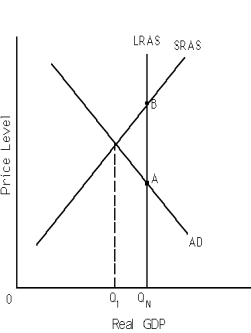 -Refer to Exhibit 15-6. Assume that the economy starts out producing Q1. An economist who believes that the economy is not self-regulating would assert that the government should use _________________ fiscal policy to close the existing ___________________ gap.
 (Multiple Choice)
4.9/5 (76)
(76) According to Keynesians, __________ monetary policy will not remove the economy from a(an) __________ gap if __________.
(Multiple Choice)
4.8/5 (77)
(77) Exhibit 15-5
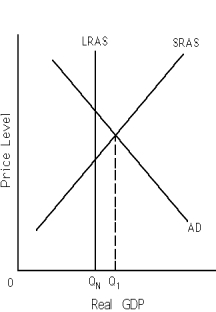 -Refer to Exhibit 15-5. Assume that the economy starts out in short-run equilibrium. An economist who believes that the economy is not self-regulating would assert that the government should use _________________ fiscal policy to close the existing ___________________ gap.
 (Multiple Choice)
5.0/5 (80)
(80) Economists who believe that the economy is self-regulating are more likely to be nonactivists than activists.
(True/False)
4.8/5 (79)
(79) The Taylor Rule specifies that the federal funds rate target should be equal to
(Multiple Choice)
4.7/5 (72)
(72) Which best describes the Keynesian transmission mechanism when the money supply increases?
(Multiple Choice)
5.0/5 (88)
(88) If people have only two ways of holding their wealth, money or bonds, a surplus in the money market implies a surplus in the bond market.
(True/False)
4.9/5 (72)
(72) The rules-based monetary policy reads: The money supply will increase 3 percent each year. If the average annual growth rate in Real GDP is 2 percent and velocity increases by 1 percent each year, it follows that
(Multiple Choice)
4.9/5 (98)
(98) The SRAS curve is upward sloping, there is a liquidity trap, and investment spending is sensitive to changes in the interest rate. According to the monetarist transmission mechanism, if the money supply increases the AD curve __________ and the price level __________.
(Multiple Choice)
4.8/5 (79)
(79) Compared to the Keynesian transmission mechanism, the monetarist transmission mechanism is
(Multiple Choice)
4.9/5 (81)
(81) An individual buys a bond for $1,000 and sells it one year later for $1,070. What is the annual interest rate return that this individual has received on this bond?
(Multiple Choice)
4.9/5 (89)
(89) In the liquidity trap, the demand curve for investment is horizontal.
(True/False)
4.9/5 (83)
(83) The economy is in the horizontal portion of the AS curve, investment spending is interest insensitive and there is no liquidity trap. According to the Keynesian transmission mechanism, if the money supply increases the interest rate will __________, investment spending will __________, the AD curve will __________, and Real GDP will __________.
(Multiple Choice)
4.9/5 (70)
(70) Describe the monetary policy known as inflation targeting. What are the three major issues that surround this practice?
(Essay)
4.8/5 (79)
(79) Assume that because of a long policy lag, the Fed starts implementing expansionary monetary policy too late, i.e., at a time when the economy is already healing itself. As a result, the economy will probably move from an initial
(Multiple Choice)
5.0/5 (82)
(82) 
Filters
- Essay(0)
- Multiple Choice(0)
- Short Answer(0)
- True False(0)
- Matching(0)