



 Chat with AI
Exam 15: Monetary Policy

Exam 1: What Economics Is About174 Questions
Exam 2: Production Possibilities Frontier Framework156 Questions
Exam 3: Supply and Demand Theory224 Questions
Exam 4: Prices Free Controlled and Relative122 Questions
Exam 5: Supply Demand and Price Applications76 Questions
Exam 6: Macroeconomic Measurements Part I Prices and Unemployment151 Questions
Exam 7: Macroeconomic Measurements Part II Gdp and Real Gdp150 Questions
Exam 8: Aggregate Demand and Aggregate Supply204 Questions
Exam 9: Classical Macroeconomics and the Self Regulating Economy172 Questions
Exam 10: Keynesian Macroeconomics and Economic Instability a Critique of the Self Regulating Economy200 Questions
Exam 11: Fiscal Policy and the Federal Budget167 Questions
Exam 12: Money Banking and the Financial System150 Questions
Exam 13: The Federal Reserve System180 Questions
Exam 14: Money and the Economy150 Questions
Exam 15: Monetary Policy185 Questions
Exam 16: Expectations Theory and the Economy150 Questions
Exam 17: Economic Growth Resources Technology Ideas and Institutions103 Questions
Exam 18: Debates in Macroeconomics Over the Role and Effects of Government100 Questions
Exam 19: Elasticity204 Questions
Exam 20: Consumer Choice and Behavioral Economics179 Questions
Exam 21: Production and Costs245 Questions
Exam 22: Perfect Competition187 Questions
Exam 23: Monopoly195 Questions
Exam 24: Monopolistic Competition Oligopoly and Game Theory172 Questions
Exam 25: Government and Product Markets Antitrust and Regulation158 Questions
Exam 26: Factor Markets With Emphasis on the Labor Market184 Questions
Exam 27: Wages Unions and Labor138 Questions
Exam 28: The Distribution of Income and Poverty99 Questions
Exam 29: Interest Rent and Profit198 Questions
Exam 30: Market Failure Externalities Public Goods and Asymmetric Information187 Questions
Exam 31: Public Choice and Special Interest Group Politics135 Questions
Exam 32: Building Theories to Explain Everyday Life From Observations to Questions to Theories to Predictions62 Questions
Exam 33: International Trade152 Questions
Exam 34: International Finance122 Questions
Exam 35: The Economic Case for and Against Government Five Topics Considered87 Questions
Exam 36: Stocks Bonds Futures and Options110 Questions
Select questions type


Suppose that the bond market and the money market both start out in equilibrium, then the Federal Reserve decreases the money supply. The result will be a ______________ in the money market and a _________________ in the bond market, which will push bond prices _________________ and interest rates will ___________________ until a new equilibrium is reached.
(Multiple Choice)
4.9/5  (78)
(78) Under a gold standard, if the market price of gold is below the official price of gold (set by the monetary authority), people will be more likely to sell gold __________________, which will cause the money supply to _______________ and the price level.to _______________.
(Multiple Choice)
4.7/5 (90)
(90) Exhibit 15-2
 -Refer to Exhibit 15-2. If the interest rate is i2 and the relevant money supply curve is S1, then there is a
 (Multiple Choice)
4.8/5 (83)
(83) Suppose the money market is in the liquidity trap and the Fed increases the supply of money. We expect that
(Multiple Choice)
5.0/5 (75)
(75) Assume the Keynesian transmission mechanism is operational and the economy is currently operating in the horizontal portion of the AS curve. If the money supply decreases and the demand for money curve is downward sloping and investment is interest-____________, then Real GDP will ___________________.
(Multiple Choice)
4.8/5 (77)
(77) Suppose that the bond market and the money market start out in equilibrium. Explain the process by which the interest rate and the price of bonds will change as a result of the Fed increasing the money supply.
(Essay)
4.8/5 (90)
(90) Under a gold standard, if the market price of gold is above the official price of gold (set by the monetary authority) members of the public would likely buy gold _______________ and sell it __________________, causing the market price of gold to ____________________.
(Multiple Choice)
4.8/5 (87)
(87) The rules-based monetary policy reads: The annual growth rate in the money supply will be equal to the average annual growth rate in Real GDP minus the growth rate in velocity. If the average growth rate in Real GDP this year is 3 percent and the growth rate in velocity is 2 percent, then the money supply will increase by ______________ percent this year.
(Multiple Choice)
4.9/5 (70)
(70) In the monetarist transmission mechanism, changes in the money market directly affect aggregate demand.
(True/False)
4.8/5 (79)
(79) Exhibit 15-4
 Assume that people have only two choices when it comes to holding their wealth: in money or in bonds.
-Refer to Exhibit 15-4. In the row of this table containing blank (C), people are holding ______________ of their wealth in bonds and ________________ of their wealth in money.
Assume that people have only two choices when it comes to holding their wealth: in money or in bonds.
-Refer to Exhibit 15-4. In the row of this table containing blank (C), people are holding ______________ of their wealth in bonds and ________________ of their wealth in money. (Multiple Choice)
4.9/5 (83)
(83) People should buy bonds when they think that interest rates are as high as they will go.
(True/False)
4.9/5 (71)
(71) Exhibit 15-1
 -Refer to Exhibit 15-l. A Keynesian would say that natural market forces work so slowly in a recessionary gap in taking the economy between point __________ that an activist monetary policy is called for.
 (Multiple Choice)
4.9/5 (87)
(87) The economy is in a recessionary gap and there is evidence that the economy is in a liquidity trap. In this situation, a Keynesian is likely to advocate the use of __________ policy.
(Multiple Choice)
4.8/5 (85)
(85) Exhibit 15-3
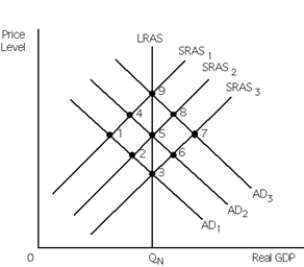 -Refer to Exhibit 15-3. The economy is currently at point 5. If contractionary monetary policy is implemented, and prices are flexible, the economy will likely move to point ______ in the short run.
 (Multiple Choice)
4.8/5 (86)
(86) According to the Keynesian transmission mechanism (and assuming there is no liquidity trap and investment is not interest insensitive), if the money supply increases, the interest rate __________, investment spending __________ and the AD curve shifts to the __________.
(Multiple Choice)
4.8/5 (76)
(76) The object of inflation targeting is for a country's central bank to try to keep the inflation rate near
(Multiple Choice)
4.7/5 (88)
(88) Suppose that one year ago you purchased a $1,000 bond with an interest payment of $40 per year and, at the time, the interest rate was 4 percent. One year later the interest rate on bonds has increased to 5 percent, and you still hold the bond you purchased a year ago. If you were to sell your bond now, the price that you could sell it for would be
(Multiple Choice)
5.0/5 (86)
(86) To try to eliminate a recessionary gap the Fed typically__________ the money supply, and to try to eliminate an inflationary gap the Fed typically __________ the money supply.
(Multiple Choice)
4.8/5 (76)
(76) 
Filters
- Essay(0)
- Multiple Choice(0)
- Short Answer(0)
- True False(0)
- Matching(0)