



 Chat with AI
Exam 2: Production Possibilities Frontier Framework

Exam 1: What Economics Is About174 Questions
Exam 2: Production Possibilities Frontier Framework156 Questions
Exam 3: Supply and Demand Theory224 Questions
Exam 4: Prices Free Controlled and Relative122 Questions
Exam 5: Supply Demand and Price Applications76 Questions
Exam 6: Macroeconomic Measurements Part I Prices and Unemployment151 Questions
Exam 7: Macroeconomic Measurements Part II Gdp and Real Gdp150 Questions
Exam 8: Aggregate Demand and Aggregate Supply204 Questions
Exam 9: Classical Macroeconomics and the Self Regulating Economy172 Questions
Exam 10: Keynesian Macroeconomics and Economic Instability a Critique of the Self Regulating Economy200 Questions
Exam 11: Fiscal Policy and the Federal Budget167 Questions
Exam 12: Money Banking and the Financial System150 Questions
Exam 13: The Federal Reserve System180 Questions
Exam 14: Money and the Economy150 Questions
Exam 15: Monetary Policy185 Questions
Exam 16: Expectations Theory and the Economy150 Questions
Exam 17: Economic Growth Resources Technology Ideas and Institutions103 Questions
Exam 18: Debates in Macroeconomics Over the Role and Effects of Government100 Questions
Exam 19: Elasticity204 Questions
Exam 20: Consumer Choice and Behavioral Economics179 Questions
Exam 21: Production and Costs245 Questions
Exam 22: Perfect Competition187 Questions
Exam 23: Monopoly195 Questions
Exam 24: Monopolistic Competition Oligopoly and Game Theory172 Questions
Exam 25: Government and Product Markets Antitrust and Regulation158 Questions
Exam 26: Factor Markets With Emphasis on the Labor Market184 Questions
Exam 27: Wages Unions and Labor138 Questions
Exam 28: The Distribution of Income and Poverty99 Questions
Exam 29: Interest Rent and Profit198 Questions
Exam 30: Market Failure Externalities Public Goods and Asymmetric Information187 Questions
Exam 31: Public Choice and Special Interest Group Politics135 Questions
Exam 32: Building Theories to Explain Everyday Life From Observations to Questions to Theories to Predictions62 Questions
Exam 33: International Trade152 Questions
Exam 34: International Finance122 Questions
Exam 35: The Economic Case for and Against Government Five Topics Considered87 Questions
Exam 36: Stocks Bonds Futures and Options110 Questions
Select questions type


Give a definition of an advance in technology. Suppose that you are drawing a PPF for civilian goods and military goods, describe the effect on the PPF of an advance in technology in both civilian goods and military goods. How would the impact on the PPF be different if the technological improvement only helped in the production of military goods, but not civilian goods?

Free
(Essay)
4.8/5  (74)
(74) Correct Answer: Verified
An advance in technology commonly refers to the ability to produce more output with a fixed amount of resources (or the same amount of output with a smaller amount of resources). When technology advances in the production of both products the PPF shifts outward. When technology advances in the production of military goods, but not civilian goods, the PPF shifts outward along the axis for military goods and the intercept remains constant along the axis for civilian goods.
Jose has one evening in which to prepare for two exams and can employ one of two possible strategies:  The opportunity cost of receiving a 92 on the statistics exam is __________ points on the economics exam.
Free
(Multiple Choice)
5.0/5 (80)
(80) Correct Answer:Verified
VerifiedC
An economy is productive efficient if it produces
Free
(Multiple Choice)
4.8/5 (90)
(90) Correct Answer:Verified
VerifiedC
Exhibit 2-5
 -Refer to Exhibit 2-5. Which of the following labeled points are productive efficient?
 (Multiple Choice)
4.9/5 (77)
(77) Exhibit 2-8
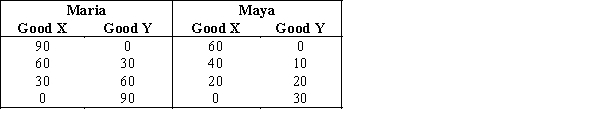 -Refer to Exhibit 2-8. For Maria, the opportunity cost of producing one unit of good Y is ___________ unit(s) of good X.
 (Multiple Choice)
4.9/5 (75)
(75) 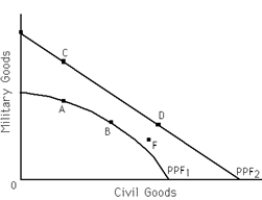 -Refer to Exhibit 2-7. Point F is
Exhibit 2-1
 -Refer to Exhibit 2-1. The opportunity cost of moving from point B to A is
 (Multiple Choice)
4.8/5 (76)
(76) Consider the following combinations of guns and butter that can be produced: 0 guns, 20,000 units of butter; 5,000 guns, 15,000 units of butter; 10,000 guns, 10,000 units of butter; 15,000 guns, 5,000 units of butter; 20,000 guns, 0 units of butter. The PPF between guns and butter is
(Multiple Choice)
5.0/5 (74)
(74) A decrease in unemployment causes the PPF to shift outward (to the right).
(True/False)
4.9/5 (75)
(75) If the law of increasing opportunity costs is operable, and currently the opportunity cost of producing the 101st unit of good X is 5Y, then the opportunity cost of producing the 201st unit of good is X is
(Multiple Choice)
4.9/5 (80)
(80) Exhibit 2-8
-Refer to Exhibit 2-8. If Maria and Maya each specialize in the good in which she has a comparative advantage and then engage in trade, ____________________ can consume a combination of goods that lies beyond her PPF.
-Refer to Exhibit 2-8. If Maria and Maya each specialize in the good in which she has a comparative advantage and then engage in trade, ____________________ can consume a combination of goods that lies beyond her PPF. (Multiple Choice)
4.7/5 (86)
(86) A decrease in the quantity of resources available causes a movement from one point on a given PPF to another point along the same PPF.
(True/False)
4.9/5 (82)
(82) If a production possibilities frontier (PPF) is concave outward, it follows that
(Multiple Choice)
4.8/5 (82)
(82) Which of the following is not true about production possibilities frontiers?
(Multiple Choice)
5.0/5 (78)
(78) Exhibit 2-9
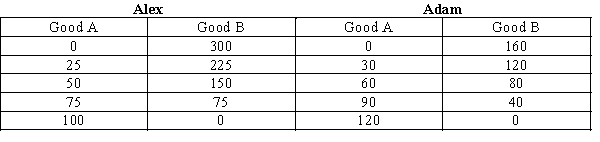 -Refer to Exhibit 2-9. If Alex and Adam each specialize in the good in which he has a comparative advantage and then engage in trade, ____________________ can consume a combination of goods that lies beyond their PPF.
 (Multiple Choice)
4.7/5 (93)
(93) 
Filters
- Essay(0)
- Multiple Choice(0)
- Short Answer(0)
- True False(0)
- Matching(0)