



 Chat with AI
Exam 23: Monopoly

Exam 1: What Economics Is About174 Questions
Exam 2: Production Possibilities Frontier Framework156 Questions
Exam 3: Supply and Demand Theory224 Questions
Exam 4: Prices Free Controlled and Relative122 Questions
Exam 5: Supply Demand and Price Applications76 Questions
Exam 6: Macroeconomic Measurements Part I Prices and Unemployment151 Questions
Exam 7: Macroeconomic Measurements Part II Gdp and Real Gdp150 Questions
Exam 8: Aggregate Demand and Aggregate Supply204 Questions
Exam 9: Classical Macroeconomics and the Self Regulating Economy172 Questions
Exam 10: Keynesian Macroeconomics and Economic Instability a Critique of the Self Regulating Economy200 Questions
Exam 11: Fiscal Policy and the Federal Budget167 Questions
Exam 12: Money Banking and the Financial System150 Questions
Exam 13: The Federal Reserve System180 Questions
Exam 14: Money and the Economy150 Questions
Exam 15: Monetary Policy185 Questions
Exam 16: Expectations Theory and the Economy150 Questions
Exam 17: Economic Growth Resources Technology Ideas and Institutions103 Questions
Exam 18: Debates in Macroeconomics Over the Role and Effects of Government100 Questions
Exam 19: Elasticity204 Questions
Exam 20: Consumer Choice and Behavioral Economics179 Questions
Exam 21: Production and Costs245 Questions
Exam 22: Perfect Competition187 Questions
Exam 23: Monopoly195 Questions
Exam 24: Monopolistic Competition Oligopoly and Game Theory172 Questions
Exam 25: Government and Product Markets Antitrust and Regulation158 Questions
Exam 26: Factor Markets With Emphasis on the Labor Market184 Questions
Exam 27: Wages Unions and Labor138 Questions
Exam 28: The Distribution of Income and Poverty99 Questions
Exam 29: Interest Rent and Profit198 Questions
Exam 30: Market Failure Externalities Public Goods and Asymmetric Information187 Questions
Exam 31: Public Choice and Special Interest Group Politics135 Questions
Exam 32: Building Theories to Explain Everyday Life From Observations to Questions to Theories to Predictions62 Questions
Exam 33: International Trade152 Questions
Exam 34: International Finance122 Questions
Exam 35: The Economic Case for and Against Government Five Topics Considered87 Questions
Exam 36: Stocks Bonds Futures and Options110 Questions
Select questions type


If economies of scale are so pronounced in an industry that only one firm can survive in the industry, this firm is called a(n) __________ monopoly.

Free
(Multiple Choice)
4.7/5  (76)
(76) Correct Answer: Verified
B
Exhibit 23-6
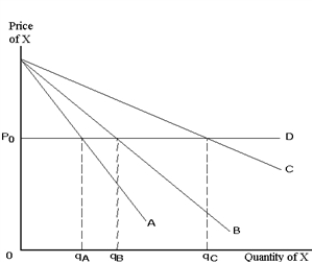 -Refer to Exhibit 23-6. If C is the demand curve facing a perfectly price-discriminating monopolist selling qC units of X, its marginal revenue curve is
Free
(Multiple Choice)
4.8/5 (93)
(93) Correct Answer:Verified
VerifiedC
Exhibit 23-10
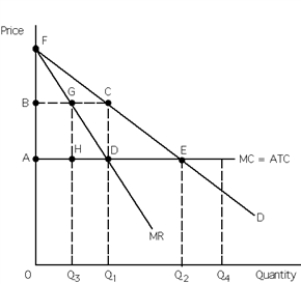 -Refer to Exhibit 23-10. The profit-maximizing single-price monopolist will produce which quantity of output?
Free
(Multiple Choice)
4.8/5 (83)
(83) Correct Answer:Verified
VerifiedB
Exhibit 23-2
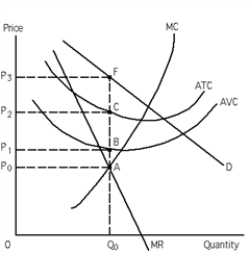 -Refer to Exhibit 23-2. The profit-maximizing monopolist produces Q0 units and charges a price of
 (Multiple Choice)
4.8/5 (90)
(90) Exhibit 23-3
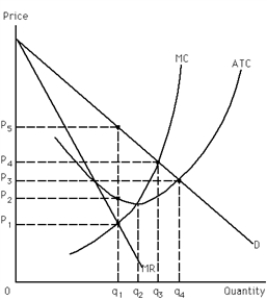 -Refer to Exhibit 23-3. The profit of the single-price monopolist is
 (Multiple Choice)
4.8/5 (82)
(82) Marginal revenue is equal to __________ divided by __________.
(Multiple Choice)
4.8/5 (84)
(84) Exhibit 23-5
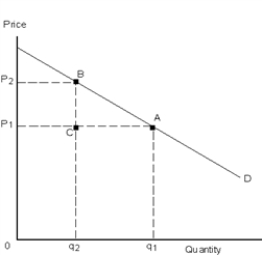 -Refer to Exhibit 23-5. What area represents the revenue gained when price goes from P2 to P1?
 (Multiple Choice)
4.9/5 (84)
(84) Exhibit 23-9
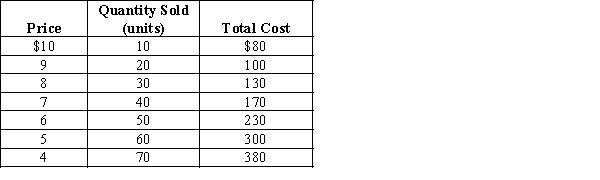 -Refer to Exhibit 23-9. A single-price monopolist earns a total profit of __________ when it produces the profit maximizing level of output.
 (Multiple Choice)
4.9/5 (79)
(79) Exhibit 23-4
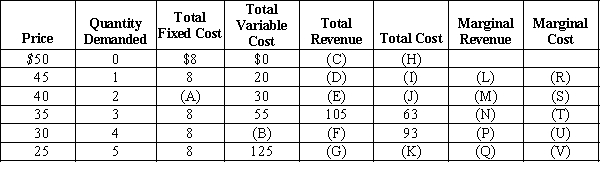 -Refer to Exhibit 23-4. What dollar amounts go in blanks (T), (U) and (V), respectively?
 (Multiple Choice)
4.9/5 (76)
(76) Cents-off coupons can be seen as a form of third-degree price discrimination.
(True/False)
4.8/5 (76)
(76) If a firm has no variable costs, the profit-maximizing price is also the revenue-maximizing price.
(True/False)
4.7/5 (80)
(80) The seller of good X sells 1,000 units of the good. Each unit is being sold for the highest price each consumer is willing to pay for the good. The seller practices
(Multiple Choice)
4.9/5 (65)
(65) Suppose a monopolist practices perfect price discrimination. Its marginal revenue curve
(Multiple Choice)
4.9/5 (78)
(78) In the United States, patents are granted to inventors of a product or process for a period of
(Multiple Choice)
4.9/5 (89)
(89) Which of the following is characteristic of the monopoly firm?
(Multiple Choice)
4.9/5 (87)
(87) A monopolist can sell 8,000 units at a price of $10 per unit. Lowering price to all buyers by $1 raises the quantity demanded by 500 units. What is the change in total revenue resulting from this price change?
(Multiple Choice)
4.9/5 (81)
(81) Which of the following is not an assumption of the theory of monopoly?
(Multiple Choice)
4.8/5 (80)
(80) 
Filters
- Essay(0)
- Multiple Choice(0)
- Short Answer(0)
- True False(0)
- Matching(0)