



 Chat with AI
Exam 23: Monopoly

Exam 1: What Economics Is About174 Questions
Exam 2: Production Possibilities Frontier Framework156 Questions
Exam 3: Supply and Demand Theory224 Questions
Exam 4: Prices Free Controlled and Relative122 Questions
Exam 5: Supply Demand and Price Applications76 Questions
Exam 6: Macroeconomic Measurements Part I Prices and Unemployment151 Questions
Exam 7: Macroeconomic Measurements Part II Gdp and Real Gdp150 Questions
Exam 8: Aggregate Demand and Aggregate Supply204 Questions
Exam 9: Classical Macroeconomics and the Self Regulating Economy172 Questions
Exam 10: Keynesian Macroeconomics and Economic Instability a Critique of the Self Regulating Economy200 Questions
Exam 11: Fiscal Policy and the Federal Budget167 Questions
Exam 12: Money Banking and the Financial System150 Questions
Exam 13: The Federal Reserve System180 Questions
Exam 14: Money and the Economy150 Questions
Exam 15: Monetary Policy185 Questions
Exam 16: Expectations Theory and the Economy150 Questions
Exam 17: Economic Growth Resources Technology Ideas and Institutions103 Questions
Exam 18: Debates in Macroeconomics Over the Role and Effects of Government100 Questions
Exam 19: Elasticity204 Questions
Exam 20: Consumer Choice and Behavioral Economics179 Questions
Exam 21: Production and Costs245 Questions
Exam 22: Perfect Competition187 Questions
Exam 23: Monopoly195 Questions
Exam 24: Monopolistic Competition Oligopoly and Game Theory172 Questions
Exam 25: Government and Product Markets Antitrust and Regulation158 Questions
Exam 26: Factor Markets With Emphasis on the Labor Market184 Questions
Exam 27: Wages Unions and Labor138 Questions
Exam 28: The Distribution of Income and Poverty99 Questions
Exam 29: Interest Rent and Profit198 Questions
Exam 30: Market Failure Externalities Public Goods and Asymmetric Information187 Questions
Exam 31: Public Choice and Special Interest Group Politics135 Questions
Exam 32: Building Theories to Explain Everyday Life From Observations to Questions to Theories to Predictions62 Questions
Exam 33: International Trade152 Questions
Exam 34: International Finance122 Questions
Exam 35: The Economic Case for and Against Government Five Topics Considered87 Questions
Exam 36: Stocks Bonds Futures and Options110 Questions
Select questions type


The profit-maximizing monopolist produces the quantity of output at which marginal revenue equals marginal cost.
(True/False)
4.8/5  (95)
(95) Exhibit 23-10
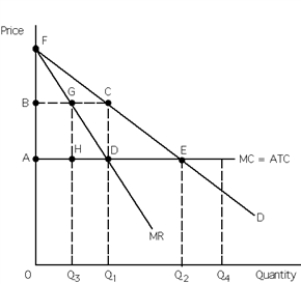 -Refer to Exhibit 23-10. The profit-maximizing single-price monopolist incurs total cost equal to what area?
 (Multiple Choice)
4.8/5 (82)
(82) Exhibit 23-1
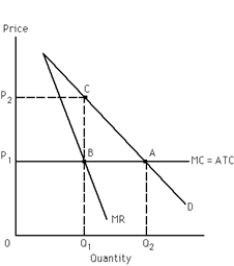 -Refer to Exhibit 23-1 The deadweight loss of the profit-maximizing monopoly is identified by what area?
 (Multiple Choice)
4.8/5 (84)
(84) Exhibit 23-8
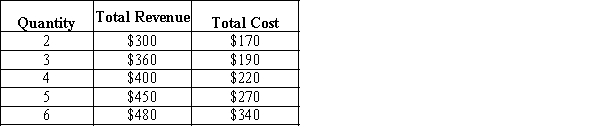
-Refer to Exhibit 23-8. Assuming that total fixed costs are $80, the average variable cost of producing 5 units of output is
-Refer to Exhibit 23-8. Assuming that total fixed costs are $80, the average variable cost of producing 5 units of output is (Multiple Choice)
4.8/5 (83)
(83) The monopoly firm may earn positive economic profits in the long run because
(Multiple Choice)
4.8/5 (77)
(77) By definition, monopolists sell a product for which there are absolutely no substitutes.
(True/False)
4.9/5 (83)
(83) Explain why price is greater than marginal revenue for a single-price monopolist and how this differs from perfect competition.
(Essay)
4.8/5 (87)
(87) The perfectly price-discriminating monopolist achieves resource allocative efficiency, while the single-price monopolist does not.
(True/False)
4.7/5 (82)
(82) The Townsend Acts, passed by the British Parliament in 1767, imposed taxes on various products imported into the American colonies.
(True/False)
4.7/5 (68)
(68) Since price __________ for a monopoly firm, the profit-maximizing monopoly firm does not produce the quantity of output for which price equals marginal cost.
(Multiple Choice)
4.9/5 (92)
(92) At one time, monopolies were granted to people who were in the favor of kings and queens.
(True/False)
4.9/5 (78)
(78) Legal barriers to entry include patents, government licenses and economies of scale.
(True/False)
4.9/5 (69)
(69) A single-price monopolist receives the maximum price for each unit of the good it sells; a perfectly price-discriminating monopolist does not.
(True/False)
4.9/5 (86)
(86) Second-degree price discrimination is discrimination among
(Multiple Choice)
4.8/5 (79)
(79) In maximizing profits, a single-price monopolist will charge a price that is
(Multiple Choice)
4.9/5 (81)
(81) Exhibit 23-9
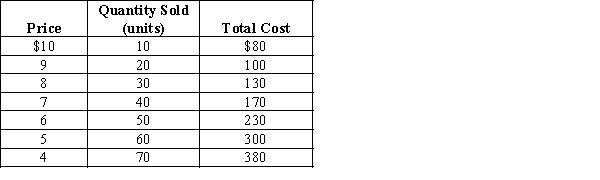 -Refer to Exhibit 23-9. A single-price monopolist that seeks to maximize profits will sell __________ units and charge a per-unit price of __________.
 (Multiple Choice)
4.8/5 (86)
(86) If a perfectly competitive firm and a single-price monopolist face the same demand and cost curves, then
(Multiple Choice)
4.8/5 (67)
(67) Exhibit 23-4
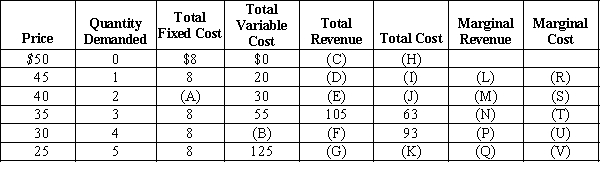 -Refer to Exhibit 23-4. What dollar amounts go in blanks (P), (Q), (R), and (S), respectively?
 (Multiple Choice)
4.9/5 (81)
(81) 
Filters
- Essay(0)
- Multiple Choice(0)
- Short Answer(0)
- True False(0)
- Matching(0)