



 Chat with AI
Exam 15: Monetary Policy

Exam 1: What Economics Is About174 Questions
Exam 2: Production Possibilities Frontier Framework156 Questions
Exam 3: Supply and Demand Theory224 Questions
Exam 4: Prices Free Controlled and Relative122 Questions
Exam 5: Supply Demand and Price Applications76 Questions
Exam 6: Macroeconomic Measurements Part I Prices and Unemployment151 Questions
Exam 7: Macroeconomic Measurements Part II Gdp and Real Gdp150 Questions
Exam 8: Aggregate Demand and Aggregate Supply204 Questions
Exam 9: Classical Macroeconomics and the Self Regulating Economy172 Questions
Exam 10: Keynesian Macroeconomics and Economic Instability a Critique of the Self Regulating Economy200 Questions
Exam 11: Fiscal Policy and the Federal Budget167 Questions
Exam 12: Money Banking and the Financial System150 Questions
Exam 13: The Federal Reserve System180 Questions
Exam 14: Money and the Economy150 Questions
Exam 15: Monetary Policy185 Questions
Exam 16: Expectations Theory and the Economy150 Questions
Exam 17: Economic Growth Resources Technology Ideas and Institutions103 Questions
Exam 18: Debates in Macroeconomics Over the Role and Effects of Government100 Questions
Exam 19: Elasticity204 Questions
Exam 20: Consumer Choice and Behavioral Economics179 Questions
Exam 21: Production and Costs245 Questions
Exam 22: Perfect Competition187 Questions
Exam 23: Monopoly195 Questions
Exam 24: Monopolistic Competition Oligopoly and Game Theory172 Questions
Exam 25: Government and Product Markets Antitrust and Regulation158 Questions
Exam 26: Factor Markets With Emphasis on the Labor Market184 Questions
Exam 27: Wages Unions and Labor138 Questions
Exam 28: The Distribution of Income and Poverty99 Questions
Exam 29: Interest Rent and Profit198 Questions
Exam 30: Market Failure Externalities Public Goods and Asymmetric Information187 Questions
Exam 31: Public Choice and Special Interest Group Politics135 Questions
Exam 32: Building Theories to Explain Everyday Life From Observations to Questions to Theories to Predictions62 Questions
Exam 33: International Trade152 Questions
Exam 34: International Finance122 Questions
Exam 35: The Economic Case for and Against Government Five Topics Considered87 Questions
Exam 36: Stocks Bonds Futures and Options110 Questions
Select questions type


According to the Keynesian transmission mechanism, if the Fed conducts an open market purchase of government securities, it may cause which of the following in the investment goods market?

Free
(Multiple Choice)
4.8/5  (76)
(76) Correct Answer: Verified
C
As the interest rate increases, the opportunity cost of holding money __________ and individuals choose to hold __________ money.
Free
(Multiple Choice)
4.9/5 (87)
(87) Correct Answer:Verified
VerifiedC
Persons who argue against the deliberate use of fiscal and monetary policies to smooth out the business cycle are referred to as
(Multiple Choice)
4.9/5 (70)
(70) The predetermined-money-growth-rate rule states that the annual growth rate in the money supply will be constant at the average annual growth rate of Real GDP.
(True/False)
4.9/5 (82)
(82) Economists who propose a constant-money-growth-rate rule often argue that setting the annual growth rate in the money supply equal to the average annual growth rate in Real GDP
(Multiple Choice)
4.8/5 (65)
(65) A person who opposes the deliberate use of fiscal and monetary policies is called a(n)
(Multiple Choice)
4.9/5 (83)
(83) What are the two assumptions made in the nonactivist constant-money-growth-rate rule? Describe the alternative rule known as the predetermined-money-growth-rate rule and explain why some nonactivists prefer this rule.
(Essay)
4.8/5 (78)
(78) Exhibit 15-4
 Assume that people have only two choices when it comes to holding their wealth: in money or in bonds.
-Refer to Exhibit 15-4. In the row of this table containing blank (A), people are holding ______________ of their wealth in bonds and ________________ of their wealth in money.
Assume that people have only two choices when it comes to holding their wealth: in money or in bonds.
-Refer to Exhibit 15-4. In the row of this table containing blank (A), people are holding ______________ of their wealth in bonds and ________________ of their wealth in money. (Multiple Choice)
4.8/5 (75)
(75) If you believe the economy is self-regulating, you are more likely to be a(an) __________ than a(an) __________.
(Multiple Choice)
4.9/5 (68)
(68) One criticism of monetary policy based on a predetermined steady growth rate in money supply is that
(Multiple Choice)
4.8/5 (81)
(81) If the money market is in the liquidity trap, it is operating in the __________ segment of the __________ demand curve.
(Multiple Choice)
4.8/5 (89)
(89) If the interest rate increases, the opportunity cost of holding money __________, and the quantity demanded of money __________.
(Multiple Choice)
4.9/5 (69)
(69) Nonactivists argue against the use of discretionary monetary policy and rules-based monetary policy.
(True/False)
4.8/5 (78)
(78) Exhibit 15-3
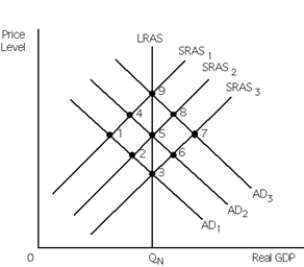 -Refer to Exhibit 15-3. The economy is currently at point 7. If the economy self-regulates, it will end up at point __________, whereas if contractionary monetary policy is effective, it will end up at point __________.
 (Multiple Choice)
4.9/5 (82)
(82) The supply of bonds rises, ceteris paribus, and the price of bonds __________. This __________ the interest rate and __________ the quantity demanded of money.
(Multiple Choice)
4.8/5 (73)
(73) The quantity demanded of money decreases as the supply of money increases.
(True/False)
4.9/5 (82)
(82) 
Filters
- Essay(0)
- Multiple Choice(0)
- Short Answer(0)
- True False(0)
- Matching(0)