



 Chat with AI
Exam 15: Monetary Policy

Exam 1: What Economics Is About174 Questions
Exam 2: Production Possibilities Frontier Framework156 Questions
Exam 3: Supply and Demand Theory224 Questions
Exam 4: Prices Free Controlled and Relative122 Questions
Exam 5: Supply Demand and Price Applications76 Questions
Exam 6: Macroeconomic Measurements Part I Prices and Unemployment151 Questions
Exam 7: Macroeconomic Measurements Part II Gdp and Real Gdp150 Questions
Exam 8: Aggregate Demand and Aggregate Supply204 Questions
Exam 9: Classical Macroeconomics and the Self Regulating Economy172 Questions
Exam 10: Keynesian Macroeconomics and Economic Instability a Critique of the Self Regulating Economy200 Questions
Exam 11: Fiscal Policy and the Federal Budget167 Questions
Exam 12: Money Banking and the Financial System150 Questions
Exam 13: The Federal Reserve System180 Questions
Exam 14: Money and the Economy150 Questions
Exam 15: Monetary Policy185 Questions
Exam 16: Expectations Theory and the Economy150 Questions
Exam 17: Economic Growth Resources Technology Ideas and Institutions103 Questions
Exam 18: Debates in Macroeconomics Over the Role and Effects of Government100 Questions
Exam 19: Elasticity204 Questions
Exam 20: Consumer Choice and Behavioral Economics179 Questions
Exam 21: Production and Costs245 Questions
Exam 22: Perfect Competition187 Questions
Exam 23: Monopoly195 Questions
Exam 24: Monopolistic Competition Oligopoly and Game Theory172 Questions
Exam 25: Government and Product Markets Antitrust and Regulation158 Questions
Exam 26: Factor Markets With Emphasis on the Labor Market184 Questions
Exam 27: Wages Unions and Labor138 Questions
Exam 28: The Distribution of Income and Poverty99 Questions
Exam 29: Interest Rent and Profit198 Questions
Exam 30: Market Failure Externalities Public Goods and Asymmetric Information187 Questions
Exam 31: Public Choice and Special Interest Group Politics135 Questions
Exam 32: Building Theories to Explain Everyday Life From Observations to Questions to Theories to Predictions62 Questions
Exam 33: International Trade152 Questions
Exam 34: International Finance122 Questions
Exam 35: The Economic Case for and Against Government Five Topics Considered87 Questions
Exam 36: Stocks Bonds Futures and Options110 Questions
Select questions type


Which of the following may block the Keynesian transmission mechanism?
(Multiple Choice)
4.7/5  (86)
(86) Exhibit 15-3
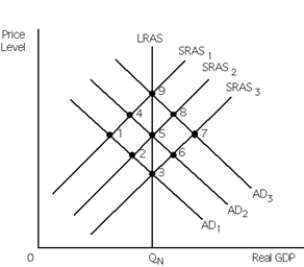 -Refer to Exhibit 15-3. The economy is currently at point 4. The Fed increases the money supply and the economy ends up at point 8. Has monetary policy been effective at moderating the business cycle?
 (Multiple Choice)
4.8/5 (78)
(78) Exhibit 15-1
 -Refer to Exhibit 15-1. A Keynesian would say that market forces work more quickly in taking the economy from point______________ than from point _______________.
 (Multiple Choice)
4.8/5 (72)
(72) According to the Keynesian transmission mechanism, if the Fed conducts an open market sale of government securities, it may cause which of the following in the investment goods market?
(Multiple Choice)
4.8/5 (72)
(72) According to the Keynesian transmission mechanism, an increase in the money supply causes a(n) __________ in the interest rate and a(n) __________ in investment, which in turn causes a(n) __________ in total expenditures and aggregate demand.
(Multiple Choice)
4.8/5 (87)
(87) Suppose the economy is experiencing an inflationary gap. Based on available data, the Fed starts implementing contractionary monetary policy, but this moves the economy into a recessionary gap. The most probable explanation is that, because of the total lag in monetary policy, the government did not realize that the economy was already healing itself, i.e., that the
(Multiple Choice)
4.8/5 (72)
(72) The demand-for-money curve illustrates the __________ relationship between the quantity demanded of money and __________.
(Multiple Choice)
4.7/5 (85)
(85) Exhibit 15-1
-Refer to Exhibit 15-l. A Keynesian monetary policy to eliminate a recessionary gap can be portrayed as a move between points
-Refer to Exhibit 15-l. A Keynesian monetary policy to eliminate a recessionary gap can be portrayed as a move between points (Multiple Choice)
5.0/5 (74)
(74) Economist Jones favors a constant-money-growth-rate rule. She says that if the annual money supply growth rate each year is equal to the average annual growth rate in Real GDP, price stability will exist over time. What would economist Smith, who favors activist monetary policy, say to economist Jones?
(Multiple Choice)
4.7/5 (72)
(72) If the investment demand curve is vertical, a decrease in the interest rate will __________ investment, and therefore aggregate demand will __________.
(Multiple Choice)
4.8/5 (88)
(88) The money supply increased and the AD curve did not shift to the right. This is consistent with the
(Multiple Choice)
4.9/5 (78)
(78) If Real GDP increases at an annual rate of 4 percent and velocity increases at a rate of 2 percent per year, then rules-based monetary policy advocates who wish to maintain a stable price level would set the annual money supply growth rate at
(Multiple Choice)
4.8/5 (90)
(90) When an economist states that the monetarist transmission mechanism is "direct" it means that a change in the money supply creates a direct impact on the goods and services market.
(True/False)
4.7/5 (74)
(74) Suppose the money market is in the liquidity trap and that the economy is experiencing a recessionary gap. A Keynesian economist would most likely advocate
(Multiple Choice)
4.9/5 (79)
(79) 
Filters
- Essay(0)
- Multiple Choice(0)
- Short Answer(0)
- True False(0)
- Matching(0)