



 Chat with AI
Exam 15: Monetary Policy

Exam 1: What Economics Is About174 Questions
Exam 2: Production Possibilities Frontier Framework156 Questions
Exam 3: Supply and Demand Theory224 Questions
Exam 4: Prices Free Controlled and Relative122 Questions
Exam 5: Supply Demand and Price Applications76 Questions
Exam 6: Macroeconomic Measurements Part I Prices and Unemployment151 Questions
Exam 7: Macroeconomic Measurements Part II Gdp and Real Gdp150 Questions
Exam 8: Aggregate Demand and Aggregate Supply204 Questions
Exam 9: Classical Macroeconomics and the Self Regulating Economy172 Questions
Exam 10: Keynesian Macroeconomics and Economic Instability a Critique of the Self Regulating Economy200 Questions
Exam 11: Fiscal Policy and the Federal Budget167 Questions
Exam 12: Money Banking and the Financial System150 Questions
Exam 13: The Federal Reserve System180 Questions
Exam 14: Money and the Economy150 Questions
Exam 15: Monetary Policy185 Questions
Exam 16: Expectations Theory and the Economy150 Questions
Exam 17: Economic Growth Resources Technology Ideas and Institutions103 Questions
Exam 18: Debates in Macroeconomics Over the Role and Effects of Government100 Questions
Exam 19: Elasticity204 Questions
Exam 20: Consumer Choice and Behavioral Economics179 Questions
Exam 21: Production and Costs245 Questions
Exam 22: Perfect Competition187 Questions
Exam 23: Monopoly195 Questions
Exam 24: Monopolistic Competition Oligopoly and Game Theory172 Questions
Exam 25: Government and Product Markets Antitrust and Regulation158 Questions
Exam 26: Factor Markets With Emphasis on the Labor Market184 Questions
Exam 27: Wages Unions and Labor138 Questions
Exam 28: The Distribution of Income and Poverty99 Questions
Exam 29: Interest Rent and Profit198 Questions
Exam 30: Market Failure Externalities Public Goods and Asymmetric Information187 Questions
Exam 31: Public Choice and Special Interest Group Politics135 Questions
Exam 32: Building Theories to Explain Everyday Life From Observations to Questions to Theories to Predictions62 Questions
Exam 33: International Trade152 Questions
Exam 34: International Finance122 Questions
Exam 35: The Economic Case for and Against Government Five Topics Considered87 Questions
Exam 36: Stocks Bonds Futures and Options110 Questions
Select questions type


Last year, Leah bought a bond for $1,000 that promises to pay $40 a year. This year, a person who buys a bond for $1,000 receives $45 a year. If Leah were to sell her (old) bond, its price would be approximately
(Multiple Choice)
4.8/5  (71)
(71) The Keynesian transmission mechanism could be blocked by either interest-insensitive investment or by the liquidity trap.
(True/False)
4.9/5 (76)
(76) A general definition of the "transmission mechanism" is: the routes or channels that ripple effects created in the
(Multiple Choice)
4.8/5 (91)
(91) Exhibit 15-5
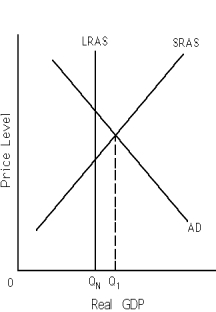 -Refer to Exhibit 15-5. At short-run equilibrium, this economy is in a(n) ___________________ gap. An economist who believes that the economy is self-regulating would assert that _____________________________.
 (Multiple Choice)
4.7/5 (90)
(90) According to the Taylor Rule, if the inflation rate is 3 percent and the GDP gap is 2 percent, what does the federal funds rate target equal?
(Multiple Choice)
4.9/5 (72)
(72) Suppose that a rules-based monetary policy proposal specifies that the money supply will grow 5 percent each year. If velocity grows 2 percent this year and Real GDP grows 2 percent, the price level will __________ by __________ percent.
(Multiple Choice)
4.9/5 (90)
(90) Advocates of a gold standard believe that long-term price stability would be more likely under a gold standard than under current Fed monetary policy.
(True/False)
4.8/5 (73)
(73) According to economist Arnold Kling's perspective on the economy, economic activity is best viewed by focusing on
(Multiple Choice)
4.8/5 (76)
(76) Economists who favor activist monetary policy often argue that
(Multiple Choice)
4.9/5 (77)
(77) Last year, Bentley bought a bond for $1,000 that promises to pay $45 a year. This year, a person who buys a bond for $1,000 receives $39 a year. If Bentley were to sell his (old) bond, its price would be approximately
(Multiple Choice)
4.7/5 (84)
(84) Exhibit 15-4
 Assume that people have only two choices when it comes to holding their wealth: in money or in bonds.
-Refer to Exhibit 15-4. Identify the appropriate state of the bond market that would fill in blanks (A), (B), and (C), respectively.
Assume that people have only two choices when it comes to holding their wealth: in money or in bonds.
-Refer to Exhibit 15-4. Identify the appropriate state of the bond market that would fill in blanks (A), (B), and (C), respectively. (Multiple Choice)
4.8/5 (85)
(85) Changes in the money market have an impact upon the bond market.
(True/False)
4.8/5 (73)
(73) Exhibit 15-4
Assume that people have only two choices when it comes to holding their wealth: in money or in bonds.
-Refer to Exhibit 15-4. In the row of this table containing blank (B), people are holding ______________ of their wealth in bonds and ________________ of their wealth in money.
Assume that people have only two choices when it comes to holding their wealth: in money or in bonds.
-Refer to Exhibit 15-4. In the row of this table containing blank (B), people are holding ______________ of their wealth in bonds and ________________ of their wealth in money. (Multiple Choice)
4.8/5 (74)
(74) If the interest rate falls, the opportunity cost of holding money __________ and the quantity demanded of money __________.
(Multiple Choice)
4.8/5 (88)
(88) As the interest rate falls, the quantity supplied of money falls and the quantity demanded of money rises.
(True/False)
4.8/5 (90)
(90) 
Filters
- Essay(0)
- Multiple Choice(0)
- Short Answer(0)
- True False(0)
- Matching(0)