



 Chat with AI
Exam 15: Monetary Policy

Exam 1: What Economics Is About174 Questions
Exam 2: Production Possibilities Frontier Framework156 Questions
Exam 3: Supply and Demand Theory224 Questions
Exam 4: Prices Free Controlled and Relative122 Questions
Exam 5: Supply Demand and Price Applications76 Questions
Exam 6: Macroeconomic Measurements Part I Prices and Unemployment151 Questions
Exam 7: Macroeconomic Measurements Part II Gdp and Real Gdp150 Questions
Exam 8: Aggregate Demand and Aggregate Supply204 Questions
Exam 9: Classical Macroeconomics and the Self Regulating Economy172 Questions
Exam 10: Keynesian Macroeconomics and Economic Instability a Critique of the Self Regulating Economy200 Questions
Exam 11: Fiscal Policy and the Federal Budget167 Questions
Exam 12: Money Banking and the Financial System150 Questions
Exam 13: The Federal Reserve System180 Questions
Exam 14: Money and the Economy150 Questions
Exam 15: Monetary Policy185 Questions
Exam 16: Expectations Theory and the Economy150 Questions
Exam 17: Economic Growth Resources Technology Ideas and Institutions103 Questions
Exam 18: Debates in Macroeconomics Over the Role and Effects of Government100 Questions
Exam 19: Elasticity204 Questions
Exam 20: Consumer Choice and Behavioral Economics179 Questions
Exam 21: Production and Costs245 Questions
Exam 22: Perfect Competition187 Questions
Exam 23: Monopoly195 Questions
Exam 24: Monopolistic Competition Oligopoly and Game Theory172 Questions
Exam 25: Government and Product Markets Antitrust and Regulation158 Questions
Exam 26: Factor Markets With Emphasis on the Labor Market184 Questions
Exam 27: Wages Unions and Labor138 Questions
Exam 28: The Distribution of Income and Poverty99 Questions
Exam 29: Interest Rent and Profit198 Questions
Exam 30: Market Failure Externalities Public Goods and Asymmetric Information187 Questions
Exam 31: Public Choice and Special Interest Group Politics135 Questions
Exam 32: Building Theories to Explain Everyday Life From Observations to Questions to Theories to Predictions62 Questions
Exam 33: International Trade152 Questions
Exam 34: International Finance122 Questions
Exam 35: The Economic Case for and Against Government Five Topics Considered87 Questions
Exam 36: Stocks Bonds Futures and Options110 Questions
Select questions type


Describe the Keynesian transmission mechanism for a decrease in the money supply. Assuming that no liquidity trap exists, that investment is interest-sensitive, and that the economy is in the horizontal portion of the AS curve, what happens to Real GDP and the price level? How can you tell if this is a direct transmission mechanism or an indirect one?
(Essay)
4.9/5  (83)
(83) Under a constant growth rate of money rule of 2 percent in an economy in which Real GDP grows at an average rate of 1 percent and velocity is constant, the inflation rate is
(Multiple Choice)
4.9/5 (74)
(74) The demand for money rises. According to the Keynesian transmission mechanism, the interest rate __________, investment spending __________ (assuming it is interest-sensitive), the AD curve shifts to the __________ and if the AS curve is horizontal, Real GDP __________.
(Multiple Choice)
4.7/5 (81)
(81) The rules-based monetary policy that some nonactivists have proposed to maintain price stability reads this way:
(Multiple Choice)
4.8/5 (81)
(81) From the Patterns of Sustainable Specialization and Trade (PSST) perspective, expansionary monetary and fiscal policies that are designed to boost aggregate demand
(Multiple Choice)
4.8/5 (68)
(68) Exhibit 15-1
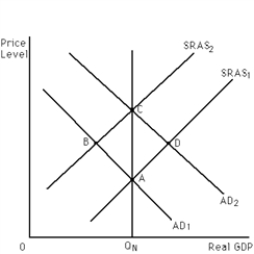 -Refer to Exhibit 15-l. One argument against the use of activist monetary policy claims that it can destabilize the economy. For example, suppose we are in a recessionary gap. Expansionary monetary policy is implemented, but there are so many lags that by the time it has its effect, self-regulation has already closed the gap by itself. The end result is a movement from point
 (Multiple Choice)
4.8/5 (90)
(90) One argument in favor of activist monetary policy is that the economy does not always equilibrate quickly enough at Natural Real GDP.
(True/False)
4.8/5 (70)
(70) Suppose the money market is in the liquidity trap and the Fed increases the supply of money. Individuals would rather hold __________ than __________ because they expect that bond prices can go no __________.
(Multiple Choice)
4.9/5 (77)
(77) Which of the following statements is likely to be made by an economist who does not believe in activist monetary policy? (1) The more closely monetary policy can he designed to meet the particulars of a given economic environment, the better. (2) Because of long and uncertain time lags, activist monetary policy may be destabilizing rather than stabilizing. (3) There is sufficient flexibility in wages and prices in modern economies to allow the economy to equilibrate in reasonable speed at the natural level of Real GDP, (4) The "same-for-all-seasons" monetary policy is the way to proceed. (5) There is evidence that monetary policy in the mid-1970s caused a recession.
(Multiple Choice)
4.9/5 (78)
(78) The economy is in a recessionary gap and there is complete crowding out. Furthermore, there is no evidence that the economy is in a liquidity trap or that investment is interest-insensitive. This makes the case for the use of __________ policy stronger than it might be otherwise.
(Multiple Choice)
4.7/5 (78)
(78) As the opportunity cost of holding money decreases, the quantity demanded of money
(Multiple Choice)
4.9/5 (66)
(66) Which scenario best explains the Keynesian transmission mechanism when the investment demand curve is vertical?
(Multiple Choice)
4.7/5 (89)
(89) Exhibit 15-2
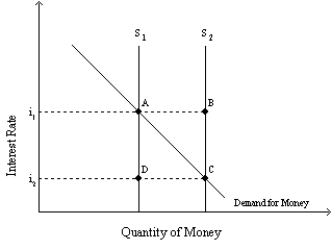 -Refer to Exhibit 15-2. A(n)__________ in the money supply from S1 to S2 would have a tendency to __________ the opportunity cost of holding money.
 (Multiple Choice)
4.9/5 (85)
(85) Under a gold standard, if the market price of gold is below the official price of gold (set by the monetary authority) members of the public would likely buy gold _______________ and sell it __________________, causing the market price of gold to ____________________.
(Multiple Choice)
4.9/5 (89)
(89) 
Filters
- Essay(0)
- Multiple Choice(0)
- Short Answer(0)
- True False(0)
- Matching(0)