



 Chat with AI
Exam 23: Monopoly

Exam 1: What Economics Is About174 Questions
Exam 2: Production Possibilities Frontier Framework156 Questions
Exam 3: Supply and Demand Theory224 Questions
Exam 4: Prices Free Controlled and Relative122 Questions
Exam 5: Supply Demand and Price Applications76 Questions
Exam 6: Macroeconomic Measurements Part I Prices and Unemployment151 Questions
Exam 7: Macroeconomic Measurements Part II Gdp and Real Gdp150 Questions
Exam 8: Aggregate Demand and Aggregate Supply204 Questions
Exam 9: Classical Macroeconomics and the Self Regulating Economy172 Questions
Exam 10: Keynesian Macroeconomics and Economic Instability a Critique of the Self Regulating Economy200 Questions
Exam 11: Fiscal Policy and the Federal Budget167 Questions
Exam 12: Money Banking and the Financial System150 Questions
Exam 13: The Federal Reserve System180 Questions
Exam 14: Money and the Economy150 Questions
Exam 15: Monetary Policy185 Questions
Exam 16: Expectations Theory and the Economy150 Questions
Exam 17: Economic Growth Resources Technology Ideas and Institutions103 Questions
Exam 18: Debates in Macroeconomics Over the Role and Effects of Government100 Questions
Exam 19: Elasticity204 Questions
Exam 20: Consumer Choice and Behavioral Economics179 Questions
Exam 21: Production and Costs245 Questions
Exam 22: Perfect Competition187 Questions
Exam 23: Monopoly195 Questions
Exam 24: Monopolistic Competition Oligopoly and Game Theory172 Questions
Exam 25: Government and Product Markets Antitrust and Regulation158 Questions
Exam 26: Factor Markets With Emphasis on the Labor Market184 Questions
Exam 27: Wages Unions and Labor138 Questions
Exam 28: The Distribution of Income and Poverty99 Questions
Exam 29: Interest Rent and Profit198 Questions
Exam 30: Market Failure Externalities Public Goods and Asymmetric Information187 Questions
Exam 31: Public Choice and Special Interest Group Politics135 Questions
Exam 32: Building Theories to Explain Everyday Life From Observations to Questions to Theories to Predictions62 Questions
Exam 33: International Trade152 Questions
Exam 34: International Finance122 Questions
Exam 35: The Economic Case for and Against Government Five Topics Considered87 Questions
Exam 36: Stocks Bonds Futures and Options110 Questions
Select questions type


Which of the following is the best example of price discrimination?
(Multiple Choice)
4.8/5  (59)
(59) If a price-discriminating monopoly charges a lower price to individuals in city X, it is likely that the firm
(Multiple Choice)
4.9/5 (85)
(85) Monopolists are guaranteed to earn a positive economic profit because they are the only seller in their industry.
(True/False)
4.9/5 (73)
(73) Which of the following is not a necessary condition for price discrimination to hold?
(Multiple Choice)
4.8/5 (74)
(74) Maximizing total revenue turns out to be the same as maximizing profit only when
(Multiple Choice)
4.9/5 (81)
(81) The profit-maximizing single-price monopolist will charge a price
(Multiple Choice)
4.9/5 (84)
(84) Describe the similarities between why sellers want to price discriminate and why district attorneys want to plea-bargain. In addition, discuss the conditions that must be satisfied before district attorneys (DAs) can plea-bargain successfully and how they relate to the three conditions necessary for successful price discrimination.
(Essay)
4.9/5 (80)
(80) For the monopoly firm that does not engage in perfect price discrimination,
(Multiple Choice)
4.8/5 (66)
(66) If a monopolist wishes to sell an additional unit of the good, then
(Multiple Choice)
5.0/5 (82)
(82) X-inefficiency occurs when a monopolist produces output at a cost that is greater than the lowest possible cost.
(True/False)
4.9/5 (84)
(84) Exhibit 23-10
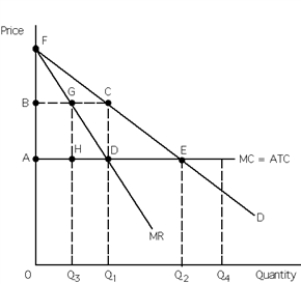 -Refer to Exhibit 23-10. The profit-maximizing single-price monopolist earns total revenue equal to what area?
 (Multiple Choice)
5.0/5 (69)
(69) 
Filters
- Essay(0)
- Multiple Choice(0)
- Short Answer(0)
- True False(0)
- Matching(0)