



 Chat with AI
Exam 2: Production Possibilities Frontier Framework

Exam 1: What Economics Is About174 Questions
Exam 2: Production Possibilities Frontier Framework156 Questions
Exam 3: Supply and Demand Theory224 Questions
Exam 4: Prices Free Controlled and Relative122 Questions
Exam 5: Supply Demand and Price Applications76 Questions
Exam 6: Macroeconomic Measurements Part I Prices and Unemployment151 Questions
Exam 7: Macroeconomic Measurements Part II Gdp and Real Gdp150 Questions
Exam 8: Aggregate Demand and Aggregate Supply204 Questions
Exam 9: Classical Macroeconomics and the Self Regulating Economy172 Questions
Exam 10: Keynesian Macroeconomics and Economic Instability a Critique of the Self Regulating Economy200 Questions
Exam 11: Fiscal Policy and the Federal Budget167 Questions
Exam 12: Money Banking and the Financial System150 Questions
Exam 13: The Federal Reserve System180 Questions
Exam 14: Money and the Economy150 Questions
Exam 15: Monetary Policy185 Questions
Exam 16: Expectations Theory and the Economy150 Questions
Exam 17: Economic Growth Resources Technology Ideas and Institutions103 Questions
Exam 18: Debates in Macroeconomics Over the Role and Effects of Government100 Questions
Exam 19: Elasticity204 Questions
Exam 20: Consumer Choice and Behavioral Economics179 Questions
Exam 21: Production and Costs245 Questions
Exam 22: Perfect Competition187 Questions
Exam 23: Monopoly195 Questions
Exam 24: Monopolistic Competition Oligopoly and Game Theory172 Questions
Exam 25: Government and Product Markets Antitrust and Regulation158 Questions
Exam 26: Factor Markets With Emphasis on the Labor Market184 Questions
Exam 27: Wages Unions and Labor138 Questions
Exam 28: The Distribution of Income and Poverty99 Questions
Exam 29: Interest Rent and Profit198 Questions
Exam 30: Market Failure Externalities Public Goods and Asymmetric Information187 Questions
Exam 31: Public Choice and Special Interest Group Politics135 Questions
Exam 32: Building Theories to Explain Everyday Life From Observations to Questions to Theories to Predictions62 Questions
Exam 33: International Trade152 Questions
Exam 34: International Finance122 Questions
Exam 35: The Economic Case for and Against Government Five Topics Considered87 Questions
Exam 36: Stocks Bonds Futures and Options110 Questions
Select questions type


Consider two points on the PPF: point A, at which there are 50 apples and 40 pears, and point B, at which there are 46 apples and 41 pears. If the economy is currently at point A, the opportunity cost of moving to point B is
(Multiple Choice)
4.9/5  (80)
(80) Explain how a technological advancement in one sector of the economy can lead to a change in the number of people who work in another sector of the economy. Give an example to help support your answer.
(Essay)
5.0/5 (77)
(77) Exhibit 2-8
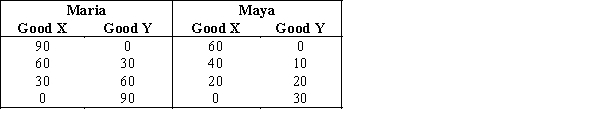 -Refer to Exhibit 2-8. Who has the comparative advantage in the production of good X?
 (Multiple Choice)
4.9/5 (81)
(81) An economy can produce the following combinations of goods: 50X and 0Y, 40X and 10Y, 30X and 20Y, 20X and 30Y, 10X and 40Y, and 0X and 50Y. The production possibilities frontier (PPF) for the economy is
(Multiple Choice)
4.9/5 (87)
(87) Exhibit 2-3
 -Refer to Exhibit 2-3. If PPF1 is the relevant production possibilities frontier, society may move to PPF2 as a result of
 (Multiple Choice)
4.7/5 (94)
(94) Exhibit 2-6
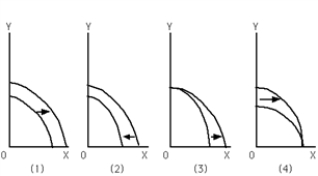 -Refer to Exhibit 2-6. Which graph depicts a technological breakthrough in the production of good X only?
 (Multiple Choice)
4.9/5 (78)
(78) Exhibit 2-6
-Refer to Exhibit 2-6. Which graph depicts the result of an increase in the number of immigrants entering the country in order to work?
-Refer to Exhibit 2-6. Which graph depicts the result of an increase in the number of immigrants entering the country in order to work? (Multiple Choice)
4.9/5 (93)
(93) Exhibit 2-9
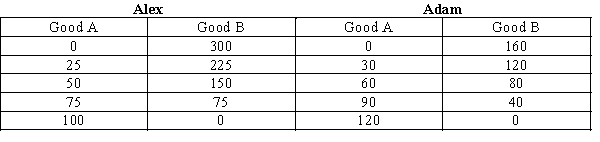 -Refer to Exhibit 2-9. For Alex, the opportunity cost of producing one unit of good B is ____________ unit(s) of good A.
 (Multiple Choice)
4.8/5 (76)
(76) When an economy is not using all of its resources, it is producing at a point below its production possibilities frontier.
(True/False)
5.0/5 (79)
(79) Exhibit 2-2
 -Refer to Exhibit 2-2. If PPF2 is the relevant production possibilities frontier, then point __________ is unattainable.
 (Multiple Choice)
4.9/5 (75)
(75) The economy can produce 0X and 15Y, 10X and 10Y, 20X and 5Y, or 30X and 0Y. It follows that opportunity cost of 1X is ___Y.
(Multiple Choice)
4.9/5 (82)
(82) Exhibit 2-6
-Refer to Exhibit 2-6. Which graph depicts the result of an increase in the unemployment rate?
-Refer to Exhibit 2-6. Which graph depicts the result of an increase in the unemployment rate? (Multiple Choice)
4.9/5 (85)
(85) Along its production possibilities frontier (PPF) an economy can produce 0X and 15Y, 10X and 10Y, 20X and 5Y, or 30X and 0Y. It follows that the PPF is
(Multiple Choice)
4.8/5 (67)
(67) Exhibit 2-5
 -Refer to Exhibit 2-5. As more fax machines are produced, the opportunity cost of producing them
 (Multiple Choice)
4.9/5 (82)
(82) If increasingly more units of good Y must be given up as each successive unit of good X is produced, then the PPF for these two goods is
(Multiple Choice)
5.0/5 (84)
(84) Jose has one evening in which to prepare for two exams and can employ one of two possible strategies:
 The opportunity cost of receiving a 93 on the economics exam is __________ points on the statistics exam.
 (Multiple Choice)
4.7/5 (71)
(71) Exhibit 2-9
-Refer to Exhibit 2-9. For Adam, the opportunity cost of producing one unit of good B is ____________ unit(s) of good A.
-Refer to Exhibit 2-9. For Adam, the opportunity cost of producing one unit of good B is ____________ unit(s) of good A. (Multiple Choice)
4.9/5 (80)
(80) 
Filters
- Essay(0)
- Multiple Choice(0)
- Short Answer(0)
- True False(0)
- Matching(0)