



 Chat with AI
Exam 22: Perfect Competition

Exam 1: What Economics Is About174 Questions
Exam 2: Production Possibilities Frontier Framework156 Questions
Exam 3: Supply and Demand Theory224 Questions
Exam 4: Prices Free Controlled and Relative122 Questions
Exam 5: Supply Demand and Price Applications76 Questions
Exam 6: Macroeconomic Measurements Part I Prices and Unemployment151 Questions
Exam 7: Macroeconomic Measurements Part II Gdp and Real Gdp150 Questions
Exam 8: Aggregate Demand and Aggregate Supply204 Questions
Exam 9: Classical Macroeconomics and the Self Regulating Economy172 Questions
Exam 10: Keynesian Macroeconomics and Economic Instability a Critique of the Self Regulating Economy200 Questions
Exam 11: Fiscal Policy and the Federal Budget167 Questions
Exam 12: Money Banking and the Financial System150 Questions
Exam 13: The Federal Reserve System180 Questions
Exam 14: Money and the Economy150 Questions
Exam 15: Monetary Policy185 Questions
Exam 16: Expectations Theory and the Economy150 Questions
Exam 17: Economic Growth Resources Technology Ideas and Institutions103 Questions
Exam 18: Debates in Macroeconomics Over the Role and Effects of Government100 Questions
Exam 19: Elasticity204 Questions
Exam 20: Consumer Choice and Behavioral Economics179 Questions
Exam 21: Production and Costs245 Questions
Exam 22: Perfect Competition187 Questions
Exam 23: Monopoly195 Questions
Exam 24: Monopolistic Competition Oligopoly and Game Theory172 Questions
Exam 25: Government and Product Markets Antitrust and Regulation158 Questions
Exam 26: Factor Markets With Emphasis on the Labor Market184 Questions
Exam 27: Wages Unions and Labor138 Questions
Exam 28: The Distribution of Income and Poverty99 Questions
Exam 29: Interest Rent and Profit198 Questions
Exam 30: Market Failure Externalities Public Goods and Asymmetric Information187 Questions
Exam 31: Public Choice and Special Interest Group Politics135 Questions
Exam 32: Building Theories to Explain Everyday Life From Observations to Questions to Theories to Predictions62 Questions
Exam 33: International Trade152 Questions
Exam 34: International Finance122 Questions
Exam 35: The Economic Case for and Against Government Five Topics Considered87 Questions
Exam 36: Stocks Bonds Futures and Options110 Questions
Select questions type


Exhibit 22-3

-Refer to Exhibit 22-3. What is the increase in profit that would result from producing 43 units of the product rather than producing 40 units?
-Refer to Exhibit 22-3. What is the increase in profit that would result from producing 43 units of the product rather than producing 40 units? (Multiple Choice)
4.9/5  (68)
(68) Exhibit 22-3
-Refer to Exhibit 22-3. Is it possible for this firm to produce "too much" in the short-run (in terms of profitability)?
-Refer to Exhibit 22-3. Is it possible for this firm to produce "too much" in the short-run (in terms of profitability)? (Multiple Choice)
4.9/5 (63)
(63) If the firm is producing a quantity of output for which MC > MR, then the firm should increase production to increase its profits.
(True/False)
4.8/5 (83)
(83) Exhibit 22-2
 -Refer to Exhibit 22-2. If the firm produces the quantity of output at which marginal revenue (MR) equals marginal cost (MC), is it guaranteed maximum profit or minimized loss?
 (Multiple Choice)
4.9/5 (76)
(76) Consider the following data: equilibrium price = $15, quantity of output produced = 10,000 units, average total cost = $12, and average variable cost $7. Given this data, total revenue is __________, total cost is __________, and total fixed cost is __________.
(Multiple Choice)
4.9/5 (76)
(76) Demand increases in an increasing-cost industry that is initially in long-run competitive equilibrium. After full adjustment, price will be
(Multiple Choice)
4.9/5 (73)
(73) Which of the following is a characteristic of perfect competition?
(Multiple Choice)
5.0/5 (93)
(93) If firms are earning zero economic profits, they must be producing at an output level at which
(Multiple Choice)
4.9/5 (73)
(73) Exhibit 22-8
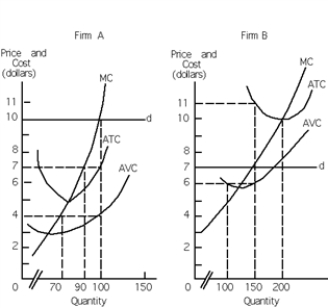 -Refer to Exhibit 22-8. What is the total revenue of Firm A at the profit-maximizing (or loss-minimizing) level of output?
 (Multiple Choice)
4.9/5 (82)
(82) If, for a perfectly competitive firm, price is greater than average variable cost, then it follows that
(Multiple Choice)
4.9/5 (85)
(85) Exhibit 22-9
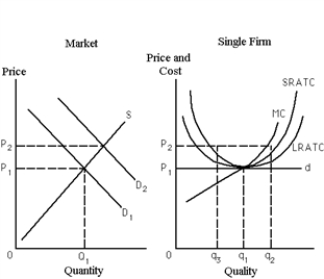 -Refer to Exhibit 22-9. Following an increase in market demand from D1 to D2, the firm's profits in the short run will
 (Multiple Choice)
5.0/5 (94)
(94) Exhibit 22-3
-Refer to Exhibit 22-3. Based upon the information provided in this table, what is the maximum profit this firm can earn?
-Refer to Exhibit 22-3. Based upon the information provided in this table, what is the maximum profit this firm can earn? (Multiple Choice)
4.7/5 (76)
(76) Which of the following conditions does not characterize long-run competitive equilibrium?
(Multiple Choice)
4.8/5 (69)
(69) List and describe the four assumptions that underlie the theory of perfect competition.
(Essay)
4.9/5 (79)
(79) When a firm produces the quantity of output where price equals marginal cost, it has achieved resource allocative efficiency.
(True/False)
5.0/5 (76)
(76) Exhibit 22-1

-Refer to Exhibit 22-1. The dollar amounts that go in blanks (A) and (B) are, respectively,
-Refer to Exhibit 22-1. The dollar amounts that go in blanks (A) and (B) are, respectively, (Multiple Choice)
4.9/5 (82)
(82) Exhibit 22-8
-Refer to Exhibit 22-8. What is the profit (loss) of firm B at the profit-maximizing (or loss-minimizing) level of production?
-Refer to Exhibit 22-8. What is the profit (loss) of firm B at the profit-maximizing (or loss-minimizing) level of production? (Multiple Choice)
4.7/5 (81)
(81) 
Filters
- Essay(0)
- Multiple Choice(0)
- Short Answer(0)
- True False(0)
- Matching(0)