



 Chat with AI
Exam 22: Perfect Competition

Exam 1: What Economics Is About174 Questions
Exam 2: Production Possibilities Frontier Framework156 Questions
Exam 3: Supply and Demand Theory224 Questions
Exam 4: Prices Free Controlled and Relative122 Questions
Exam 5: Supply Demand and Price Applications76 Questions
Exam 6: Macroeconomic Measurements Part I Prices and Unemployment151 Questions
Exam 7: Macroeconomic Measurements Part II Gdp and Real Gdp150 Questions
Exam 8: Aggregate Demand and Aggregate Supply204 Questions
Exam 9: Classical Macroeconomics and the Self Regulating Economy172 Questions
Exam 10: Keynesian Macroeconomics and Economic Instability a Critique of the Self Regulating Economy200 Questions
Exam 11: Fiscal Policy and the Federal Budget167 Questions
Exam 12: Money Banking and the Financial System150 Questions
Exam 13: The Federal Reserve System180 Questions
Exam 14: Money and the Economy150 Questions
Exam 15: Monetary Policy185 Questions
Exam 16: Expectations Theory and the Economy150 Questions
Exam 17: Economic Growth Resources Technology Ideas and Institutions103 Questions
Exam 18: Debates in Macroeconomics Over the Role and Effects of Government100 Questions
Exam 19: Elasticity204 Questions
Exam 20: Consumer Choice and Behavioral Economics179 Questions
Exam 21: Production and Costs245 Questions
Exam 22: Perfect Competition187 Questions
Exam 23: Monopoly195 Questions
Exam 24: Monopolistic Competition Oligopoly and Game Theory172 Questions
Exam 25: Government and Product Markets Antitrust and Regulation158 Questions
Exam 26: Factor Markets With Emphasis on the Labor Market184 Questions
Exam 27: Wages Unions and Labor138 Questions
Exam 28: The Distribution of Income and Poverty99 Questions
Exam 29: Interest Rent and Profit198 Questions
Exam 30: Market Failure Externalities Public Goods and Asymmetric Information187 Questions
Exam 31: Public Choice and Special Interest Group Politics135 Questions
Exam 32: Building Theories to Explain Everyday Life From Observations to Questions to Theories to Predictions62 Questions
Exam 33: International Trade152 Questions
Exam 34: International Finance122 Questions
Exam 35: The Economic Case for and Against Government Five Topics Considered87 Questions
Exam 36: Stocks Bonds Futures and Options110 Questions
Select questions type


The price charged by a perfectly competitive firm is determined by
(Multiple Choice)
4.8/5  (74)
(74) Exhibit 22-10
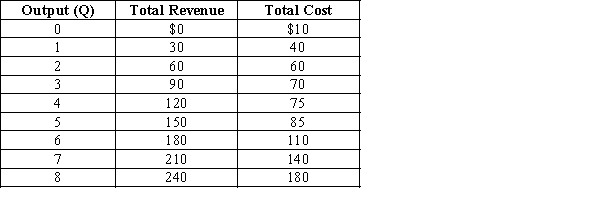
-Refer to Exhibit 22-10. Is the firm depicted here a perfectly competitive firm?
-Refer to Exhibit 22-10. Is the firm depicted here a perfectly competitive firm? (Multiple Choice)
4.9/5 (76)
(76) The demand curve faced by a perfectly competitive firm is horizontal at the price determined in the market.
(True/False)
4.9/5 (74)
(74) In a perfectly competitive market, if a resource that one firm utilizes is superior to resources used by other firms, and, as a result, lowers unit costs for the firm, that firm is likely to earn __________ in the short run. In time, however, the firm's __________ curve will rise to reflect the superior-quality of the resource it employs and the firm will then earn __________.
(Multiple Choice)
4.9/5 (80)
(80) Exhibit 22-8
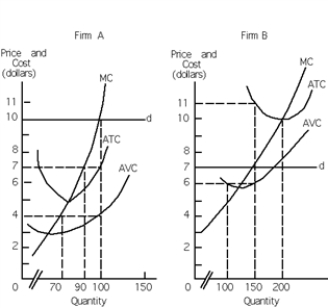 -Refer to Exhibit 22-8. What is the total fixed cost of firm B at the profit-maximizing (or loss-minimizing) level of output?
 (Multiple Choice)
4.9/5 (89)
(89) For a price taker, market equilibrium price is $50. At 1,000 units, MR = MC, ATC = $45, and AVC = $30. This price taker will
(Multiple Choice)
5.0/5 (70)
(70) 
Filters
- Essay(0)
- Multiple Choice(0)
- Short Answer(0)
- True False(0)
- Matching(0)