



 Chat with AI
Exam 22: Perfect Competition

Exam 1: What Economics Is About174 Questions
Exam 2: Production Possibilities Frontier Framework156 Questions
Exam 3: Supply and Demand Theory224 Questions
Exam 4: Prices Free Controlled and Relative122 Questions
Exam 5: Supply Demand and Price Applications76 Questions
Exam 6: Macroeconomic Measurements Part I Prices and Unemployment151 Questions
Exam 7: Macroeconomic Measurements Part II Gdp and Real Gdp150 Questions
Exam 8: Aggregate Demand and Aggregate Supply204 Questions
Exam 9: Classical Macroeconomics and the Self Regulating Economy172 Questions
Exam 10: Keynesian Macroeconomics and Economic Instability a Critique of the Self Regulating Economy200 Questions
Exam 11: Fiscal Policy and the Federal Budget167 Questions
Exam 12: Money Banking and the Financial System150 Questions
Exam 13: The Federal Reserve System180 Questions
Exam 14: Money and the Economy150 Questions
Exam 15: Monetary Policy185 Questions
Exam 16: Expectations Theory and the Economy150 Questions
Exam 17: Economic Growth Resources Technology Ideas and Institutions103 Questions
Exam 18: Debates in Macroeconomics Over the Role and Effects of Government100 Questions
Exam 19: Elasticity204 Questions
Exam 20: Consumer Choice and Behavioral Economics179 Questions
Exam 21: Production and Costs245 Questions
Exam 22: Perfect Competition187 Questions
Exam 23: Monopoly195 Questions
Exam 24: Monopolistic Competition Oligopoly and Game Theory172 Questions
Exam 25: Government and Product Markets Antitrust and Regulation158 Questions
Exam 26: Factor Markets With Emphasis on the Labor Market184 Questions
Exam 27: Wages Unions and Labor138 Questions
Exam 28: The Distribution of Income and Poverty99 Questions
Exam 29: Interest Rent and Profit198 Questions
Exam 30: Market Failure Externalities Public Goods and Asymmetric Information187 Questions
Exam 31: Public Choice and Special Interest Group Politics135 Questions
Exam 32: Building Theories to Explain Everyday Life From Observations to Questions to Theories to Predictions62 Questions
Exam 33: International Trade152 Questions
Exam 34: International Finance122 Questions
Exam 35: The Economic Case for and Against Government Five Topics Considered87 Questions
Exam 36: Stocks Bonds Futures and Options110 Questions
Select questions type


Exhibit 22-10
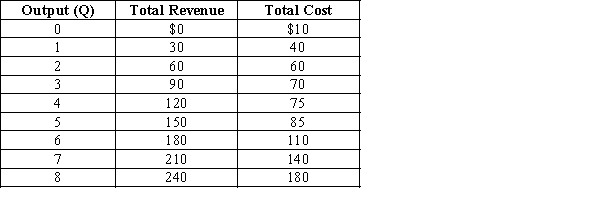
-Refer to Exhibit 22-10. What is the marginal revenue and marginal cost, respectively, of the 7th unit of output?
-Refer to Exhibit 22-10. What is the marginal revenue and marginal cost, respectively, of the 7th unit of output? (Multiple Choice)
5.0/5  (77)
(77) Exhibit 22-8
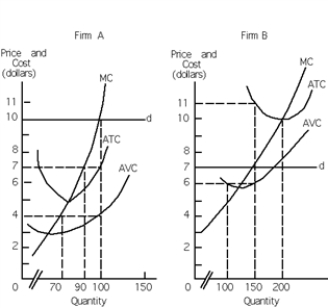 -Refer to Exhibit 22-8. What is the total cost of firm B at the profit-maximizing (or loss-minimizing) level of production?
 (Multiple Choice)
4.9/5 (85)
(85) Exhibit 22-1

-Refer to Exhibit 22-1. The marginal revenue curve represented by the information in this table is
-Refer to Exhibit 22-1. The marginal revenue curve represented by the information in this table is (Multiple Choice)
4.9/5 (79)
(79) A firm operating in a perfectly competitive market finds itself producing a level of output for which marginal revenue is less than marginal cost. In order to maximize profits (or minimize losses), the firm should
(Multiple Choice)
4.8/5 (84)
(84) If, for the last unit of a good produced by a perfectly competitive firm, MR > MC, then in producing that unit the firm
(Multiple Choice)
4.8/5 (69)
(69) A constant-cost industry has a long-run (industry) supply curve that is
(Multiple Choice)
4.9/5 (81)
(81) One of the assumptions upon which the theory of perfect competition is built is that each firm produces and sells a heterogeneous product.
(True/False)
4.9/5 (85)
(85) There are 200 firms in a perfectly competitive industry. Half of the firms supply 100 units at $3 per unit and the other half of the firms supply 130 units at $3 per unit. One point on the market supply curve is
(Multiple Choice)
4.8/5 (74)
(74) When the perfectly competitive firm produces the quantity of output at which marginal revenue equals marginal cost, it naturally
(Multiple Choice)
4.8/5 (72)
(72) Exhibit 22-1
-Refer to Exhibit 22-1. The dollar amounts that go in blanks (C) and (D) are, respectively,
-Refer to Exhibit 22-1. The dollar amounts that go in blanks (C) and (D) are, respectively, (Multiple Choice)
4.9/5 (74)
(74) At the quantity of output for which total revenue equals total cost,
(Multiple Choice)
5.0/5 (74)
(74) If, for a perfectly competitive firm, marginal cost is greater than marginal revenue for the 100th unit, then it follows that
(Multiple Choice)
4.8/5 (78)
(78) Which of the following is not an assumption of the theory of perfect competition?
(Multiple Choice)
4.9/5 (83)
(83) Exhibit 22-4
 -Refer to Exhibit 22-4. The market equilibrium price is P1 and the firm produces Q1. At this level of output, average variable cost and average total cost are indicated by the dots. Given this situation, the firm is
 (Multiple Choice)
4.9/5 (67)
(67) Exhibit 22-8
-Refer to Exhibit 22-8. What is the total fixed cost of firm A at the profit-maximizing (or loss-minimizing) level of output?
-Refer to Exhibit 22-8. What is the total fixed cost of firm A at the profit-maximizing (or loss-minimizing) level of output? (Multiple Choice)
4.9/5 (74)
(74) Exhibit 22-7
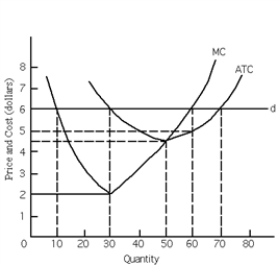 -Refer to Exhibit 22-7. At the profit-maximizing output level, average total cost is
 (Multiple Choice)
4.7/5 (69)
(69) Firm X is producing the quantity of output at which marginal revenue equals marginal cost. It is earning
(Multiple Choice)
4.7/5 (85)
(85) 
Filters
- Essay(0)
- Multiple Choice(0)
- Short Answer(0)
- True False(0)
- Matching(0)