



 Chat with AI
Exam 22: Perfect Competition

Exam 1: What Economics Is About174 Questions
Exam 2: Production Possibilities Frontier Framework156 Questions
Exam 3: Supply and Demand Theory224 Questions
Exam 4: Prices Free Controlled and Relative122 Questions
Exam 5: Supply Demand and Price Applications76 Questions
Exam 6: Macroeconomic Measurements Part I Prices and Unemployment151 Questions
Exam 7: Macroeconomic Measurements Part II Gdp and Real Gdp150 Questions
Exam 8: Aggregate Demand and Aggregate Supply204 Questions
Exam 9: Classical Macroeconomics and the Self Regulating Economy172 Questions
Exam 10: Keynesian Macroeconomics and Economic Instability a Critique of the Self Regulating Economy200 Questions
Exam 11: Fiscal Policy and the Federal Budget167 Questions
Exam 12: Money Banking and the Financial System150 Questions
Exam 13: The Federal Reserve System180 Questions
Exam 14: Money and the Economy150 Questions
Exam 15: Monetary Policy185 Questions
Exam 16: Expectations Theory and the Economy150 Questions
Exam 17: Economic Growth Resources Technology Ideas and Institutions103 Questions
Exam 18: Debates in Macroeconomics Over the Role and Effects of Government100 Questions
Exam 19: Elasticity204 Questions
Exam 20: Consumer Choice and Behavioral Economics179 Questions
Exam 21: Production and Costs245 Questions
Exam 22: Perfect Competition187 Questions
Exam 23: Monopoly195 Questions
Exam 24: Monopolistic Competition Oligopoly and Game Theory172 Questions
Exam 25: Government and Product Markets Antitrust and Regulation158 Questions
Exam 26: Factor Markets With Emphasis on the Labor Market184 Questions
Exam 27: Wages Unions and Labor138 Questions
Exam 28: The Distribution of Income and Poverty99 Questions
Exam 29: Interest Rent and Profit198 Questions
Exam 30: Market Failure Externalities Public Goods and Asymmetric Information187 Questions
Exam 31: Public Choice and Special Interest Group Politics135 Questions
Exam 32: Building Theories to Explain Everyday Life From Observations to Questions to Theories to Predictions62 Questions
Exam 33: International Trade152 Questions
Exam 34: International Finance122 Questions
Exam 35: The Economic Case for and Against Government Five Topics Considered87 Questions
Exam 36: Stocks Bonds Futures and Options110 Questions
Select questions type


Exhibit 22-9
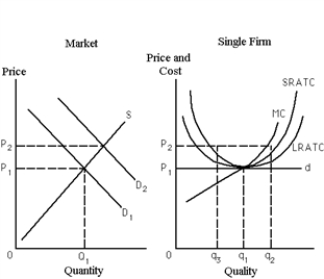 -Refer to Exhibit 22-9. Suppose that the market starts out at long-run competitive equilibrium with price equal to P1 and producing Q1 output, and then demand increases from D1 to D2. As a consequence, the typical profit-maximizing firm will
 (Multiple Choice)
4.8/5  (81)
(81) Which of the assumptions below assures us that economic profit will be zero in long-run equilibrium for perfectly competitive firms?
(Multiple Choice)
4.9/5 (79)
(79) Consider the following data: equilibrium price = $12.50, quantity of output produced = 1,000 units, average total cost = $15, and average variable cost = $13. What will the firm do and why?
(Multiple Choice)
4.9/5 (73)
(73) In long-run competitive equilibrium, no firm has an incentive to change its plant size.
(True/False)
4.7/5 (75)
(75) Exhibit 22-2
 -Refer to Exhibit 22-2. What quantity of output does the profit-maximizing (or loss-minimizing) firm produce?
 (Multiple Choice)
4.9/5 (65)
(65) Which of the following is the best example of a homogeneous good?
(Multiple Choice)
4.9/5 (77)
(77) A perfectly competitive market is initially in long-run competitive equilibrium. Then, market demand falls. This causes the marginal revenue curves for existing firms to shift __________ and for these firms to produce __________ output. Some of the existing firms will end up __________.
(Multiple Choice)
4.9/5 (84)
(84) A firm that is a price taker will not sell any of its product for less than the equilibrium price because
(Multiple Choice)
4.8/5 (81)
(81) When an industry is described as a decreasing-cost, increasing-cost, or constant-cost industry, the "cost" that is being referred to is
(Multiple Choice)
4.8/5 (91)
(91) A perfectly competitive firm that wants to maximize profits or minimize losses will produce in the short run as long as
(Multiple Choice)
4.9/5 (81)
(81) Exhibit 22-8
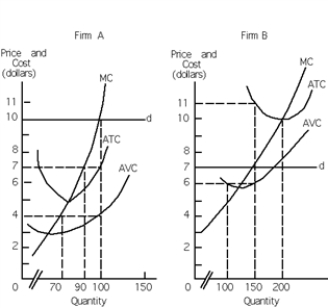 -Refer to Exhibit 22-8. What is the total revenue of firm B at profit-maximizing (or loss-minimizing) level of output?
 (Multiple Choice)
4.9/5 (75)
(75) Perfectly competitive firms are price takers for all of the following reasons except that
(Multiple Choice)
4.9/5 (83)
(83) A perfectly competitive market is initially in long-run competitive equilibrium. Then, market demand increases. By the time all adjustments have been made, price will be __________ its original level if the industry is a(n) __________ cost industry.
(Multiple Choice)
4.9/5 (82)
(82) Assume the following for a certain industry: (l) there is no incentive for firms to enter or exit the industry; (2) for some firms in the industry, short-run average total cost is greater than long-run average total cost at the level of output where marginal revenue equals marginal cost; (3) all firms in the industry are currently producing the quantity of output at which marginal revenue equals marginal cost. Is the industry in long-run competitive equilibrium?
(Multiple Choice)
4.8/5 (73)
(73) In order for a firm to continue producing, price must exceed __________ and total revenue must exceed __________.
(Multiple Choice)
4.7/5 (87)
(87) A firm produces the quantity of output at which P = MC and P = ATC. It follows that the firm is
(Multiple Choice)
4.7/5 (78)
(78) 
Filters
- Essay(0)
- Multiple Choice(0)
- Short Answer(0)
- True False(0)
- Matching(0)