



 Chat with AI
Exam 20: Thermodynamics: Entropy, Free Energy, and the Direction of Chemical Reactions

Exam 1: Keys to the Study of Chemistry68 Questions
Exam 2: The Components of Matter104 Questions
Exam 3: Stoichiometry of Formulas and Equations96 Questions
Exam 4: Three Major Classes of Chemical Reactions105 Questions
Exam 5: Gases and the Kinetic-Molecular Theory103 Questions
Exam 6: Thermochemistry: Energy Flow and Chemical Change79 Questions
Exam 7: Quantum Theory and Atomic Structure74 Questions
Exam 8: Electron Configuration and Chemical Periodicity81 Questions
Exam 9: Models of Chemical Bonding73 Questions
Exam 10: The Shapes of Molecules108 Questions
Exam 11: Theories of Covalent Bonding56 Questions
Exam 12: Intermolecular Forces: Liquids, Solids, and Phase Changes97 Questions
Exam 13: The Properties of Mixtures: Solutions and Colloids98 Questions
Exam 14: Periodic Patterns in the Main-Group Elements111 Questions
Exam 15: Organic Compounds and the Atomic Properties of Carbon113 Questions
Exam 16: Kinetics: Rates and Mechanisms of Chemical Reactions89 Questions
Exam 17: Equilibrium: the Extent of Chemical Reactions102 Questions
Exam 18: Acid-Base Equilibria106 Questions
Exam 19: Ionic Equilibria in Aqueous Systems115 Questions
Exam 20: Thermodynamics: Entropy, Free Energy, and the Direction of Chemical Reactions85 Questions
Exam 21: Electrochemistry: Chemical Change and Electrical Work102 Questions
Exam 22: The Elements in Nature and Industry56 Questions
Exam 23: The Transition Elements and Their Coordination Compounds92 Questions
Exam 24: Nuclear Reactions and Their Applications90 Questions
Select questions type


The water-gas shift reaction plays an important role in the production of clean fuel from coal.
(Essay)
4.8/5  (76)
(76) Which relationship or statement best describes S for the following reaction? 
(Multiple Choice)
4.8/5 (96)
(96) The higher the pressure of a gas sample, the greater is its entropy.
(True/False)
4.8/5 (80)
(80) 

Which relationship or statement best describes S for the following reaction? 
(Multiple Choice)
4.9/5 (72)
(72) A sample of water is heated at a constant pressure of one atmosphere. Initially, the sample is ice at 260 K, and at the end the sample consists of steam at 400 K. In which of the following 5 K temperature intervals would there be the greatest increase in the entropy of the sample?
(Multiple Choice)
4.9/5 (72)
(72) Which relationship or statement best describes S for the following reaction? 
(Multiple Choice)
4.9/5 (81)
(81) For a process with S < 0, which one of the following statements is correct?
(Multiple Choice)
4.9/5 (78)
(78) Which one of the following changes of state increases the entropy of the system?
(Multiple Choice)
4.8/5 (76)
(76) The entropy of one mole of oxygen gas in a 0.5-L container is less than it would be in a 22.4-L container at the same temperature.
(True/False)
4.7/5 (89)
(89) Use the thermodynamic data at 298 K below to determine the Ksp for barium carbonate, BaCO3 at this temperature. 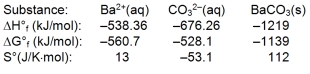
(Multiple Choice)
4.7/5 (88)
(88) Which relationship or statement best describes S for the following reaction? 
(Multiple Choice)
4.9/5 (84)
(84) As a chemical reaction proceeds toward equilibrium, the free energy of the system decreases.
(True/False)
4.8/5 (81)
(81) Which of the following should have the greatest molar entropy at 298 K?
(Multiple Choice)
4.9/5 (65)
(65) The temperature at which the following process reaches equilibrium at 1.0 atm is the normal boiling point of hydrogen peroxide.
(Short Answer)
4.9/5 (74)
(74) Hydrogen sulfide decomposes according to the following reaction:  For this reaction at 298 K, S = 78.1 J/K, H = 169.4 kJ, and G = 146.1 kJ. What is the value of G at 900 K?
 (Multiple Choice)
4.8/5 (83)
(83) The term "microstate" refers to the energy state of a single molecule in a system of many molecules.
(True/False)
4.8/5 (80)
(80) 
Filters
- Essay(0)
- Multiple Choice(0)
- Short Answer(0)
- True False(0)
- Matching(0)