



 Chat with AI
Exam 20: Thermodynamics: Entropy, Free Energy, and the Direction of Chemical Reactions

Exam 1: Keys to the Study of Chemistry68 Questions
Exam 2: The Components of Matter104 Questions
Exam 3: Stoichiometry of Formulas and Equations96 Questions
Exam 4: Three Major Classes of Chemical Reactions105 Questions
Exam 5: Gases and the Kinetic-Molecular Theory103 Questions
Exam 6: Thermochemistry: Energy Flow and Chemical Change79 Questions
Exam 7: Quantum Theory and Atomic Structure74 Questions
Exam 8: Electron Configuration and Chemical Periodicity81 Questions
Exam 9: Models of Chemical Bonding73 Questions
Exam 10: The Shapes of Molecules108 Questions
Exam 11: Theories of Covalent Bonding56 Questions
Exam 12: Intermolecular Forces: Liquids, Solids, and Phase Changes97 Questions
Exam 13: The Properties of Mixtures: Solutions and Colloids98 Questions
Exam 14: Periodic Patterns in the Main-Group Elements111 Questions
Exam 15: Organic Compounds and the Atomic Properties of Carbon113 Questions
Exam 16: Kinetics: Rates and Mechanisms of Chemical Reactions89 Questions
Exam 17: Equilibrium: the Extent of Chemical Reactions102 Questions
Exam 18: Acid-Base Equilibria106 Questions
Exam 19: Ionic Equilibria in Aqueous Systems115 Questions
Exam 20: Thermodynamics: Entropy, Free Energy, and the Direction of Chemical Reactions85 Questions
Exam 21: Electrochemistry: Chemical Change and Electrical Work102 Questions
Exam 22: The Elements in Nature and Industry56 Questions
Exam 23: The Transition Elements and Their Coordination Compounds92 Questions
Exam 24: Nuclear Reactions and Their Applications90 Questions
Select questions type


Which, if any, of the following processes is spontaneous under the specified conditions?

Free
(Multiple Choice)
4.7/5  (71)
(71) Correct Answer: Verified
B
In a spontaneous process, the entropy of the system always increases.
Free
(True/False)
4.7/5 (90)
(90) Correct Answer:Verified
VerifiedFalse
Which relationship or statement best describes S for the following reaction? 2H2S(g) + 3O2(g) 2H2O(g) + 2SO2(g)
Free
(Multiple Choice)
4.9/5 (74)
(74) Correct Answer:Verified
VerifiedB
In tables of thermodynamic data provided in chemistry books, one finds H f, G f and S listed. Briefly, explain why the entropy data are supplied as S , while the enthalpy and free energy data are in the form of H f and G 1U1B1f, respectively.
(Essay)
4.9/5 (80)
(80) A reaction has G= 10.0 kJ and G = 15.0 kJ at a temperature of 50 C. Calculate the value of the reaction quotient Q under these conditions.
(Multiple Choice)
5.0/5 (81)
(81) You are given pure samples of ethane, C2H6(g), and toluene, C7H8(l). What prediction would you make concerning their standard molar entropies at 298 K?
(Multiple Choice)
4.7/5 (71)
(71) A reaction is proceeding towards equilibrium. At a certain stage, the concentrations of reactants and products are such that G = G . What conclusion can reasonably be drawn about the reaction at this time?
(Multiple Choice)
4.8/5 (78)
(78) Which of the following results in a decrease in the entropy of the system?
(Multiple Choice)
4.8/5 (86)
(86) You are given pure samples of ammonia, NH3(g), and nitrogen trifluoride, NF3(g). What prediction would you make concerning their standard molar entropies at 298 K?
(Multiple Choice)
4.9/5 (81)
(81) What is the free energy change, G , for the equilibrium between hydrogen iodide, hydrogen, and iodine at 453 C?
Kc = 0.020 
(Multiple Choice)
4.8/5 (73)
(73) Given: C2H2(g) 2C(graphite) + H2(g), G = -209 kJ
A sample of gaseous C2H2 (acetylene, or ethyne) was stored for one year, yet at the end of this period, the sample remained unchanged and no graphite or hydrogen gas had been formed. Briefly explain why there is no inconsistency between the sign of G and the apparent stability of the sample.
(Essay)
4.8/5 (82)
(82) Which relationship or statement best describes S for the following reaction?
Pb(s) + Cl2(g) PbCl2(s)
(Multiple Choice)
4.7/5 (78)
(78) Given: H2O(l) H2O(s), H = -6.02 kJ at 273K, calculate the entropy change of the surroundings ( Ssurr) when one mole of water freezes at 0 C and a pressure of one atmosphere.
(Multiple Choice)
4.9/5 (70)
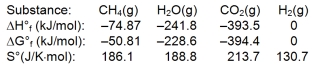
(70) The reaction of methane with water to form carbon dioxide and hydrogen is non-spontaneous at 298 K. At what temperature will this system make the transition from non-spontaneous to spontaneous? The data refer to 298 K. 
(Multiple Choice)
4.8/5 (72)
(72) 

For a chemical reaction to be spontaneous only at low temperatures, which of the following conditions must be met?
(Multiple Choice)
4.8/5 (79)
(79) 

A reaction has a positive value of H and a positive value of S . Draw a neat, labeled schematic plot to show how G (y-axis) will depend on absolute temperature (x-axis).
(Essay)
4.8/5 (72)
(72) 
Filters
- Essay(0)
- Multiple Choice(0)
- Short Answer(0)
- True False(0)
- Matching(0)