



 Chat with AI
Exam 17: Equilibrium: the Extent of Chemical Reactions

Exam 1: Keys to the Study of Chemistry68 Questions
Exam 2: The Components of Matter104 Questions
Exam 3: Stoichiometry of Formulas and Equations96 Questions
Exam 4: Three Major Classes of Chemical Reactions105 Questions
Exam 5: Gases and the Kinetic-Molecular Theory103 Questions
Exam 6: Thermochemistry: Energy Flow and Chemical Change79 Questions
Exam 7: Quantum Theory and Atomic Structure74 Questions
Exam 8: Electron Configuration and Chemical Periodicity81 Questions
Exam 9: Models of Chemical Bonding73 Questions
Exam 10: The Shapes of Molecules108 Questions
Exam 11: Theories of Covalent Bonding56 Questions
Exam 12: Intermolecular Forces: Liquids, Solids, and Phase Changes97 Questions
Exam 13: The Properties of Mixtures: Solutions and Colloids98 Questions
Exam 14: Periodic Patterns in the Main-Group Elements111 Questions
Exam 15: Organic Compounds and the Atomic Properties of Carbon113 Questions
Exam 16: Kinetics: Rates and Mechanisms of Chemical Reactions89 Questions
Exam 17: Equilibrium: the Extent of Chemical Reactions102 Questions
Exam 18: Acid-Base Equilibria106 Questions
Exam 19: Ionic Equilibria in Aqueous Systems115 Questions
Exam 20: Thermodynamics: Entropy, Free Energy, and the Direction of Chemical Reactions85 Questions
Exam 21: Electrochemistry: Chemical Change and Electrical Work102 Questions
Exam 22: The Elements in Nature and Industry56 Questions
Exam 23: The Transition Elements and Their Coordination Compounds92 Questions
Exam 24: Nuclear Reactions and Their Applications90 Questions
Select questions type


In water, the following equilibrium exists:  In pure water at 25 C, the concentration of H+ ions is 1.00 * 10¯7 mol/L. Calculate the value of the equilibrium constant for the reaction as written above.
Free
(Multiple Choice)
4.9/5  (66)
(66) Correct Answer: Verified
A
At a high temperature, the following reaction has an equilibrium constant of 1.0 *102. 
Free
(Essay)
4.8/5 (78)
(78) Correct Answer:Verified
VerifiedIf 1.00 mol of each of H2 and F2 are allowed to come to equilibrium in a 10.0 L vessel, calculate the equilibrium amounts of H2 and HF. 0.17 mol of H2 and 1.7 mol of HF
Although a system may be at equilibrium, the rate constants of the forward and reverse reactions will in general be different.
Free
(True/False)
4.9/5 (86)
(86) Correct Answer:Verified
VerifiedTrue
An equilibrium is established in which both the forward (fwd) and the reverse (rev) reactions are elementary. If the equilibrium constant Kc = 1.6 *10¯2 and the rate constant kfwd = 8.0 * 10¯7 s¯1 what is the value of krev?
(Multiple Choice)
4.9/5 (79)
(79) When 0.152 mol of solid PH3BCl3 is introduced into a 3.0 L container at a certain temperature, 8.44 *10¯3 mol of PH3 is present at equilibrium:
PH3BCl3(s)  PH3(g) + BCl3(g)
Construct a reaction table for the process, and use it to calculate Kc at this temperature.
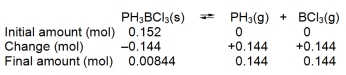
PH3(g) + BCl3(g)
Construct a reaction table for the process, and use it to calculate Kc at this temperature.
(Essay)
4.8/5 (71)
(71) Carbon monoxide and chlorine combine in an equilibrium reaction to produce the highly toxic product, phosgene (COCl2).  If the equilibrium constant for this reaction is Kc = 248, predict, if possible, what will happen when the reactants and product are combined with the concentrations shown. [CO] = [Cl2] = 0.0200 M; [COCl2] = 0.0992 M
 (Multiple Choice)
4.7/5 (71)
(71) Write the mass-action expression, Qc, for the following chemical reaction. 
(Multiple Choice)
4.7/5 (74)
(74) For a solution equilibrium, a change in concentration of a reactant or product does not change Kc.
(True/False)
4.8/5 (78)
(78) There is a direct correlation between the speed of a reaction and its equilibrium constant.
(True/False)
4.9/5 (84)
(84) The two equilibrium constants for the same reaction, Kc and Kp, will always equal one another when
(Multiple Choice)
4.9/5 (74)
(74) In order to write the correct mass-action expression for a reaction one must
(Multiple Choice)
4.7/5 (73)
(73) Consider the equilibrium reaction:  Which of the following correctly describes the relationship between Kc and Kp for the reaction?
 (Multiple Choice)
4.9/5 (64)
(64) The equilibrium constant, Kc, for the decomposition of COBr2 
(Multiple Choice)
4.7/5 (62)
(62) Given this equilibrium constant data at 25 C,  what is the value of Kc at this temperature for the reaction

what is the value of Kc at this temperature for the reaction (Multiple Choice)
4.8/5 (82)
(82) Methanol can be synthesized by combining carbon monoxide and hydrogen.  A reaction vessel contains these compounds at equilibrium. What effect will be seen when equilibrium is reestablished after decreasing the temperature by 45 C?
 (Multiple Choice)
4.9/5 (96)
(96) Increasing the initial amount of the limiting reactant in a reaction will increase the value of the equilibrium constant, Kc.
(True/False)
5.0/5 (84)
(84) For a gas-phase equilibrium, a change in the pressure of any single reactant or product will affect the amounts of other substances involved in the equilibrium.
(True/False)
4.8/5 (76)
(76) Methanol can be synthesized by combining carbon monoxide and hydrogen.  A reaction vessel contains the three gases at equilibrium with a total pressure of 1.00 atm. What will happen to the partial pressure of hydrogen if enough argon is added to raise the total pressure to 1.4 atm?
 (Multiple Choice)
5.0/5 (93)
(93) Consider the reactions of cadmium with the thiosulfate anion.  What is the value for the equilibrium constant for the following reaction?

What is the value for the equilibrium constant for the following reaction? (Multiple Choice)
4.9/5 (86)
(86) Write the mass-action expression, Qc, for the following chemical reaction. 
(Multiple Choice)
4.9/5 (88)
(88) 
Filters
- Essay(0)
- Multiple Choice(0)
- Short Answer(0)
- True False(0)
- Matching(0)