



 Chat with AI
Exam 20: Thermodynamics: Entropy, Free Energy, and the Direction of Chemical Reactions

Exam 1: Keys to the Study of Chemistry68 Questions
Exam 2: The Components of Matter104 Questions
Exam 3: Stoichiometry of Formulas and Equations96 Questions
Exam 4: Three Major Classes of Chemical Reactions105 Questions
Exam 5: Gases and the Kinetic-Molecular Theory103 Questions
Exam 6: Thermochemistry: Energy Flow and Chemical Change79 Questions
Exam 7: Quantum Theory and Atomic Structure74 Questions
Exam 8: Electron Configuration and Chemical Periodicity81 Questions
Exam 9: Models of Chemical Bonding73 Questions
Exam 10: The Shapes of Molecules108 Questions
Exam 11: Theories of Covalent Bonding56 Questions
Exam 12: Intermolecular Forces: Liquids, Solids, and Phase Changes97 Questions
Exam 13: The Properties of Mixtures: Solutions and Colloids98 Questions
Exam 14: Periodic Patterns in the Main-Group Elements111 Questions
Exam 15: Organic Compounds and the Atomic Properties of Carbon113 Questions
Exam 16: Kinetics: Rates and Mechanisms of Chemical Reactions89 Questions
Exam 17: Equilibrium: the Extent of Chemical Reactions102 Questions
Exam 18: Acid-Base Equilibria106 Questions
Exam 19: Ionic Equilibria in Aqueous Systems115 Questions
Exam 20: Thermodynamics: Entropy, Free Energy, and the Direction of Chemical Reactions85 Questions
Exam 21: Electrochemistry: Chemical Change and Electrical Work102 Questions
Exam 22: The Elements in Nature and Industry56 Questions
Exam 23: The Transition Elements and Their Coordination Compounds92 Questions
Exam 24: Nuclear Reactions and Their Applications90 Questions
Select questions type


Use the given data at 298 K to calculate G for the reaction 

(Multiple Choice)
4.9/5  (92)
(92) Which of the following values is based on the Third Law of Thermodynamics?
(Multiple Choice)
4.7/5 (75)
(75) "A diamond is forever" is one of the most successful advertising slogans of all time. But is it true? For the reaction shown below, calculate the standard free energy change at 298 K and determine whether or not a diamond is "forever." C(diamond) C(graphite)
Data: Hf (diamond) = 1.895 kJ/mol; S (diamond) = 2.337 J mol¯1 K¯1; S (graphite) = 5.740 J mol¯1K¯1.
(Multiple Choice)
4.9/5 (83)
(83) Which of the following is true for a system at equilibrium?
(Multiple Choice)
4.9/5 (72)
(72) For a chemical reaction to be spontaneous at all temperatures, which of the following conditions must be met?
(Multiple Choice)
4.9/5 (77)
(77) In which one of the following pairs will the first system have a higher entropy than the second? Assume P and T are the same for each pair, unless stated otherwise.
(Multiple Choice)
4.9/5 (75)
(75) Which relationship or statement best describes S for the following reaction? HgS(s) + O2(g) Hg(l) + SO2(g)
(Multiple Choice)
4.7/5 (81)
(81) Which relationship or statement best describes S for the following reaction? 2NH3(g) + 2ClF3(g) 6HF(g) + N2(g) + Cl2(g)
(Multiple Choice)
4.9/5 (80)
(80) A chemical reaction has H = 42.8 kJ and S = 92.5 J/K, at 25 C. Calculate the temperature at which G = 0. State any approximation involved in your calculation.
(Essay)
4.9/5 (80)
(80) In the expression, S = k ln W, W is called the number of microstates. Explain clearly the meaning of the word "microstate," and why a system under a given set of conditions normally has many microstates.
(Essay)
4.8/5 (84)
(84) You are given pure samples of pentane, , and 1,3-pentadiene, What prediction would you make concerning their standard molar entropies at 298 K?
(Multiple Choice)
4.8/5 (83)
(83) (p. Various sections) For a given reaction, a change in the pressure may result in a change in the sign of G.
(True/False)
4.9/5 (89)
(89) Consider the figure below which shows G for a chemical process plotted against absolute temperature. 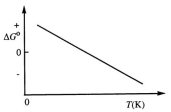 From this plot, it is reasonable to conclude that:
 (Multiple Choice)
4.9/5 (79)
(79) A certain process has 0H > 0, S < 0, and G > 0. The values of H and S do not depend on the temperature. Which of the following is a correct conclusion about this process?
(Multiple Choice)
4.9/5 (74)
(74) Which relationship or statement best describes S for the following reaction? 
(Multiple Choice)
4.7/5 (94)
(94) Which of the following conditions will ensure that a chemical reaction will definitely proceed in the forward direction, toward products?
(Multiple Choice)
5.0/5 (86)
(86) Elemental boron can be formed by reaction of boron trichloride with hydrogen.  Calculate G for the reaction.

Calculate G for the reaction. (Multiple Choice)
5.0/5 (77)
(77) Which one of the following phase changes decreases the entropy of the system?
(Multiple Choice)
4.8/5 (81)
(81) Elemental boron can be formed by reaction of boron trichloride with hydrogen. 
 If S = 80.3 J/K for the reaction above, what is S for BCl3(g)?
 (Multiple Choice)
4.8/5 (71)
(71) 
Filters
- Essay(0)
- Multiple Choice(0)
- Short Answer(0)
- True False(0)
- Matching(0)