



 Chat with AI
Exam 25: Budgetary Control and Responsibility Accounting

Exam 1: Accounting in Action220 Questions
Exam 2: The Recording Process192 Questions
Exam 3: Adjusting the Accounts216 Questions
Exam 4: Completing the Accounting Cycle203 Questions
Exam 5: Accounting for Merchandising Operations221 Questions
Exam 6: Inventories204 Questions
Exam 7: Accounting Information Systems139 Questions
Exam 8: Fraud, Internal Control, and Cash212 Questions
Exam 9: Accounting for Receivables220 Questions
Exam 10: Plant Assets, Natural Resources, and Intangible Assets293 Questions
Exam 11: Current Liabilities and Payroll Accounting207 Questions
Exam 12: Accounting for Partnerships210 Questions
Exam 13: Corporations: Organization and Capital Stock Transactions195 Questions
Exam 14: Corporations: Dividends, Retained Earnings, and Income Reporting176 Questions
Exam 15: Long-Term Liabilities215 Questions
Exam 16: Investments178 Questions
Exam 17: Statement of Cash Flows203 Questions
Exam 18: Financial Analysis: the Big Picture225 Questions
Exam 19: Managerial Accounting197 Questions
Exam 20: Job Order Costing199 Questions
Exam 21: Process Costing198 Questions
Exam 22: Cost-Volume-Profit217 Questions
Exam 23: Incremental Analysis208 Questions
Exam 24: Budgetary Planning207 Questions
Exam 25: Budgetary Control and Responsibility Accounting207 Questions
Exam 26: Standard Costs and Balanced Scorecard221 Questions
Select questions type


Lake Company uses a standard cost accounting system. During March, 2011, the company reported the following manufacturing variances:  In addition, 15,000 units of product were sold at $18 per unit. Each unit sold had a standard cost of $12. Selling and administrative expenses for the month were $10,000.
Instructions
Prepare an income statement for management for the month ending March 31, 2011.
In addition, 15,000 units of product were sold at $18 per unit. Each unit sold had a standard cost of $12. Selling and administrative expenses for the month were $10,000.
Instructions
Prepare an income statement for management for the month ending March 31, 2011. (Essay)
4.8/5  (73)
(73) ToolTime has a standard of 1.5 pounds of materials per unit, at $4 per pound. In producing 2,000 units, ToolTime used 3,100 pounds of materials at a total cost of $12,090. ToolTime's materials quantity variance is
(Multiple Choice)
4.9/5 (84)
(84) The standard predetermined overhead rate must be based on direct labor hours as the standard activity index.
(True/False)
4.8/5 (89)
(89) Keller Company has a materials price standard of $2.00 per pound. Five thousand pounds of materials were purchased at $2.20 a pound. The actual quantity of materials used was 5,000 pounds, although the standard quantity allowed for the output was 4,500 pounds.
Keller Company's materials quantity variance is
(Multiple Choice)
4.8/5 (81)
(81) An advantage of standard costs is that they simplify costing of inventories and reduce clerical costs.
(True/False)
4.9/5 (86)
(86) Ratliff Industries provided the following information about its standard costing system for 2011: 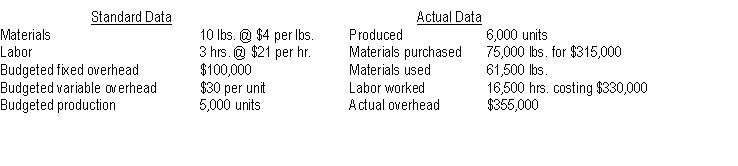 Instructions
Calculate the labor price variance and the labor quantity variance.
Instructions
Calculate the labor price variance and the labor quantity variance. (Essay)
4.9/5 (77)
(77) The labor time requirements for standards may be determined by the
(Multiple Choice)
4.8/5 (81)
(81) Parnell Company prepared its income statement for internal use. How would amounts for cost of goods sold and variances appear?
(Multiple Choice)
4.8/5 (91)
(91) Lloyd Inc. manufactures and sells a nutrition drink for children. It wants to develop a standard cost per gallon. The following are required for production of a 100 gallon batch:
1,960 ounces of lime Kool-Drink at $.12 per ounce
40 pounds of granulated sugar at $.60 per pound
63 kiwi fruit at $.50 each
100 protein tablets at $.90 each
4,000 ounces of water at $.003 per ounce
Lloyd estimates that 2% of the lime Kool-Drink is wasted, 20% of the sugar is lost, and 10% of the kiwis cannot be used.
Instructions
Compute the standard cost of the ingredients for one gallon of the nutrition drink.
(Essay)
4.9/5 (85)
(85) A two-variance approach to analyzing overhead variances requires the calculation of the overhead _________________ variance and the overhead ________________ variance.
(Short Answer)
4.8/5 (72)
(72) The standard number of hours that should have been worked for the output attained is 10,000 direct labor hours and the actual number of direct labor hours worked was 10,500. If the direct labor price variance was $10,500 unfavorable, and the standard rate of pay was $15 per direct labor hour, what was the actual rate of pay for direct labor?
(Multiple Choice)
4.8/5 (74)
(74) Manufacturing overhead costs are applied to work in process on the basis of
(Multiple Choice)
4.9/5 (73)
(73) The starting point for determining the causes of an unfavorable materials price variance is the purchasing department.
(True/False)
4.9/5 (83)
(83) ToolTime has a standard of 2 hours of labor per unit, at $12 per hour. In producing 2,000 units, ToolTime used 3,850 hours of labor at a total cost of $46,970. ToolTime's labor price variance is
(Multiple Choice)
4.9/5 (81)
(81) Humphreys, Inc. uses standard costing for its one product, baseball bats. The standards call for 3 board-feet of wood at $1.40 per board-foot, and 45 minutes of work at $12 per hour per bat. Total manufacturing overhead costs were estimated at $5,250, of which the variable portion was $0.50 per bat and the fixed portion was $0.75 per bat with an estimate of 4,200 bats to be produced. Humphreys identifies price variances at the earliest possible point in time.
During March, the company had the following results:
Direct labor used = 3,200 hours at a cost of $37,760
Actual manufacturing overhead fixed costs = $3,000
Actual manufacturing overhead variable costs = $2,050
Bats produced = 4,000
Instructions
Compute the following variances for March.
1. Labor quantity variance
2. Total labor variance
3. Overhead controllable variance
4. Overhead volume variance
(Essay)
4.9/5 (91)
(91) During March 2011, the following activity was recorded by the company relating to the production of tybos:
1. The company produced 7,500 units during the month.
2. A total of 20,000 pounds of materials were purchased at a cost of $55,000.
3. A total of 20,000 pounds of materials were used in production.
4. 4,000 hours of labor were incurred during the month at a total wage cost of $44,000.
Instructions
Calculate the following variances for March for Malone, Inc.
(a) Materials price variance
(b) Materials quantity variance
(c) Labor price variance
(d) Labor quantity variance
(Essay)
4.9/5 (86)
(86) Newell Company developed the following standards for 2011: 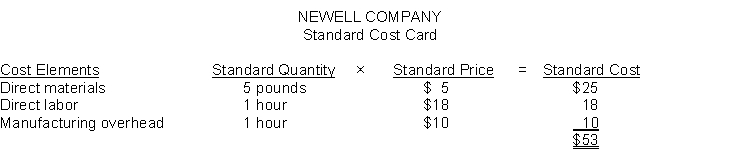 The company planned to produce 90,000 units of product and work at the 90,000 direct labor level of activity in 2011. The company uses a standard cost accounting system which records standard costs in the accounts and recognizes variances in the accounts at the earliest opportunity. During 2011, 87,000 actual units of product were produced.
Instructions
Prepare the journal entries to record the following transactions for Newell Company during 2011.
(a) Purchased 441,000 pounds of raw materials for $4.90 per pound on account.
(b) Actual direct labor payroll amounted to $1,581,000 for 85,500 actual direct labor hours worked. Factory labor cost is to be recorded and distributed to production.
(c) Direct materials issued for production amounted to 441,000 pounds which actually cost $4.90 per pound.
(d) Actual manufacturing overhead costs incurred were $864,000 in 2011.
(e) Manufacturing overhead was applied when the 87,000 units were completed.
(f) Transferred the 87,000 completed units to finished goods.
The company planned to produce 90,000 units of product and work at the 90,000 direct labor level of activity in 2011. The company uses a standard cost accounting system which records standard costs in the accounts and recognizes variances in the accounts at the earliest opportunity. During 2011, 87,000 actual units of product were produced.
Instructions
Prepare the journal entries to record the following transactions for Newell Company during 2011.
(a) Purchased 441,000 pounds of raw materials for $4.90 per pound on account.
(b) Actual direct labor payroll amounted to $1,581,000 for 85,500 actual direct labor hours worked. Factory labor cost is to be recorded and distributed to production.
(c) Direct materials issued for production amounted to 441,000 pounds which actually cost $4.90 per pound.
(d) Actual manufacturing overhead costs incurred were $864,000 in 2011.
(e) Manufacturing overhead was applied when the 87,000 units were completed.
(f) Transferred the 87,000 completed units to finished goods. (Essay)
4.7/5 (82)
(82) 
Filters
- Essay(0)
- Multiple Choice(0)
- Short Answer(0)
- True False(0)
- Matching(0)