



 Chat with AI
Exam 21: Process Costing

Exam 1: Accounting in Action220 Questions
Exam 2: The Recording Process192 Questions
Exam 3: Adjusting the Accounts216 Questions
Exam 4: Completing the Accounting Cycle203 Questions
Exam 5: Accounting for Merchandising Operations221 Questions
Exam 6: Inventories204 Questions
Exam 7: Accounting Information Systems139 Questions
Exam 8: Fraud, Internal Control, and Cash212 Questions
Exam 9: Accounting for Receivables220 Questions
Exam 10: Plant Assets, Natural Resources, and Intangible Assets293 Questions
Exam 11: Current Liabilities and Payroll Accounting207 Questions
Exam 12: Accounting for Partnerships210 Questions
Exam 13: Corporations: Organization and Capital Stock Transactions195 Questions
Exam 14: Corporations: Dividends, Retained Earnings, and Income Reporting176 Questions
Exam 15: Long-Term Liabilities215 Questions
Exam 16: Investments178 Questions
Exam 17: Statement of Cash Flows203 Questions
Exam 18: Financial Analysis: the Big Picture225 Questions
Exam 19: Managerial Accounting197 Questions
Exam 20: Job Order Costing199 Questions
Exam 21: Process Costing198 Questions
Exam 22: Cost-Volume-Profit217 Questions
Exam 23: Incremental Analysis208 Questions
Exam 24: Budgetary Planning207 Questions
Exam 25: Budgetary Control and Responsibility Accounting207 Questions
Exam 26: Standard Costs and Balanced Scorecard221 Questions
Select questions type


The primary benefit of activity-based costing is ______________ product costing.

Free
(Short Answer)
4.7/5  (75)
(75) Correct Answer: Verified
more accurate
ABC seeks to identify the _______________ that measure the activities performed on the product.
Free
(Short Answer)
4.9/5 (85)
(85) Correct Answer:Verified
Verifiedcost drivers
The weighted-average method of computing equivalent units is the most widely used method in practice.
Free
(True/False)
4.8/5 (70)
(70) Correct Answer:Verified
VerifiedTrue
Grey Building Supplies' total materials costs are $50,000 and total conversion costs are $39,000. Equivalent units of production for materials are 10,000, and 6,000 for conversion costs.
Instructions
Compute the unit costs for materials, conversion costs, and total manufacturing costs for the month.
(Essay)
4.8/5 (87)
(87) Carlton Company has gathered the following information 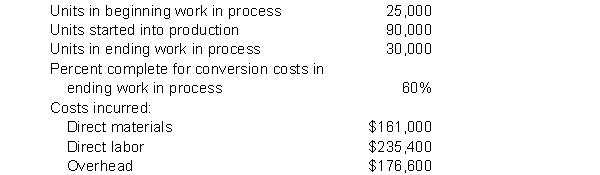 Instructions
(a) Compute equivalent units of production for materials and for conversion costs.
(b) Determine the unit costs of production.
(c) Show the assignment of costs to units transferred out and in process.
Instructions
(a) Compute equivalent units of production for materials and for conversion costs.
(b) Determine the unit costs of production.
(c) Show the assignment of costs to units transferred out and in process. (Essay)
4.7/5 (76)
(76) A production cost report is an internal document for management that shows production quantity and cost data for a particular job.
(True/False)
4.9/5 (74)
(74) The assignment of the three manufacturing cost elements to Work in Process in a process cost system is the same as in a job order cost system.
(True/False)
4.9/5 (61)
(61) A department had the following information for the month:  What are the equivalent units of production for materials?
 (Multiple Choice)
4.9/5 (79)
(79) In the month of June, a department had 12,000 units in beginning work in process that were 70% complete. During June, 48,000 units were transferred into production from another department. At the end of June there were 6,000 units in ending work in process that were 40% complete. Materials are added at the beginning of the process, while conversion costs are incurred uniformly throughout the process. The equivalent units of production for materials for June were
(Multiple Choice)
4.8/5 (78)
(78) In the month of April, a department had 500 units in the beginning work in process inventory that were 60% complete. These units had $30,000 of materials costs and $22,500 of conversion costs. Materials are added at the beginning of the process and conversion costs are added uniformly throughout the process. During April, 10,000 units were completed and transferred to the finished goods inventory and there were 2,000 units that were 25% complete in the ending work in process inventory on April 30. During April, manufacturing costs charged to the department were: Materials $690,000; Conversion costs $765,000.
The cost assigned to the units in the ending work in process inventory on April 30 was
(Multiple Choice)
4.9/5 (90)
(90) In Moyer Company, the Cutting Department had beginning work in process of 6,000 units, transferred out 14,000 units, and had an ending work in process of 3,000 units. How many units were started by Moyer during the month?
(Multiple Choice)
4.8/5 (78)
(78) Dirt Cleaners, Inc. has the following production data for January:  The units in ending work in process are 100% complete for materials and 60% complete for conversion costs. There is no beginning work in process. Materials cost is $8 per unit and conversion costs are $11 per unit.
Instructions
Determine the costs to be assigned to the units transferred out and the units in ending work in process.
The units in ending work in process are 100% complete for materials and 60% complete for conversion costs. There is no beginning work in process. Materials cost is $8 per unit and conversion costs are $11 per unit.
Instructions
Determine the costs to be assigned to the units transferred out and the units in ending work in process. (Essay)
4.8/5 (73)
(73) A primary driver of overhead costs in continuous manufacturing operations is machine time used.
(True/False)
4.8/5 (74)
(74) In a process cost system, costs are tracked through a series of connected manufacturing processes or departments, rather than by individual jobs.
(True/False)
4.9/5 (69)
(69) Physical units are 40,000. Total conversion costs are $316,000. There are 1,000 units in ending inventory which are 50% complete as to conversion costs. How much are conversion costs per unit?
(Multiple Choice)
4.8/5 (74)
(74) The Polishing Department of Estaban Manufacturing Company has the following production and manufacturing cost data for September. Materials are entered at the beginning of the process.
Production: Beginning inventory 2,000 units that are 100% complete as to materials and 30% complete as to conversion costs; units started during the period are 23,000, ending inventory of 6,000 units 10% complete as to conversion costs.
Manufacturing costs: Beginning inventory costs, comprised of $18,000 of materials and $13,000 of conversion costs; materials costs added in Polishing during the month, $202,000 labor and overhead applied in Polishing during the month $125,300 and $312,500 respectively.
Instructions
(a) Compute the equivalent units of productions for materials and conversion costs for the month of September.
(b) Compute the unit costs for materials and conversion costs for the month.
(c) Determine the costs to be assigned to the units transferred out and in process.
(Essay)
4.8/5 (69)
(69) Byrd Manufacturing decided to analyze certain costs for June of the current year. Units started into production equaled 14,000 and ending work in process equaled 2,000 units. With no beginning work in process inventory, how much is the conversion cost per unit if ending work in process was 25% complete and total conversion costs equaled $70,000?
(Multiple Choice)
4.7/5 (79)
(79) Given below are the production data for Department No. 1 for the first month of operation:
Costs charged to Department 1:  During this first month of operations, 3,000 units were started into production; 2,500 units were transferred out; and the remaining 500 units are 100% completed with respect to materials and 60% complete with respect to conversion costs.
Instructions
Compute the following:
(a) Unit materials cost.
(b) Equivalent units of conversion costs.
(c) Unit conversion cost.
(d) Total cost of 500 units in process at end of month.
(e) Total cost of 2,500 units transferred out.
During this first month of operations, 3,000 units were started into production; 2,500 units were transferred out; and the remaining 500 units are 100% completed with respect to materials and 60% complete with respect to conversion costs.
Instructions
Compute the following:
(a) Unit materials cost.
(b) Equivalent units of conversion costs.
(c) Unit conversion cost.
(d) Total cost of 500 units in process at end of month.
(e) Total cost of 2,500 units transferred out. (Essay)
4.8/5 (81)
(81) 
Filters
- Essay(0)
- Multiple Choice(0)
- Short Answer(0)
- True False(0)
- Matching(0)