



 Chat with AI
Exam 21: Process Costing

Exam 1: Accounting in Action220 Questions
Exam 2: The Recording Process192 Questions
Exam 3: Adjusting the Accounts216 Questions
Exam 4: Completing the Accounting Cycle203 Questions
Exam 5: Accounting for Merchandising Operations221 Questions
Exam 6: Inventories204 Questions
Exam 7: Accounting Information Systems139 Questions
Exam 8: Fraud, Internal Control, and Cash212 Questions
Exam 9: Accounting for Receivables220 Questions
Exam 10: Plant Assets, Natural Resources, and Intangible Assets293 Questions
Exam 11: Current Liabilities and Payroll Accounting207 Questions
Exam 12: Accounting for Partnerships210 Questions
Exam 13: Corporations: Organization and Capital Stock Transactions195 Questions
Exam 14: Corporations: Dividends, Retained Earnings, and Income Reporting176 Questions
Exam 15: Long-Term Liabilities215 Questions
Exam 16: Investments178 Questions
Exam 17: Statement of Cash Flows203 Questions
Exam 18: Financial Analysis: the Big Picture225 Questions
Exam 19: Managerial Accounting197 Questions
Exam 20: Job Order Costing199 Questions
Exam 21: Process Costing198 Questions
Exam 22: Cost-Volume-Profit217 Questions
Exam 23: Incremental Analysis208 Questions
Exam 24: Budgetary Planning207 Questions
Exam 25: Budgetary Control and Responsibility Accounting207 Questions
Exam 26: Standard Costs and Balanced Scorecard221 Questions
Select questions type


Activity-based costing (ABC) can be used only with process cost systems.
(True/False)
4.9/5  (77)
(77) Production costs chargeable to the Sanding Department in July in Magnum Company are $25,000 for materials, $17,000 for labor, and $10,000 for manufacturing overhead. Equivalent units of production are 25,000 for materials and 15,000 for conversion costs.
Instructions
Compute the unit costs for materials and conversion costs.
(Essay)
4.8/5 (70)
(70) Wilkinson Company has gathered the following information. 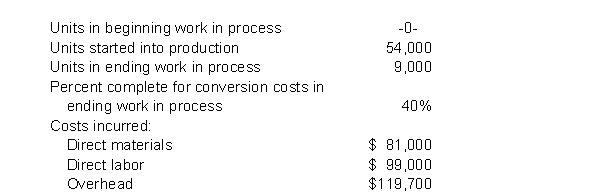 Instructions
(a) Compute equivalent units of production for materials and for conversion costs.
(b) Determine the unit costs of production.
(c) Show the assignment of costs to units transferred out and in process.
Instructions
(a) Compute equivalent units of production for materials and for conversion costs.
(b) Determine the unit costs of production.
(c) Show the assignment of costs to units transferred out and in process. (Essay)
4.9/5 (71)
(71) Unit material cost is computed by taking total material costs charged to the department for the period and dividing by the physical units in the process during the period.
(True/False)
4.8/5 (86)
(86) At Crenshaw Company, materials are entered at the beginning of each process. Work in process inventories, with the percentage of work done on conversion, and production data for its Painting Department in selected months are as follows:
Instructions
(a) Compute the physical units for July.
(b) Compute the equivalent units of production for materials and conversion costs for September.
(Essay)
5.0/5 (76)
(76) In the month of June, a department had 12,000 units in beginning work in process that were 70% complete. During June, 48,000 units were transferred into production from another department. At the end of June there were 6,000 units in ending work in process that were 40% complete. Materials are added at the beginning of the process, while conversion costs are incurred uniformly throughout the process. The equivalent units of production for conversion costs for June were
(Multiple Choice)
4.8/5 (89)
(89) In a process cost system, unit costs are determined using a
(Multiple Choice)
4.9/5 (84)
(84) The Molding Department of Kennett Company has the following production data: beginning work in process 25,000 units (60% complete), started into production 425,000 units, completed and transferred out 400,000 units, and ending work in process 50,000 units (40% complete). Assuming conversion costs are incurred uniformly during the process, the equivalent units for conversion costs are:
(Multiple Choice)
4.9/5 (88)
(88) Conversion cost per unit equals $9.00. Total materials costs are $60,000. Equivalent units are 20,000. How much is the total manufacturing cost per unit?
(Multiple Choice)
4.9/5 (91)
(91) The total manufacturing cost per unit is used in costing the units completed and transferred during the period.
(True/False)
4.8/5 (94)
(94) In the month of June, a department had 12,000 units in beginning work in process that were 70% complete. During June, 48,000 units were transferred into production from another department. At the end of June there were 6,000 units in ending work in process that were 40% complete. Materials are added at the beginning of the process, while conversion costs are incurred uniformly throughout the process. How many units were transferred out of the process in June?
(Multiple Choice)
4.9/5 (77)
(77) Zibba Company enters materials at the beginning of the process. In January, there was no beginning work in process, but there were 200 units in the ending work in process inventory. The number of units completed equals the number of
(Multiple Choice)
4.7/5 (91)
(91) Barnes and Miller Manufacturing is trying to determine the equivalent units for conversion costs with 5,000 units of ending work in process at 80% completion and 14,000 physical units. There are no beginning units in the department. Conversion costs occur evenly throughout the entire production period. What are the equivalent units for conversion costs for the current period?
(Multiple Choice)
4.8/5 (91)
(91) In a process cost system, units to be accounted for in a department are equal to the
(Multiple Choice)
4.9/5 (94)
(94) In order to compute the physical unit flow, a company must first compute unit production costs.
(True/False)
4.9/5 (88)
(88) The Slicing Department production process shows:  How many units were started into production in Department 1?
 (Multiple Choice)
4.9/5 (80)
(80) Lowman Painting Company has the following production data for March:
Beginning work in process, 2,000 units
Units transferred out, 42,000
Units in ending work in process, 8,000, which are 80% complete for conversion costs
Materials are added only at the beginning of the process.
Instructions
Compute equivalent units of production for both materials and conversion costs.
(Essay)
4.9/5 (86)
(86) 
Filters
- Essay(0)
- Multiple Choice(0)
- Short Answer(0)
- True False(0)
- Matching(0)