



 Chat with AI
Exam 13: Corporations: Organization and Capital Stock Transactions

Exam 1: Accounting in Action220 Questions
Exam 2: The Recording Process192 Questions
Exam 3: Adjusting the Accounts216 Questions
Exam 4: Completing the Accounting Cycle203 Questions
Exam 5: Accounting for Merchandising Operations221 Questions
Exam 6: Inventories204 Questions
Exam 7: Accounting Information Systems139 Questions
Exam 8: Fraud, Internal Control, and Cash212 Questions
Exam 9: Accounting for Receivables220 Questions
Exam 10: Plant Assets, Natural Resources, and Intangible Assets293 Questions
Exam 11: Current Liabilities and Payroll Accounting207 Questions
Exam 12: Accounting for Partnerships210 Questions
Exam 13: Corporations: Organization and Capital Stock Transactions195 Questions
Exam 14: Corporations: Dividends, Retained Earnings, and Income Reporting176 Questions
Exam 15: Long-Term Liabilities215 Questions
Exam 16: Investments178 Questions
Exam 17: Statement of Cash Flows203 Questions
Exam 18: Financial Analysis: the Big Picture225 Questions
Exam 19: Managerial Accounting197 Questions
Exam 20: Job Order Costing199 Questions
Exam 21: Process Costing198 Questions
Exam 22: Cost-Volume-Profit217 Questions
Exam 23: Incremental Analysis208 Questions
Exam 24: Budgetary Planning207 Questions
Exam 25: Budgetary Control and Responsibility Accounting207 Questions
Exam 26: Standard Costs and Balanced Scorecard221 Questions
Select questions type


The term "Capital surplus" can be used instead of "Additional Paid-in Capital".

Free
(True/False)
4.8/5  (68)
(68) Correct Answer: Verified
False
On February 1, Burchess Corporation issued 5,000 shares of its $20 par value preferred stock for $24 per share.
Instructions
Journalize the transaction.
Free
(Essay)
5.0/5 (71)
(71) Correct Answer:Verified
Verified
When no-par value stock does not have a stated value, the entire proceeds from the issuance of the stock becomes legal capital.
Free
(True/False)
5.0/5 (65)
(65) Correct Answer:Verified
VerifiedTrue
Kerwin Packaging Corporation began business in 2010 by issuing 30,000 shares of $5 par common stock for $8 per share and 10,000 shares of 6%, $10 par preferred stock for par. At year end, the common stock had a market value of $10. On its December 31, 2010 balance sheet, Kerwin Packaging would report
(Multiple Choice)
4.8/5 (82)
(82) In its first year of operations, Webber Corporation had the following transactions pertaining to its $10 par value preferred stock.
Feb. 1 Issued 6,000 shares for cash at $41 per share.
Nov. 1 Issued 3,000 shares for cash at $44 per share.
Instructions
(a) Journalize the transactions.
(b) Indicate the amount to be reported for (1) preferred stock, and (2) paid-in capital in excess of par value-preferred stock at the end of the year.
(Essay)
4.7/5 (67)
(67) Renner Corporation's December 31, 2010 balance sheet showed the following:
8% preferred stock, $20 par value, cumulative, 20,000 shares 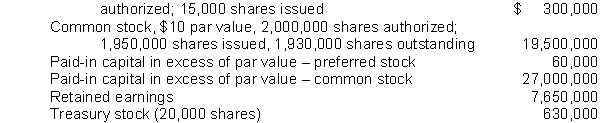 Renner's total paid-in capital was
 (Multiple Choice)
4.8/5 (72)
(72) Match the items below by entering the appropriate code letter in the space provided.  ____ 1. Net income retained in the corporation.
____ 2. The amount that must be retained in the business for the protection of creditors.
____ 3. Preferred stockholders have a right to receive current and unpaid prior-year dividends before common stockholders receive any dividends.
____ 4. Creditors only have corporate assets to satisfy their claims.
____ 5. Responsible to stockholders for corporate activity.
____ 6. The amount assigned to each share of stock in the corporate charter.
____ 7. Unit of ownership in a corporation.
____ 8. Enables stockholders to maintain their same percentage ownership when new shares are issued.
____ 9. Corporation's own stock that has been reacquired by the corporation but not retired.
____ 10. Total amount paid-in on capital stock.
____ 1. Net income retained in the corporation.
____ 2. The amount that must be retained in the business for the protection of creditors.
____ 3. Preferred stockholders have a right to receive current and unpaid prior-year dividends before common stockholders receive any dividends.
____ 4. Creditors only have corporate assets to satisfy their claims.
____ 5. Responsible to stockholders for corporate activity.
____ 6. The amount assigned to each share of stock in the corporate charter.
____ 7. Unit of ownership in a corporation.
____ 8. Enables stockholders to maintain their same percentage ownership when new shares are issued.
____ 9. Corporation's own stock that has been reacquired by the corporation but not retired.
____ 10. Total amount paid-in on capital stock. (Short Answer)
4.8/5 (88)
(88) Venco Corporation's December 31, 2010 balance sheet showed the following:
8% preferred stock, $20 par value, cumulative, 10,000 shares 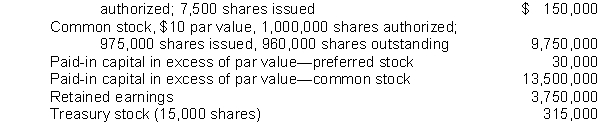 Venco's total stockholders' equity was
 (Multiple Choice)
4.9/5 (75)
(75) The par value of stock issued for noncash assets is never a factor in determining the cost of the assets received.
(True/False)
4.8/5 (64)
(64) An inexperienced accountant for Otto Corporation made the following entries. 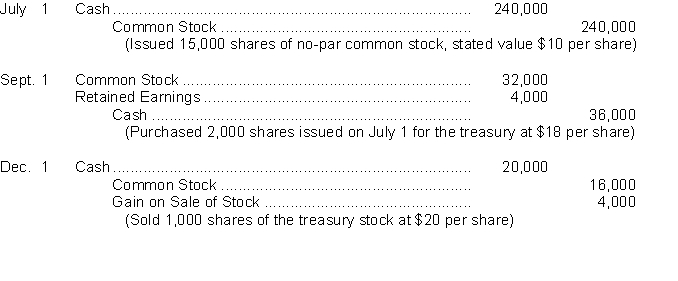 Instructions
(a) On the basis of the explanation for each entry, prepare the entry that should have been made for the transactions. (Omit explanations.)
(b) Prepare the correcting entries that should be made to correct the accounts of Otto Corporation. (Do not reverse the original entry.)
Instructions
(a) On the basis of the explanation for each entry, prepare the entry that should have been made for the transactions. (Omit explanations.)
(b) Prepare the correcting entries that should be made to correct the accounts of Otto Corporation. (Do not reverse the original entry.) (Essay)
4.8/5 (87)
(87) The corporate charter of Gregory Corporation allows the issuance of a maximum of 2,500,000 shares of $1 par value common stock. During its first three years of operation, Gregory issued 1,200,000 shares at $15 per share. It later acquired 20,000 of these shares as treasury stock for $25 per share.
Instructions
Based on the above information, answer the following questions:
(a) How many shares were authorized?
(b) How many shares were issued?
(c) How many shares are outstanding?
(d) What is the balance of the Common Stock account?
(e) What is the balance of the Treasury Stock account?
(Essay)
4.8/5 (75)
(75) Adcock Corporation began business by issuing 300,000 shares of $5 par value common stock for $24 per share. During its first year, the corporation sustained a net loss of $30,000. The year-end balance sheet would show
(Multiple Choice)
4.9/5 (73)
(73) Randolph Corporation issued 5,000 shares of stock.
Instructions
Prepare the entry for the issuance under the following assumptions.
(a) The stock had a par value of $5 per share and was issued for a total of $65,000.
(b) The stock had a stated value of $5 per share and was issued for a total of $65,000.
(c) The stock had a par value of $5 per share and was issued to attorneys for services during in-corporation valued at $65,000.
(d) The stock had a par value of $5 per share and was issued for land worth $65,000.
(Essay)
4.7/5 (82)
(82) The market value of a corporation's stock is determined by the number of shares that the corporation has been authorized to issue.
(True/False)
4.9/5 (78)
(78) Retro Company is authorized to issue 10,000 shares of 8%, $100 par value preferred stock and 500,000 shares of no-par common stock with a stated value of $1 per share. If Retro issues 5,000 shares of common stock to pay its recent attorney's bill of $20,000 for legal services on a land access dispute, which of the following would be the journal entry for Retro to record? 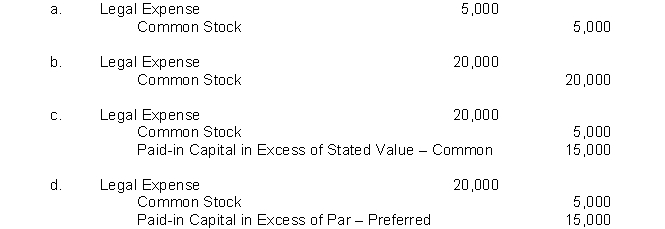
(Short Answer)
4.8/5 (82)
(82) Dawson Company issued 500 shares of no-par common stock for $4,500. Which of the following journal entries would be made if the stock has a stated value of $2 per share? 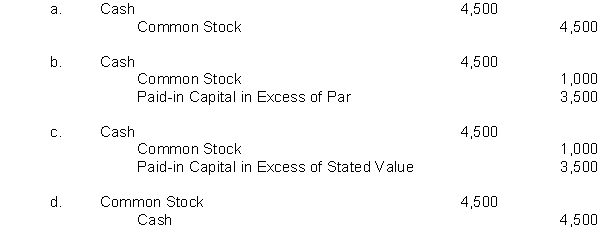
(Short Answer)
4.9/5 (70)
(70) If stock is issued for a noncash asset, the asset should be recorded on the books of the corporation at
(Multiple Choice)
4.7/5 (79)
(79) On January 1, 2010, the stockholders' equity section of Lopez Corporation shows: Common stock ($5 par value) $1,500,000; paid-in capital in excess of par value $1,000,000; and retained earnings $1,200,000. During the year, the following treasury stock transactions occurred.
Mar. 1 Purchased 30,000 shares for cash at $15 per share.
July 1 Sold 6,000 treasury shares for cash at $17 per share.
Sept. 1 Sold 5,000 treasury shares for cash at $14 per share.
Instructions
(a) Journalize the treasury stock transactions.
(b) Restate the entry for September 1, assuming the treasury shares were sold at $12 per share.
(Essay)
4.9/5 (80)
(80) 
Filters
- Essay(0)
- Multiple Choice(0)
- Short Answer(0)
- True False(0)
- Matching(0)