



 Chat with AI
Exam 13: Corporations: Organization and Capital Stock Transactions

Exam 1: Accounting in Action220 Questions
Exam 2: The Recording Process192 Questions
Exam 3: Adjusting the Accounts216 Questions
Exam 4: Completing the Accounting Cycle203 Questions
Exam 5: Accounting for Merchandising Operations221 Questions
Exam 6: Inventories204 Questions
Exam 7: Accounting Information Systems139 Questions
Exam 8: Fraud, Internal Control, and Cash212 Questions
Exam 9: Accounting for Receivables220 Questions
Exam 10: Plant Assets, Natural Resources, and Intangible Assets293 Questions
Exam 11: Current Liabilities and Payroll Accounting207 Questions
Exam 12: Accounting for Partnerships210 Questions
Exam 13: Corporations: Organization and Capital Stock Transactions195 Questions
Exam 14: Corporations: Dividends, Retained Earnings, and Income Reporting176 Questions
Exam 15: Long-Term Liabilities215 Questions
Exam 16: Investments178 Questions
Exam 17: Statement of Cash Flows203 Questions
Exam 18: Financial Analysis: the Big Picture225 Questions
Exam 19: Managerial Accounting197 Questions
Exam 20: Job Order Costing199 Questions
Exam 21: Process Costing198 Questions
Exam 22: Cost-Volume-Profit217 Questions
Exam 23: Incremental Analysis208 Questions
Exam 24: Budgetary Planning207 Questions
Exam 25: Budgetary Control and Responsibility Accounting207 Questions
Exam 26: Standard Costs and Balanced Scorecard221 Questions
Select questions type


Land appraised at $60,000 is purchased by issuing 1,000 shares of $25 par value common stock. The market price of the shares at the time of the exchange, based on active trading in the securities market, is $75 per share. Should the land be recorded at $25,000, $60,000, or $75,000? Explain.
(Essay)
4.9/5  (84)
(84) The paid-in capital section of the balance sheet consists of two classifications: ______________________ and ______________________.
(Short Answer)
4.9/5 (91)
(91) Renner Corporation's December 31, 2010 balance sheet showed the following:
8% preferred stock, $20 par value, cumulative, 20,000 shares 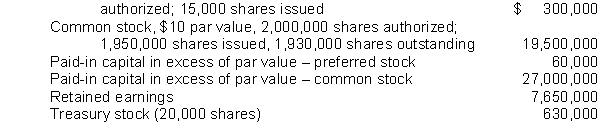 Renner's total stockholders' equity was
 (Multiple Choice)
4.7/5 (75)
(75) Andrews, Inc. paid $45,000 to buy back 9,000 shares of its $1 par value common stock. This stock was sold later at a selling price of $6 per share. The entry to record the sale includes a
(Multiple Choice)
4.9/5 (86)
(86) Stockholders generally have the right to share in corporate _______________ and in ______________ upon liquidation.
(Short Answer)
4.8/5 (83)
(83) Ed Tresh has invested $400,000 in a privately held family corporation. The corporation does not do well and must declare bankruptcy. What amount does Tresh stand to lose?
(Multiple Choice)
4.7/5 (84)
(84) Which of the following statements is not considered a disadvantage of the corporate form of organization?
(Multiple Choice)
4.9/5 (84)
(84) Which of the following represents the largest number of common shares?
(Multiple Choice)
4.9/5 (83)
(83) Simon Company issued 4,000 shares of its $5 par value common stock in payment of its attorney's bill of $35,000. The bill was for services performed in helping the company incorporate. Simon should record this transaction by debiting
(Multiple Choice)
4.8/5 (86)
(86) Boswell Corporation has the following stockholders' equity accounts:
Preferred Stock
Paid-in Capital in Excess of Par Value-Preferred Stock
Common Stock
Paid-in Capital in Excess of Stated Value-Common Stock
Paid-in Capital from Treasury Stock-Common
Retained Earnings
Treasury Stock-Common
Instructions
Classify each account using the following tabular alignment. 
(Essay)
4.9/5 (80)
(80) Venco Corporation's December 31, 2010 balance sheet showed the following:
8% preferred stock, $20 par value, cumulative, 10,000 shares 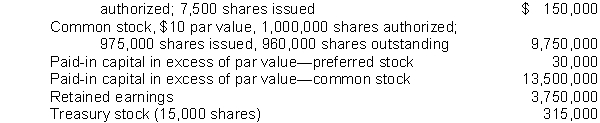 Venco's total paid-in capital was
 (Multiple Choice)
4.9/5 (86)
(86) Owners' equity for a corporation is identified as each of the following except
(Multiple Choice)
4.9/5 (83)
(83) The stockholders' equity section of a corporation's balance sheet is generally divided in two major sections: (1) _____________ and (2) _______________.
(Short Answer)
4.8/5 (77)
(77) The trial balance of Hackman Inc. includes the following balances: Common Stock, $26,000; Paid-in Capital in Excess of Par, $64,000; Treasury Stock, $6,000; Preferred Stock, $20,000. Capital stock totals
(Multiple Choice)
4.8/5 (67)
(67) The cost of a noncash asset acquired in exchange for common stock should be either the fair market value of the consideration given up or the consideration received, whichever is more clearly determinable.
(True/False)
4.8/5 (76)
(76) Treasury stock should be reported in the financial statements of a corporation as a(n)
(Multiple Choice)
4.8/5 (90)
(90) What is ordinarily the first step in the formation of a corporation?
(Multiple Choice)
4.9/5 (71)
(71) 
Filters
- Essay(0)
- Multiple Choice(0)
- Short Answer(0)
- True False(0)
- Matching(0)