



 Chat with AI
Exam 9: Accounting for Receivables

Exam 1: Accounting in Action220 Questions
Exam 2: The Recording Process192 Questions
Exam 3: Adjusting the Accounts216 Questions
Exam 4: Completing the Accounting Cycle203 Questions
Exam 5: Accounting for Merchandising Operations221 Questions
Exam 6: Inventories204 Questions
Exam 7: Accounting Information Systems139 Questions
Exam 8: Fraud, Internal Control, and Cash212 Questions
Exam 9: Accounting for Receivables220 Questions
Exam 10: Plant Assets, Natural Resources, and Intangible Assets293 Questions
Exam 11: Current Liabilities and Payroll Accounting207 Questions
Exam 12: Accounting for Partnerships210 Questions
Exam 13: Corporations: Organization and Capital Stock Transactions195 Questions
Exam 14: Corporations: Dividends, Retained Earnings, and Income Reporting176 Questions
Exam 15: Long-Term Liabilities215 Questions
Exam 16: Investments178 Questions
Exam 17: Statement of Cash Flows203 Questions
Exam 18: Financial Analysis: the Big Picture225 Questions
Exam 19: Managerial Accounting197 Questions
Exam 20: Job Order Costing199 Questions
Exam 21: Process Costing198 Questions
Exam 22: Cost-Volume-Profit217 Questions
Exam 23: Incremental Analysis208 Questions
Exam 24: Budgetary Planning207 Questions
Exam 25: Budgetary Control and Responsibility Accounting207 Questions
Exam 26: Standard Costs and Balanced Scorecard221 Questions
Select questions type


Writing off an uncollectible account under the allowance method requires a debit to

Free
(Multiple Choice)
4.8/5  (89)
(89) Correct Answer: Verified
B
The interest on a $5,000, 10%, 1-year note receivable is
Free
(Multiple Choice)
4.8/5 (69)
(69) Correct Answer:Verified
VerifiedB
Using the following information:  During 2010, sales on account were $145,000 and collections on account were $86,000. Also during 2010, the company wrote off $8,000 in uncollectible accounts. An analysis of outstanding receivable accounts at year end indicated that uncollectible accounts should be estimated at $54,000.
The change in the cash realizable value from the balance at 12/31/09 to 12/31/10 was a
During 2010, sales on account were $145,000 and collections on account were $86,000. Also during 2010, the company wrote off $8,000 in uncollectible accounts. An analysis of outstanding receivable accounts at year end indicated that uncollectible accounts should be estimated at $54,000.
The change in the cash realizable value from the balance at 12/31/09 to 12/31/10 was aFree
(Multiple Choice)
4.9/5 (81)
(81) Correct Answer:Verified
VerifiedC
Fowler Company on July 15 sells merchandise on account to Coffey Co. for $1,000, terms 2/10, n/30. On July 20 Coffey Co. returns merchandise worth $400 to Fowler Company. On July 24 payment is received from Coffey Co. for the balance due. What is the amount of cash received?
(Multiple Choice)
4.8/5 (70)
(70) On March 1, 2010, Joe Miles purchased a suit at Calvin's Fine Apparel Store. The suit cost $250 and Joe used his Calvin credit card. Calvin charges 2% per month interest if payment on credit charges is not made within 30 days. On April 30, 2010, Joe had not yet made his payment. What entry should Calvin make on April 30th? 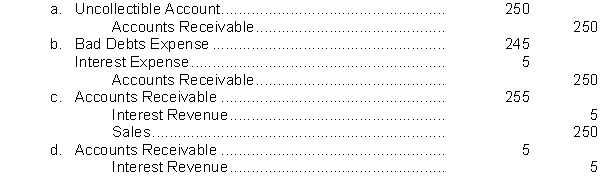
(Short Answer)
4.9/5 (77)
(77) If an account is collected after having been previously written off,
(Multiple Choice)
5.0/5 (73)
(73) The maturity value of a $30,000, 8%, 3-month note receivable is
(Multiple Choice)
4.7/5 (91)
(91) Sales resulting from the use of Visa and MasterCard are considered credit sales by the retailer.
(True/False)
4.7/5 (87)
(87) When a note is accepted to settle an open account, Notes Receivable is debited for the note's
(Multiple Choice)
4.7/5 (87)
(87) Three accounting issues associated with accounts receivable are
(Multiple Choice)
4.7/5 (81)
(81) At December 31, 2010, Grayson Company reported Accounts Receivable of $34,000 and Allowance for Doubtful Accounts of $3,500. On January 7, 2011, Duffy Enterprises declares bankruptcy and it is determined that the receivable of $1,200 from Duffy is not collectible.
1. What is the cash realizable value of Accounts Receivable at December 31, 2010?
2. What entry would Grayson make to write off the Duffy account?
3. What is the cash realizable value of Accounts Receivable after the Duffy account is written off?
(Essay)
4.9/5 (97)
(97) Receivables may be sold because they may be the only reasonable source of cash.
(True/False)
4.9/5 (79)
(79) Nolte Products is undecided about which base to use in estimating uncollectible accounts. On December 31, 2010, the balance in Accounts Receivable was $680,000 and net credit sales amounted to $3,500,000 during 2010. An aging analysis of the accounts receivable indicated that $36,000 in accounts are expected to be uncollectible. Past experience has shown that about 1% of net credit sales eventually are uncollectible.
Instructions
Prepare the adjusting entries to record estimated bad debts expense using the (1) percentage of sales basis and (2) the percentage of receivables basis under each of the following independent assumptions:
(a) Allowance for Doubtful Accounts has a credit balance of $3,200 before adjustment.
(b) Allowance for Doubtful Accounts has a debit balance of $730 before adjustment.
(Essay)
4.9/5 (80)
(80) A company has net credit sales of $900,000 for the year and it estimates that uncollectible accounts will be 2% of sales. If Allowance for Doubtful Accounts has a credit balance of $1,000 prior to adjustment, its balance after adjustment will be a credit of
(Multiple Choice)
4.8/5 (93)
(93) Two methods of accounting for uncollectible accounts are the
(Multiple Choice)
4.8/5 (81)
(81) 
Filters
- Essay(0)
- Multiple Choice(0)
- Short Answer(0)
- True False(0)
- Matching(0)