



 Chat with AI
Exam 9: Accounting for Receivables

Exam 1: Accounting in Action220 Questions
Exam 2: The Recording Process192 Questions
Exam 3: Adjusting the Accounts216 Questions
Exam 4: Completing the Accounting Cycle203 Questions
Exam 5: Accounting for Merchandising Operations221 Questions
Exam 6: Inventories204 Questions
Exam 7: Accounting Information Systems139 Questions
Exam 8: Fraud, Internal Control, and Cash212 Questions
Exam 9: Accounting for Receivables220 Questions
Exam 10: Plant Assets, Natural Resources, and Intangible Assets293 Questions
Exam 11: Current Liabilities and Payroll Accounting207 Questions
Exam 12: Accounting for Partnerships210 Questions
Exam 13: Corporations: Organization and Capital Stock Transactions195 Questions
Exam 14: Corporations: Dividends, Retained Earnings, and Income Reporting176 Questions
Exam 15: Long-Term Liabilities215 Questions
Exam 16: Investments178 Questions
Exam 17: Statement of Cash Flows203 Questions
Exam 18: Financial Analysis: the Big Picture225 Questions
Exam 19: Managerial Accounting197 Questions
Exam 20: Job Order Costing199 Questions
Exam 21: Process Costing198 Questions
Exam 22: Cost-Volume-Profit217 Questions
Exam 23: Incremental Analysis208 Questions
Exam 24: Budgetary Planning207 Questions
Exam 25: Budgetary Control and Responsibility Accounting207 Questions
Exam 26: Standard Costs and Balanced Scorecard221 Questions
Select questions type


The average collection period for receivables is computed by dividing 365 days by
(Multiple Choice)
4.8/5  (86)
(86) The entry to record the dishonor of a note receivable assuming the payee expects eventual collection includes a debit to
(Multiple Choice)
5.0/5 (74)
(74) On March 9, Fillmore gave Camp Company a 60-day, 12% promissory note for $3,200. Fillmore honors the note on May 9. Record the collection of the note and interest by Camp assuming that no interest has been accrued.
(Essay)
4.9/5 (85)
(85) Patel Co. sells Christmas angels. Patel determines that at the end of December, it has the following aging schedule of Accounts Receivable: 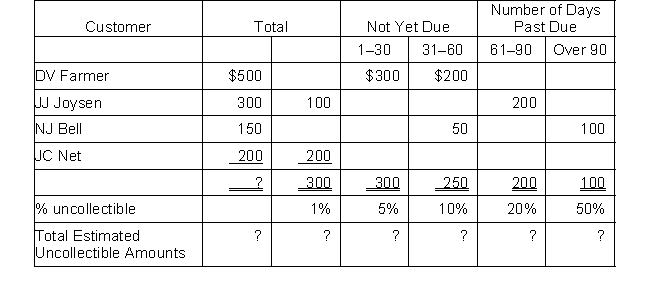 Compute the net receivables based on the above information at the end of December. (There was no beginning balance in the Allowance for Doubtful Accounts).
 (Essay)
4.7/5 (77)
(77) When the allowance method of accounting for uncollectible accounts is used, Bad Debts Expense is recorded
(Multiple Choice)
5.0/5 (62)
(62) A finance company or bank that purchases receivables from businesses is known as a ______________.
(Short Answer)
4.8/5 (70)
(70) Allowance for Doubtful Accounts is debited under the direct write-off method when an account is determined to be uncollectible.
(True/False)
4.9/5 (61)
(61) The maturity date of a 1-month note receivable dated June 30 is July 30.
(True/False)
4.8/5 (92)
(92) Greig Company uses the allowance method for estimating uncollectible accounts. Prepare journal entries to record the following transactions: 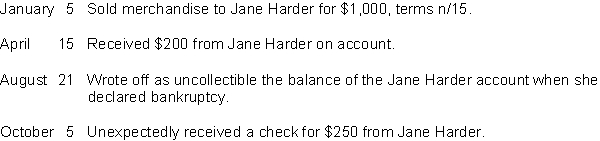
(Essay)
4.9/5 (89)
(89) The balance of Allowance for Doubtful Accounts prior to making the adjusting entry to record estimated uncollectible accounts
(Multiple Choice)
4.8/5 (77)
(77) Longbine Company's ledger at the end of the current year shows Accounts Receivable of $150,000.
Instructions
a. If Allowance for Doubtful Accounts has a credit balance of $3,000 in the trial balance and bad debts are expected to be 10% of accounts receivable, journalize the adjusting entry for the end of the period.
b. If Allowance for Doubtful Accounts has a debit balance of $3,000 in the trial balance and bad debts are expected to be 10% of accounts receivable, journalize the adjusting entry for the end of the period.
(Essay)
4.8/5 (78)
(78) Which one of the following is not a primary problem associated with accounts receivable?
(Multiple Choice)
4.7/5 (84)
(84) On January 15, 2010, Raymond Company received a two-month, 9%, $5,000 note from William Pentel for the settlement of his open account. The entry by Raymond Company on January 15, 2010 would include a:
(Multiple Choice)
4.8/5 (91)
(91) The basic issues in accounting for notes receivable include each of the following except
(Multiple Choice)
4.9/5 (77)
(77) On February 1, Platt Company received a $9,000, 10%, four-month note receivable. The cash to be received by Platt Company when the note becomes due is
(Multiple Choice)
4.8/5 (75)
(75) The percentage of sales basis for estimating uncollectible accounts always results in more Bad Debts Expense being recognized than the percentage of receivables basis.
(True/False)
4.9/5 (78)
(78) The percentage of receivables basis for estimating uncollectible accounts emphasizes
(Multiple Choice)
4.9/5 (64)
(64) When the allowance method is used to account for uncollectible accounts, the ______________ is credited when an account is determined to be uncollectible.
(Short Answer)
4.7/5 (76)
(76) 
Filters
- Essay(0)
- Multiple Choice(0)
- Short Answer(0)
- True False(0)
- Matching(0)