



 Chat with AI
Exam 9: Accounting for Receivables

Exam 1: Accounting in Action220 Questions
Exam 2: The Recording Process192 Questions
Exam 3: Adjusting the Accounts216 Questions
Exam 4: Completing the Accounting Cycle203 Questions
Exam 5: Accounting for Merchandising Operations221 Questions
Exam 6: Inventories204 Questions
Exam 7: Accounting Information Systems139 Questions
Exam 8: Fraud, Internal Control, and Cash212 Questions
Exam 9: Accounting for Receivables220 Questions
Exam 10: Plant Assets, Natural Resources, and Intangible Assets293 Questions
Exam 11: Current Liabilities and Payroll Accounting207 Questions
Exam 12: Accounting for Partnerships210 Questions
Exam 13: Corporations: Organization and Capital Stock Transactions195 Questions
Exam 14: Corporations: Dividends, Retained Earnings, and Income Reporting176 Questions
Exam 15: Long-Term Liabilities215 Questions
Exam 16: Investments178 Questions
Exam 17: Statement of Cash Flows203 Questions
Exam 18: Financial Analysis: the Big Picture225 Questions
Exam 19: Managerial Accounting197 Questions
Exam 20: Job Order Costing199 Questions
Exam 21: Process Costing198 Questions
Exam 22: Cost-Volume-Profit217 Questions
Exam 23: Incremental Analysis208 Questions
Exam 24: Budgetary Planning207 Questions
Exam 25: Budgetary Control and Responsibility Accounting207 Questions
Exam 26: Standard Costs and Balanced Scorecard221 Questions
Select questions type


Scully Company had accounts receivable of $100,000 on January 1, 2010. The only transactions that affected accounts receivable during 2010 were net credit sales of $1,200,000, cash collections of $1,000,000, and accounts written off of $30,000.
Instructions
(a) Compute the ending balance of accounts receivable.
(b) Compute the accounts receivable turnover ratio for 2010.
(c) Compute the average collection period in days.
(Essay)
4.7/5  (84)
(84) Under the direct write-off method, no attempt is made to match bad debts expense to sales revenues in the same accounting period.
(True/False)
4.9/5 (75)
(75) Prepare journal entries to record the following transactions entered into by Glaser Company:
2010
June 1 Received a $20,000, 12%, 1-year note from Ann Duff as full payment on her account.
Nov. 1 Sold merchandise on account to Malone, Inc. for $10,000, terms 2/10, n/30.
Nov. 5 Malone, Inc. returned merchandise worth $500.
Nov. 9 Received payment in full from Malone, Inc.
Dec. 31 Accrued interest on Duff's note.
2011
June 1 Ann Duff honored her promissory note by sending the face amount plus interest. No interest has been accrued in 2011.
(Essay)
4.9/5 (70)
(70) The _____________ basis of estimating uncollectibles provides a better _____________ of bad debt expense with sales revenue and therefore emphasizes income statement relationships.
(Short Answer)
4.9/5 (94)
(94) Parks Company receives a $5,000, 3-month, 8% promissory note from Todd Company in settlement of an open accounts receivable. What entry will Parks Company make upon receiving the note? 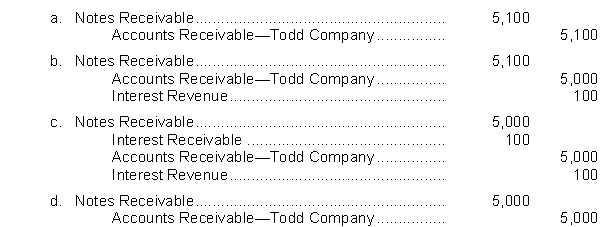
(Short Answer)
4.9/5 (77)
(77) Compute the maturity value for each of the following notes receivable.
1. A $5,000, 6%, 3-month note dated July 20.
Maturity value $____________.
2. A $12,000, 9%, 150-day note dated August 5.
Maturity value $____________.
(Essay)
4.8/5 (76)
(76) On October 1, 2010, Brosnan Company sells (factors) $400,000 of receivables to Nation Factors, Inc. Nation assesses a service charge of 3% of the amount of receivables sold. The journal entry to record the sale by Brosnan will include:
(Multiple Choice)
4.9/5 (90)
(90) On January 6, Stegner Co. sells merchandise on account to Molina Inc. for $7,000, terms 2/10, n/30. On January 16, Molina Inc. pays the amount due. Prepare the entries on Stegner's books to record the sale and related collection.
(b) On January 10, Jill Flynn uses her Calhoun Co. credit card to purchase merchandise from Calhoun Co. for $9,000. On February 10, Flynn is billed for the amount due of $9,000. On February 12, Flynn pays $4,000 on the balance due. On March 10, Flynn is billed for the amount due, including interest at 2% per month on the unpaid balance as of February 12. Prepare the entries on Calhoun Co.'s books related to the transactions that occurred on January 10, February 12, and March 10.
(Essay)
4.8/5 (61)
(61) The percentage of sales basis of estimating expected uncollectibles
(Multiple Choice)
4.8/5 (77)
(77) The three primary accounting problems with accounts receivable are: (1) recognizing, (2) depreciating, and (3) disposing.
(True/False)
4.8/5 (71)
(71) A customer charges a treadmill at Mike's Sport Shop. The price is $2,000 and the financing charge is 9% per annum if the bill is not paid in 30 days. The customer fails to pay the bill within 30 days and a finance charge is added to the customer's account.
The accounts affected by the journal entry made by Mike's Sport Shop to record the finance charge are
(Multiple Choice)
4.8/5 (82)
(82) The financial statements of Gentry Manufacturing Company report net sales of $400,000 and accounts receivable of $80,000 and $40,000 at the beginning and end of the year, respectively. What is the receivables turnover ratio for Gentry?
(Multiple Choice)
4.7/5 (89)
(89) In 2010, Freeze Company had credit sales of $900,000 and granted sales discounts of $18,000. On January 1, 2010, Allowance for Doubtful Accounts had a credit balance of $22,500. During 2010, $37,500 of uncollectible accounts receivable were written off. Past experience indicates that 3% of net credit sales become uncollectible. What should be the adjusted balance of Allowance for Doubtful Accounts at December 31, 2010?
(Multiple Choice)
4.8/5 (80)
(80) In reviewing the accounts receivable, the cash realizable value is $16,000 before the write-off of a $1,500 account. What is the cash realizable value after the write-off?
(Multiple Choice)
4.8/5 (86)
(86) Using the percentage of receivables method for recording bad debts expense, estimated uncollectible accounts are $10,000. If the balance of the Allowance for Doubtful Accounts is $2,000 credit before adjustment, what is the amount of bad debts expense for that period?
(Multiple Choice)
4.7/5 (91)
(91) Ripken Supply Co. has the following transactions related to notes receivable during the last 2 months of 2010.
Nov. 1 Loaned $30,000 cash to Linda Waters on a 1-year, 10% note.
Dec. 11 Sold goods to Wainwright, Inc., receiving a $10,800, 90-day, 8% note.
16 Received an $8,000, 6-month, 9% note in exchange for Don Garbo's outstanding accounts receivable.
31 Accrued interest revenue on all notes receivable.
Instructions
(a) Journalize the transactions for Ripken Supply Co.
(b) Record the collection of the Waters note at its maturity in 2011.
(Essay)
4.7/5 (93)
(93) 
Filters
- Essay(0)
- Multiple Choice(0)
- Short Answer(0)
- True False(0)
- Matching(0)