



 Chat with AI
Exam 25: Budgetary Control and Responsibility Accounting

Exam 1: Accounting in Action220 Questions
Exam 2: The Recording Process192 Questions
Exam 3: Adjusting the Accounts216 Questions
Exam 4: Completing the Accounting Cycle203 Questions
Exam 5: Accounting for Merchandising Operations221 Questions
Exam 6: Inventories204 Questions
Exam 7: Accounting Information Systems139 Questions
Exam 8: Fraud, Internal Control, and Cash212 Questions
Exam 9: Accounting for Receivables220 Questions
Exam 10: Plant Assets, Natural Resources, and Intangible Assets293 Questions
Exam 11: Current Liabilities and Payroll Accounting207 Questions
Exam 12: Accounting for Partnerships210 Questions
Exam 13: Corporations: Organization and Capital Stock Transactions195 Questions
Exam 14: Corporations: Dividends, Retained Earnings, and Income Reporting176 Questions
Exam 15: Long-Term Liabilities215 Questions
Exam 16: Investments178 Questions
Exam 17: Statement of Cash Flows203 Questions
Exam 18: Financial Analysis: the Big Picture225 Questions
Exam 19: Managerial Accounting197 Questions
Exam 20: Job Order Costing199 Questions
Exam 21: Process Costing198 Questions
Exam 22: Cost-Volume-Profit217 Questions
Exam 23: Incremental Analysis208 Questions
Exam 24: Budgetary Planning207 Questions
Exam 25: Budgetary Control and Responsibility Accounting207 Questions
Exam 26: Standard Costs and Balanced Scorecard221 Questions
Select questions type


Benton Company produces one product, a putter called PAR-putter. Benton uses a standard cost system and determines that it should take one hour of direct labor to produce one PAR-putter. The normal production capacity for this putter is 100,000 units per year. The total budgeted overhead at normal capacity is $600,000 comprised of $200,000 of variable costs and $400,000 of fixed costs. Benton applies overhead on the basis of direct labor hours.
During the current year, Benton produced 85,000 putters, worked 89,000 direct labor hours, and incurred variable overhead costs of $180,000 and fixed overhead costs of $400,000.
Instructions
(a) Compute the predetermined variable overhead rate and the predetermined fixed overhead rate.
(b) Compute the applied overhead for Benton for the year.
(c) Compute the total overhead variance.
(Essay)
4.8/5  (78)
(78) The overhead ______________ variance is the difference between normal capacity hours and standard hours allowed times the fixed overhead rate.
(Short Answer)
4.7/5 (71)
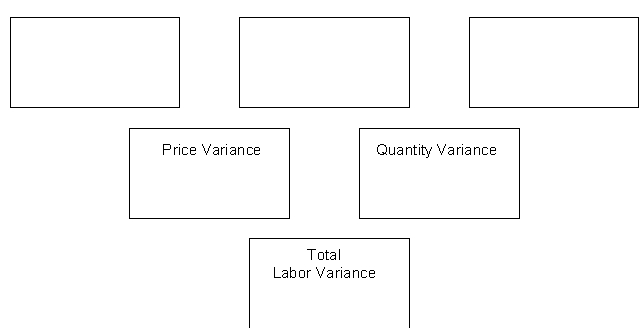
(71) The following direct labor data pertain to the operations of Nagel Manufacturing Company for the month of November:  Instructions
Prepare a matrix and calculate the labor variances.
Instructions
Prepare a matrix and calculate the labor variances. (Essay)
4.7/5 (82)
(82) A company purchases 20,000 pounds of materials. The materials price variance is $3,000 favorable. What is the difference between the standard and actual price paid for the materials?
(Multiple Choice)
4.8/5 (65)
(65) Manufacturing overhead data for the production of Product B by Elliott Company are as follows.  Instructions
Compute the controllable and volume overhead variances.
Instructions
Compute the controllable and volume overhead variances. (Essay)
4.9/5 (73)
(73) Landis Company planned to produce 20,000 units of product and work 100,000 direct labor hours in 2011. Manufacturing overhead at the 100,000 direct labor hours level of activity was estimated to be:  At the end of 2011, 21,000 units of product were actually produced and 108,000 actual direct labor hours were worked. Total actual overhead costs for 2011 were $1,025,000.
Instructions
(a) Compute the total overhead variance.
(b) Compute the overhead controllable variance.
(c) Compute the overhead volume variance.
At the end of 2011, 21,000 units of product were actually produced and 108,000 actual direct labor hours were worked. Total actual overhead costs for 2011 were $1,025,000.
Instructions
(a) Compute the total overhead variance.
(b) Compute the overhead controllable variance.
(c) Compute the overhead volume variance. (Essay)
4.9/5 (84)
(84) Vega Company has developed the following standard costs for its product for 2011: 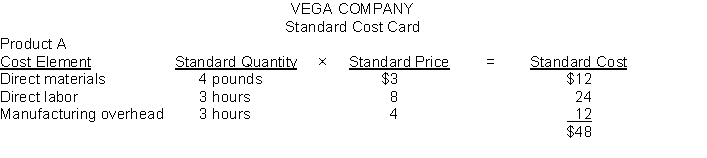 The company expected to produce 25,000 units of Product A in 2011 and work 75,000 direct labor hours.
Actual results for 2011 are as follows:
26,000 units of Product A were produced.
Actual direct labor costs were $630,800 for 76,000 direct labor hours worked.
Actual direct materials purchased and used during the year cost $283,500 for 105,000 pounds.
Actual variable overhead incurred was $130,000 and actual fixed overhead incurred was $170,000.
Instructions
Compute the following variances showing all computations to support your answers. Indicate whether the variances are favorable or unfavorable.
(a) Materials quantity variance.
(b) Total direct labor variance.
(c) Direct labor quantity variance.
(d) Direct materials price variance.
(e) Total overhead variance.
The company expected to produce 25,000 units of Product A in 2011 and work 75,000 direct labor hours.
Actual results for 2011 are as follows:
26,000 units of Product A were produced.
Actual direct labor costs were $630,800 for 76,000 direct labor hours worked.
Actual direct materials purchased and used during the year cost $283,500 for 105,000 pounds.
Actual variable overhead incurred was $130,000 and actual fixed overhead incurred was $170,000.
Instructions
Compute the following variances showing all computations to support your answers. Indicate whether the variances are favorable or unfavorable.
(a) Materials quantity variance.
(b) Total direct labor variance.
(c) Direct labor quantity variance.
(d) Direct materials price variance.
(e) Total overhead variance. (Essay)
4.9/5 (81)
(81) Which of the following statements about standard costs is false?
(Multiple Choice)
4.9/5 (62)
(62) Keller Company has a materials price standard of $2.00 per pound. Five thousand pounds of materials were purchased at $2.20 a pound. The actual quantity of materials used was 5,000 pounds, although the standard quantity allowed for the output was 4,500 pounds.
Keller Company's materials price variance is
(Multiple Choice)
4.9/5 (78)
(78) Kitselman Inc. produces a product requiring 3 direct labor hours at $20.00 per hour. During January, 2,000 products are produced using 6,300 direct labor hours. Kitselman's actual payroll during January was $122,850. What is the labor quantity variance?
(Multiple Choice)
4.8/5 (81)
(81) If the standard hours allowed are less than the standard hours at normal capacity,
(Multiple Choice)
4.8/5 (74)
(74) A materials quantity variance is calculated as the difference between the standard direct materials price and the actual direct materials price multiplied by the actual quantity of direct materials used.
(True/False)
5.0/5 (67)
(67) If production exceeds normal capacity, the overhead volume variance will be favorable.
(True/False)
4.9/5 (87)
(87) Standards which represent optimum performance under perfect operating conditions are called _______________ standards, but most companies use _________________ standards which are rigorous but attainable.
(Short Answer)
4.8/5 (80)
(80) A credit to a Materials Quantity Variance account indicates that the actual quantity of direct materials used was greater than the standard quantity of direct materials allowed.
(True/False)
4.7/5 (82)
(82) The standard quantity allowed for the units produced was 6,500 pounds, the standard price was $2.50 per pound, and the materials quantity variance was $375 favorable. Each unit uses 1 pound of materials. How many units were actually produced?
(Multiple Choice)
4.8/5 (80)
(80) Kwik Repair Service, Inc. is trying to establish the standard labor cost of a typical engine tune-up. The following data have been collected from time and motion studies conducted over the past month.  Instructions
(a) Determine the standard direct labor hours per tune-up
(b) Determine the standard direct labor hourly rate.
(c) Determine the standard direct labor cost per tune-up.
(d) If a tune-up took 1.5 hours at the standard hourly rate, what was the direct labor quantity variance?
Instructions
(a) Determine the standard direct labor hours per tune-up
(b) Determine the standard direct labor hourly rate.
(c) Determine the standard direct labor cost per tune-up.
(d) If a tune-up took 1.5 hours at the standard hourly rate, what was the direct labor quantity variance? (Essay)
4.7/5 (83)
(83) A standard which represents an efficient level of performance that is attainable under expected operating conditions is called a(n)
(Multiple Choice)
4.9/5 (88)
(88) 
Filters
- Essay(0)
- Multiple Choice(0)
- Short Answer(0)
- True False(0)
- Matching(0)