



 Chat with AI
Exam 25: Budgetary Control and Responsibility Accounting

Exam 1: Accounting in Action220 Questions
Exam 2: The Recording Process192 Questions
Exam 3: Adjusting the Accounts216 Questions
Exam 4: Completing the Accounting Cycle203 Questions
Exam 5: Accounting for Merchandising Operations221 Questions
Exam 6: Inventories204 Questions
Exam 7: Accounting Information Systems139 Questions
Exam 8: Fraud, Internal Control, and Cash212 Questions
Exam 9: Accounting for Receivables220 Questions
Exam 10: Plant Assets, Natural Resources, and Intangible Assets293 Questions
Exam 11: Current Liabilities and Payroll Accounting207 Questions
Exam 12: Accounting for Partnerships210 Questions
Exam 13: Corporations: Organization and Capital Stock Transactions195 Questions
Exam 14: Corporations: Dividends, Retained Earnings, and Income Reporting176 Questions
Exam 15: Long-Term Liabilities215 Questions
Exam 16: Investments178 Questions
Exam 17: Statement of Cash Flows203 Questions
Exam 18: Financial Analysis: the Big Picture225 Questions
Exam 19: Managerial Accounting197 Questions
Exam 20: Job Order Costing199 Questions
Exam 21: Process Costing198 Questions
Exam 22: Cost-Volume-Profit217 Questions
Exam 23: Incremental Analysis208 Questions
Exam 24: Budgetary Planning207 Questions
Exam 25: Budgetary Control and Responsibility Accounting207 Questions
Exam 26: Standard Costs and Balanced Scorecard221 Questions
Select questions type


Income statements prepared internally for management often show cost of goods sold at standard cost and variances are
(Multiple Choice)
4.9/5  (88)
(88) The total standard cost to produce one unit of product is shown
(Multiple Choice)
4.8/5 (81)
(81) Which department is usually responsible for a labor price variance attributable to misallocation of workers?
(Multiple Choice)
4.9/5 (86)
(86) The perspectives included in the balanced scorecard approach include all of the following except the
(Multiple Choice)
4.8/5 (64)
(64) The standard cost of Product 245 manufactured by Essex Company includes 2 pounds of direct materials at $5.00 per pound. During September, 40,000 pounds of direct materials are purchased at a cost of $4.80 per pound, and all of the direct materials are used to produce 19,000 units of Product 245.
Instructions
(a) Compute the materials price and quantity variances.
(b) Journalize the purchase of the materials and the issuance of the materials, assuming a standard cost system is used.
(Essay)
4.8/5 (75)
(75) Information on Francona's direct labor costs for the month of August is as follows:  What was the standard rate for August?
 (Multiple Choice)
4.9/5 (86)
(86) The total variance is $25,000. The total materials variance is $10,000. The total labor variance is twice the total overhead variance. What is the total overhead variance?
(Multiple Choice)
4.7/5 (88)
(88) The per-unit standards for direct labor are 1.5 direct labor hours at $12 per hour. If in producing 2,400 units, the actual direct labor cost was $36,800 for 3,000 direct labor hours worked, the total direct labor variance is
(Multiple Choice)
4.8/5 (79)
(79) A variance is the difference between actual costs and standard costs.
(True/False)
4.7/5 (88)
(88) Gant Co. manufactures a product with a standard direct labor cost of two hours at $24.00 per hour. During July, 2,000 units were produced using 4,200 hours at $24.40 per hour. The labor quantity variance was
(Multiple Choice)
4.9/5 (82)
(82) During January, HPA Company incurs 1,850 hours of direct labor at an hourly cost of $9.60 in producing 1,000 units of its finished product. HPA standard labor cost per unit of output is $18 (2 hours x $9.00).
Instructions
Compute the total, price, and quantity labor variances for HPA Company for January.
(Essay)
4.8/5 (81)
(81) Wagner Company developed the following standard costs for its product for 2011: 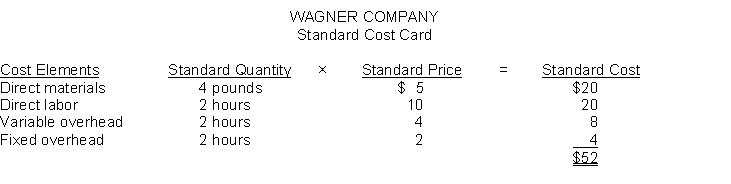 The company expected to work at the 60,000 direct labor hours level of activity and produce 30,000 units of product.
Actual results for 2011 were as follows:
28,400 units of product were actually produced.
Direct labor costs were $546,000 for 56,000 direct labor hours actually worked.
Actual direct materials purchased and used during the year cost $554,400 for 115,500 pounds.
Total actual manufacturing overhead costs were $340,000.
Instructions
Compute the following variances for Wagner Company for 2011 and indicate whether the variance is favorable or unfavorable.
1. Direct materials price variance.
2. Direct materials quantity variance.
3. Direct labor price variance.
4. Direct labor quantity variance.
5. Overhead controllable variance.
6. Overhead volume variance.
The company expected to work at the 60,000 direct labor hours level of activity and produce 30,000 units of product.
Actual results for 2011 were as follows:
28,400 units of product were actually produced.
Direct labor costs were $546,000 for 56,000 direct labor hours actually worked.
Actual direct materials purchased and used during the year cost $554,400 for 115,500 pounds.
Total actual manufacturing overhead costs were $340,000.
Instructions
Compute the following variances for Wagner Company for 2011 and indicate whether the variance is favorable or unfavorable.
1. Direct materials price variance.
2. Direct materials quantity variance.
3. Direct labor price variance.
4. Direct labor quantity variance.
5. Overhead controllable variance.
6. Overhead volume variance. (Essay)
4.9/5 (80)
(80) A company uses 8,400 pounds of materials and exceeds the standard by 400 pounds. The quantity variance is $1,800 unfavorable. What is the standard price?
(Multiple Choice)
4.8/5 (71)
(71) ToolTime has a standard of 1.5 pounds of materials per unit, at $4 per pound. In producing 2,000 units, ToolTime used 3,100 pounds of materials at a total cost of $12,090. ToolTime's total variance is
(Multiple Choice)
4.9/5 (73)
(73) The standard direct labor cost for producing one unit of product is 5 direct labor hours at a standard rate of pay of $12. Last month, 15,000 units were produced and 73,500 direct labor hours were actually worked at a total cost of $810,000. The direct labor quantity variance was
(Multiple Choice)
4.9/5 (67)
(67) 
Filters
- Essay(0)
- Multiple Choice(0)
- Short Answer(0)
- True False(0)
- Matching(0)