



 Chat with AI
Exam 6: Supply, Demand, and Government Policies

Exam 1: Ten Principles of Economics455 Questions
Exam 2: Thinking Like an Economist645 Questions
Exam 3: Interdependence and the Gains From Trade550 Questions
Exam 4: The Market Forces of Supply and Demand693 Questions
Exam 5: Elasticity and Its Application625 Questions
Exam 6: Supply, Demand, and Government Policies671 Questions
Exam 7: Consumers, Producers, and the Efficiency of Markets547 Questions
Exam 8: Application: The Costs of Taxation507 Questions
Exam 9: Application: International Trade521 Questions
Exam 10: Externalities543 Questions
Exam 11: Public Goods and Common Resources453 Questions
Exam 12: The Design of the Tax System563 Questions
Exam 13: The Costs of Production649 Questions
Exam 14: Firms in Competitive Markets608 Questions
Exam 15: Monopoly662 Questions
Exam 16: Monopolistic Competition649 Questions
Exam 17: Oligopoly522 Questions
Exam 18: The Markets for the Factors of Production592 Questions
Exam 19: Earnings and Discrimination511 Questions
Exam 20: Income Inequality and Poverty478 Questions
Exam 21: The Theory of Consumer Choice568 Questions
Exam 22: Frontiers in Microeconomics461 Questions
Select questions type


Suppose the government has imposed a price floor on the market for soybeans. Which of the following events could transform the price floor from one that is not binding into one that is binding?
(Multiple Choice)
4.9/5  (80)
(80) If a good or service is sold in a competitive market free of government regulation, then the price of the good or service adjusts to balance supply and demand.
(True/False)
4.9/5 (81)
(81) You receive a paycheck from your employer, and your pay stub indicates that $300 was deducted to pay the FICA (Social Security/Medicare) tax. Which of the following statements is correct?
(Multiple Choice)
4.8/5 (89)
(89) The United States is the only country in the world with minimum-wage laws.
(True/False)
4.9/5 (79)
(79) A price ceiling is a legal minimum on the price at which a good or service can be sold.
(True/False)
4.8/5 (85)
(85) The rationing mechanisms that develop under binding price ceilings are usually inefficient.
(True/False)
4.8/5 (85)
(85) Under rent control, landlords cease to be responsive to tenants' concerns about the quality of the housing because
(Multiple Choice)
4.7/5 (77)
(77) Figure 6-22 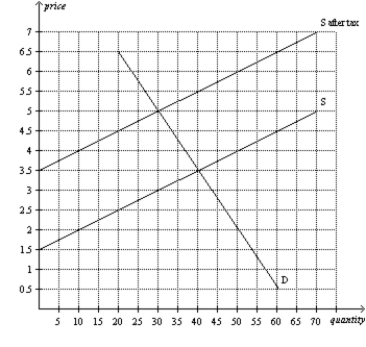 -Refer to Figure 6-22. The equilibrium price in the market before the tax is imposed is
 (Multiple Choice)
4.9/5 (80)
(80) A tax on a market with elastic demand and elastic supply will shrink the market more than a tax on a market with inelastic demand and inelastic supply will shrink the market.
(True/False)
4.7/5 (80)
(80) Figure 6-36 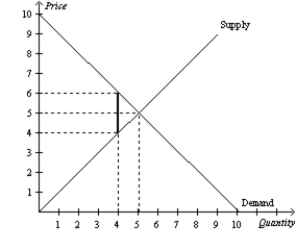 -Refer to Figure 6-36. If the government places a $2 tax in the market, the buyer pays $4.
 (True/False)
4.7/5 (74)
(74) Which of the following would not interfere with market equilibria?
(Multiple Choice)
4.8/5 (79)
(79) When a binding price ceiling is imposed on a market for a good, some people who want to buy the good cannot do so.
(True/False)
4.8/5 (79)
(79) Figure 6-32 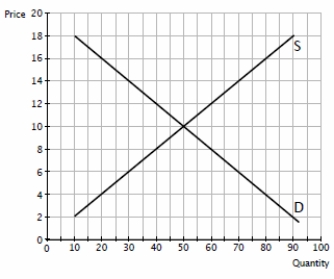 -Refer to Figure 6-32. Which of following statements is true based upon the conditions in the market?
 (Multiple Choice)
4.8/5 (79)
(79) Table 6-2 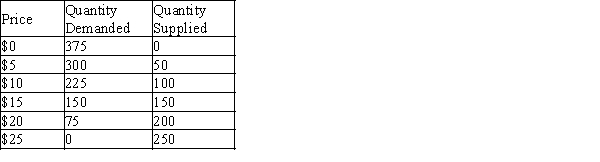 -Refer to Table 6-2. A price ceiling set at $5 will
 (Multiple Choice)
4.8/5 (69)
(69) Figure 6-21 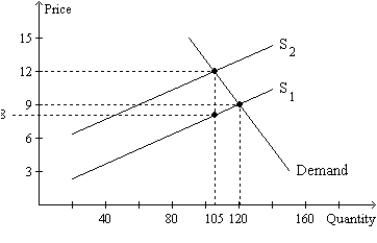 -Refer to Figure 6-21. Suppose buyers, rather than sellers, were required to pay this tax (in the same amount per unit as shown in the graph). Relative to the tax on sellers, the tax on buyers would result in
 (Multiple Choice)
4.9/5 (87)
(87) Suppose there is currently a tax of $50 per ticket on airline tickets. Buyers of airline tickets are required to pay the tax to the government. If the tax is reduced from $50 per ticket to $20 per ticket, then the
(Multiple Choice)
4.9/5 (79)
(79) A price floor set below the equilibrium price causes quantity supplied to exceed quantity demanded.
(True/False)
4.7/5 (80)
(80) 
Filters
- Essay(0)
- Multiple Choice(0)
- Short Answer(0)
- True False(0)
- Matching(0)